There is a kind of woman who still clips coupons even though she earns more in a month than her mother earned in a year, not out of habit and not out of thrift, but because the girl who watched her mother sit at the kitchen table on Sunday nights with scissors and the grocery circular learned that survival had a craft to it and the distance between enough and not enough was a woman's patience with a pair of scissors
I caught myself last Thursday doing something I couldn’t explain to anyone who didn’t already understand it.
I was standing in the cereal aisle with my phone in one hand and a box of granola in the other, scrolling through the store’s coupon app to see if there was a dollar off. I make a good living. I have a retirement account. I could buy every box of granola on that shelf and not feel it in my checking account.
But I stood there anyway, thumb moving across the screen, looking for the small savings. And when I found the coupon - eighty cents - I felt something settle in my chest that had nothing to do with eighty cents.
It had everything to do with Sunday nights in 1979.
The kitchen table on Sunday nights
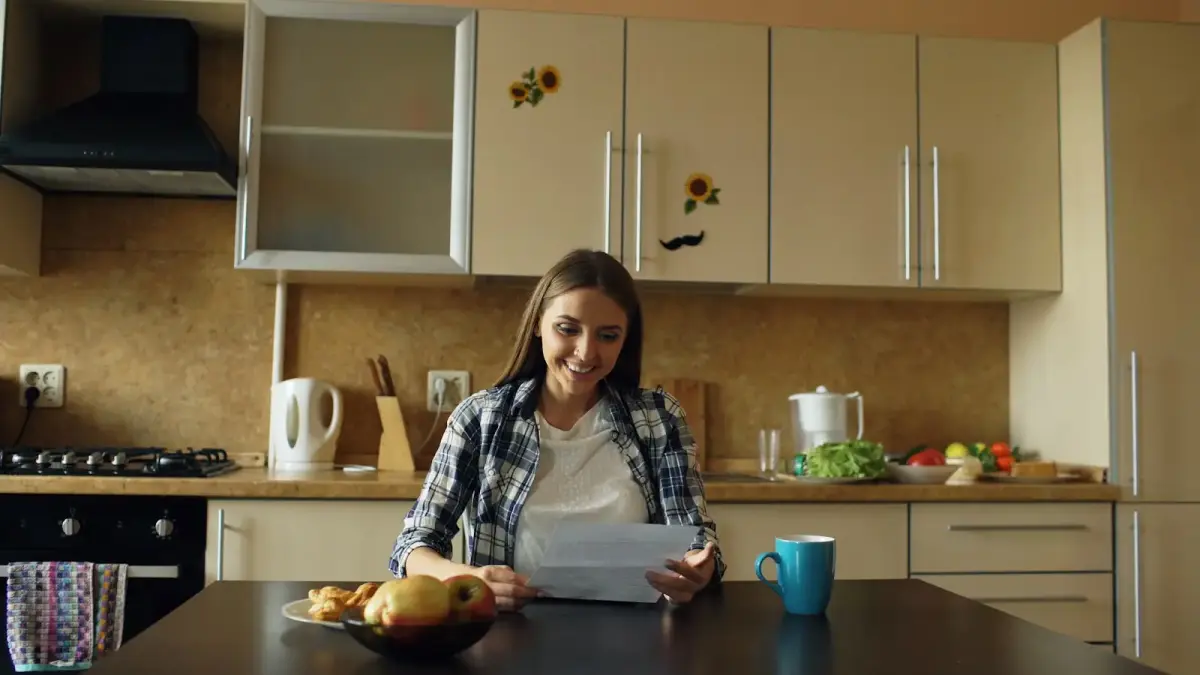
My mother did her coupons at the kitchen table after dinner, when the dishes were done and the house had gone quiet.
She spread the grocery circular across the table like a map. She had her scissors - the good ones, the ones with the orange handles that nobody else was allowed to touch. She had a manila envelope that she kept in the junk drawer, already thick with clipped rectangles from previous weeks.
I sat across from her. I was supposed to be doing homework, but I watched her hands instead.
She cut with precision. Not fast, not slow. Each coupon was examined, considered, and either placed into the envelope or set aside in a small pile that meant “not this week.” She organized them by aisle. She knew the store’s layout better than some people know their own homes.
A 2019 study published in the Journal of Consumer Psychology found that coupon use among lower-income households was not primarily motivated by savings but by a sense of agency - a feeling of control over circumstances that otherwise felt ungovernable. The researchers called it “economic self-efficacy.” My mother would have called it making sure we ate.
The distance between a Tuesday when we had chicken and a Thursday when we had rice was sometimes exactly those folded slips of paper. My mother knew this. She treated those coupons like currency because, in our house, they were.
What a daughter learns without being taught
Nobody sat me down and explained what was happening at that kitchen table. Nobody said, “We are poor and this is how your mother holds us together.” Children don’t need explanations. They have eyes.
I learned that care could be denominated in cents. That love sometimes looked like a woman hunched over newsprint with a pair of scissors at nine o’clock on a Sunday night, after she’d already worked all week at a job that didn’t pay her what she was worth. That the difference between dignity and despair could be a stack of forty-cent savings organized into a manila envelope.
I learned that survival had a craft to it. That it required patience, attention, and a particular kind of intelligence that nobody gave my mother credit for. She could walk into a grocery store and feed five people for a week on what some families spent on a single dinner out. That wasn’t luck. That was skill.
A 2021 study in Frontiers in Psychology examined what researchers called “intergenerational transmission of financial behaviors” and found that children don’t just inherit their parents’ money habits - they inherit the emotional architecture underneath those habits. The anxiety, the vigilance, the satisfaction of making a system work. The study found these transmitted behaviors persisted even when the child’s economic circumstances were dramatically different from the parent’s.
That’s the part most people miss. They see a woman earning six figures who still clips coupons and they think it’s a quirk. Something charming and slightly old-fashioned, like keeping a rotary phone or writing letters by hand.
It is not a quirk. It is a liturgy.
The things we carry from kitchens we outgrew
I left that kitchen. I went to college on financial aid and scholarships. I got jobs that paid more each year. I moved into apartments, then houses, that my mother would have walked through with wide eyes, touching the countertops and saying, “This is nice, Julia. This is really nice.”
And I kept clipping coupons.
Not because I needed to. Because stopping felt like a betrayal of something I couldn’t name. Because the act of looking for the savings, of scanning the circular, of organizing the small discounts into a plan - that act connected me to a woman who did it out of necessity, and the connection mattered more than the money.
Brene Brown writes about how shame attaches itself to class in ways we rarely examine. We are ashamed of having been poor. We are ashamed of the things our parents did to survive. And sometimes, we are ashamed of the ways we still carry those survival behaviors into lives that no longer require them.
But I am not ashamed of my mother’s coupons. I am in awe of them.
She turned scarcity into a system. She turned not-enough into almost-enough and then, with patience and scissors and a manila envelope, she turned almost-enough into enough. She did this every single week. She did this while also raising children and working and keeping a house and holding a marriage together and never once asking anyone to feel sorry for her.
The woman scrolling the store app at fifty-eight is not being frugal. She is honoring something.
The ritual that was never about money
I know women like me. We find each other in grocery store parking lots, in the quiet way we check our phones before walking in. We recognize each other in the way we handle produce - turning it over, checking for bruises, putting back the one that’s slightly too expensive even though we can afford it.
We are the daughters of women who made meals out of ingenuity. Who knew that a whole chicken was actually three dinners if you knew what you were doing. Who kept a freezer so organized it could have been catalogued by the Library of Congress.
We don’t talk about this much. Class is the great unspoken thing in American life. We talk about race and gender and politics, but we rarely talk about what it felt like to grow up in a house where the grocery budget was the most important number anyone knew.
A 2017 study published in the Journal of Personality and Social Psychology found that adults who grew up in economically unstable households maintained heightened resource-monitoring behaviors throughout their lives, regardless of their current financial status. The researchers described it as an “ecological adaptation” - the brain continues to scan for scarcity long after scarcity has passed.
I scan. I still scan. I walk into a grocery store and some part of me is calculating, comparing, optimizing. Not because I have to, but because my nervous system learned this language before it learned algebra.
And I have come to believe that this is not a problem to be solved. It is not a trauma response to be therapied away. It is something more tender than that.
A daughter sitting across the table
My mother is eighty-one now. She still clips coupons. The physical kind, from the newspaper, because she doesn’t trust the apps.
When I visit her, we sit at the same kitchen table - the actual same table, the one she’s had since 1974. She spreads the circular out. She picks up her scissors. And I watch her hands, the same way I watched them when I was nine.
Her hands are slower now. The cuts are less precise. But the ritual is identical. The concentration, the sorting, the envelope.
I could tell her she doesn’t need to do this anymore. Between my siblings and me, we make sure she has everything she needs. The coupons are not keeping her fed.
But I would never say that to her. Because I understand now that the coupons were never just about food. They were how she told us she would not let us go without. They were how she said, “I may not have much, but I have this - I have the patience to sit here on a Sunday night and find a way.”
That’s what I’m doing when I scroll the app in the cereal aisle. I’m not saving eighty cents. I’m sitting across from my mother. I’m watching her hands. I’m learning, again, that survival had a craft to it - that care could be counted in pennies, and that the difference between enough and not enough was always a woman who refused to stop trying.
Some people inherit money. Some people inherit jewelry, or houses, or stocks.
I inherited a manila envelope and a pair of scissors with orange handles. And I would not trade them for anything in the world.