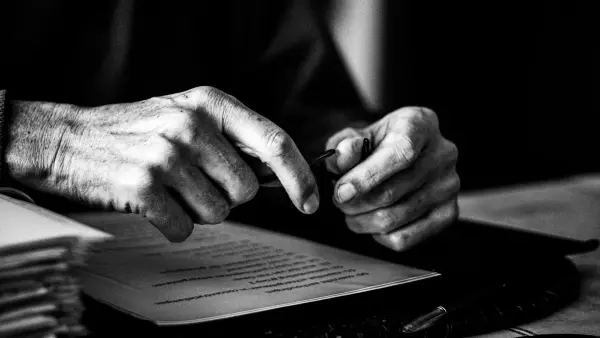
There is a way a man in his sixties holds a tool he inherited from his father - not by the handle where it was designed to be gripped but with the whole palm wrapped around the metal the way his father wrapped his, knuckles in the same position, thumb resting in the same groove worn smooth by decades of use - and the reason he cannot bring himself to replace it even though the head is loose and the hardware store sells a better version for twelve dollars is that the worn-smooth handle is the closest thing to his father's grip he will ever hold again, and a son who lost the man who taught him to build things does not replace the wrench, he preserves the handshake
The Weight That Has Nothing to Do With Steel
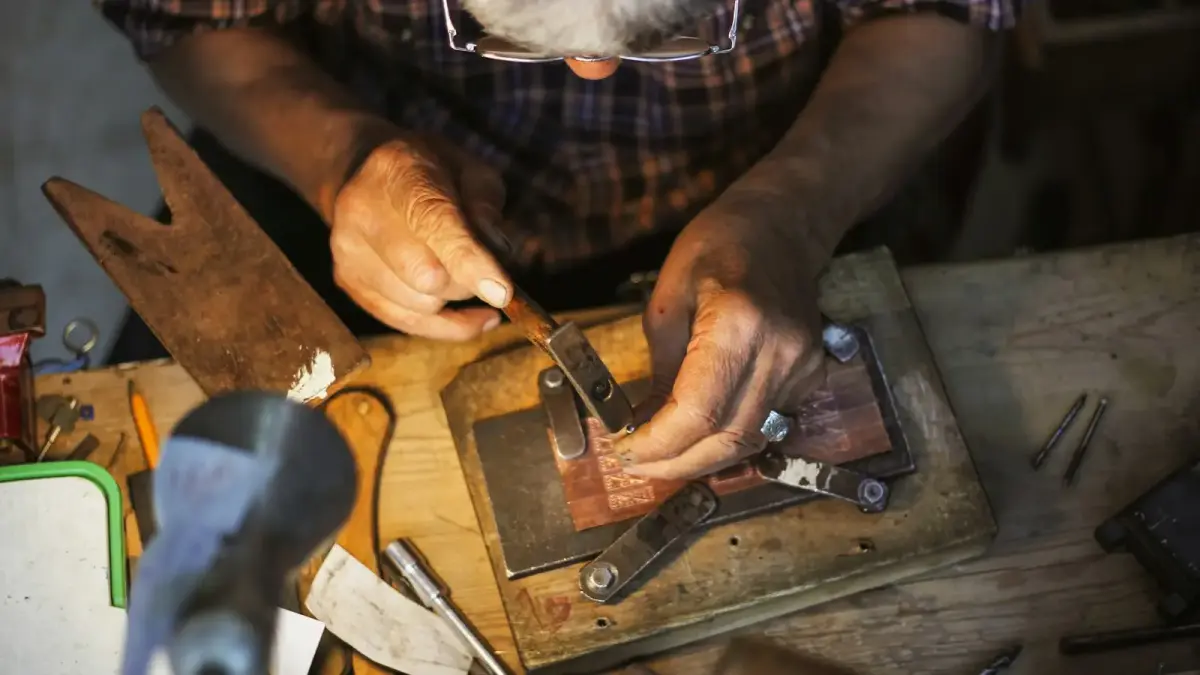
I watched a man at a hardware store last fall stand in the wrench aisle for nearly fifteen minutes. He was sixty-two, maybe sixty-five. His hands were the kind you earn - thick knuckles, nails permanently outlined in something no soap removes, skin mapped with small white scars that each tell a different Saturday afternoon.
He picked up a new adjustable wrench. Turned it over twice. Held it the way you test fruit at the grocery store - evaluating, considering. Then he set it back on the hook and walked out empty-handed.
I knew exactly what had just happened, because I have done the same thing. He had a wrench at home. It was worse than the one on the shelf in every measurable way. The jaw was loose. The knurl was half-stripped. The handle had long ago shed whatever coating the factory originally applied.
But somewhere in the grain of that old handle was a pattern worn smooth by a hand that no longer exists. And the man in the aisle had just done the math that every son eventually does - twelve dollars is not a reasonable price for erasing the last physical trace of your father’s grip.
The Cathedral at the End of the Driveway
Every man who lost his father has a room like this. Sometimes it is a garage. Sometimes it is a basement workshop. Sometimes it is just a toolbox shoved under a bed in a spare room that nobody sleeps in.
The room smells like motor oil and sawdust and something underneath both of those things that you cannot name but that your body recognizes before your mind does. It is the smell of a specific person. It is the smell of the hours between breakfast and lunch on a Saturday when you were nine and the whole world was a workbench and the man standing behind it.
A 2019 study published in the journal Cognition and Emotion found that physical objects associated with deceased loved ones activate the same neural pathways as direct social bonding. The researchers called these “linking objects” - physical things that the grieving brain treats not as symbols of the person but as extensions of the person. Your father’s wrench is not a reminder of your father. To the deepest, oldest part of your brain, your father’s wrench is your father.
This is why the garage becomes a cathedral. Not metaphorically. Functionally. It is the place where a son goes to be in the presence of someone who is gone.
Muscle Memory Is the Last Conversation
Here is the part that undoes me every time I think about it.
When a boy learns to use a tool, he does not learn from instructions. He learns from watching his father’s hands. The angle of the wrist. The pressure of the grip. The specific way the elbow stays close to the body during a downstroke.
He learns it the way you learn a language you grow up hearing - not through rules but through absorption. The knowledge goes into the body, not the mind. It sinks below conscious thought into the muscle fibers themselves.
So when a sixty-three-year-old man picks up his dead father’s hammer, something happens that he could not explain to you if you gave him a hundred years. His hand closes around the handle in the exact position his father’s hand closed around it. His thumb finds the groove. His fingers wrap the same way. The movement is not his - it is inherited. It was planted there forty years ago by a man who probably never said the words “I love you” but who said something equivalent every time he put a tool in his son’s hand and said “like this.”
Research on embodied cognition - pioneered by scholars like George Lakoff and later expanded in the grief work of psychologist Vamik Volkan - shows that physical actions carry emotional content. The body remembers what the mind edits. You may forget the sound of your father’s voice. You may lose the precise color of his eyes. But your hands will hold his wrench exactly the way he held it until the day you die.
That is not nostalgia. That is a conversation still happening in the only language two quiet men ever shared.
The Tools That Carry the Most Weight
Not every tool in the box carries the same charge. Some are just tools - bought at a store, used competently, stored without ceremony.
But there are certain ones.
The handsaw he used to cut the boards for your treehouse. You remember the sound of it - that rhythmic, breathing sound, back and forth, while you sat on the grass and watched sawdust fall like snow. The blade is dull now. You could sharpen it. You do not sharpen it because the dullness is honest. The dullness says: this saw has done its work.
The screwdriver he pressed into your palm when you were seven and said “hold this” and you felt, for the first time, like someone trusted you with something real. The handle is cracked. You wrap it in electrical tape every few years. The electrical tape has become part of the tool now. Part of the story.
The level he set on the shelf he was building the last time you worked on a project together. You remember that he checked it three times. That was who he was. A man who checked things three times. You do the same now and you do not know if that is genetics or imitation or love. Probably it is all three and the distinctions do not matter.
Daniel Goleman, who spent decades studying emotional intelligence, once wrote about how meaning transfers between people not through grand declarations but through small, repeated physical rituals. A father who hands his son a tool every Saturday for fifteen years is not teaching carpentry. He is building a language. The tool becomes the word. The shared work becomes the sentence. And the finished project - the shelf, the fence, the birdhouse that never quite hung straight - becomes the paragraph in a story that both of them are writing together without ever acknowledging that they are writing anything at all.
The Hardware Store Aisle Where Grief Lives
There is a specific kind of pain that lives in the hardware store, and it visits men who have lost their fathers with a regularity that no one talks about.
You walk in for something simple. A box of screws. A tube of caulk. And then you pass the aisle where the tools are, and your feet slow down without your permission, and you find yourself standing in front of a wall of wrenches or hammers or pliers, and you pick one up, and it is perfect. Better balanced. Better grip. Better steel.
And you stand there with this superior object in your hand and something in your chest says no.
Not because the old tool works better. It does not. Not because you cannot afford twelve dollars. You can. But because replacing the tool means admitting something your body is not ready to admit. That the hand that shaped the old one is finished shaping things. That the man who taught you the difference between a Phillips head and a flathead is not going to appear in the garage doorway on a Saturday morning with two cups of coffee and say “I’ve been thinking about that back fence.”
So you put the new one back on the shelf. You drive home. You pick up the old one with the loose head and the worn handle, and you feel what you always feel - the faint, impossible warmth of a grip that is not there anymore but that your hand remembers so completely it might as well be.
Bereavement psychologist Vamik Volkan identified this behavior decades ago. He called these items “linking objects” - possessions of the dead that the living cannot discard because they serve as a bridge between the world of the present and the world of the person who is gone. The object is not sentimental in the way a photograph is sentimental. The object is functional. It does something. It connects.
A photograph says: he existed.
A tool says: he is here. Hold this.
The Way Sons Talk to Fathers Who Cannot Answer
I think about the men in their sixties who go out to the garage on a Sunday afternoon. They do not need to fix anything. Nothing is broken that requires immediate attention. The gutter can wait. The squeaky hinge can wait.
But they go anyway. They open the toolbox. They take out the wrench or the hammer or the pliers, and they hold it, and they begin some small project that did not need to begin.
And if you watched closely - if you pulled up a chair in the corner and just observed - you would see something that looks ordinary but is not ordinary at all. You would see a man talking. Not out loud. Not in words. But in gestures. In the way he tilts his wrist. In the way he pauses before a cut. In the way he checks the level three times even though he got it right the first time.
He is not fixing a shelf. He is having the conversation he cannot have anymore. He is saying things he never learned to say when saying them was still possible. And the tool in his hand - the old, loose, imperfect, twelve-dollar-replacement-available tool - is the telephone.
This is what I want you to know if you are a man who keeps tools that no longer make practical sense. You are not being foolish. You are not being stubborn. You are not clinging to the past in some way that needs correcting.
You are holding your father’s hand.
The grip fits yours because his grip made yours. The calluses are in the same places because you learned where to press by watching where he pressed. And the reason the handle feels warm even when the garage is cold is not your imagination. It is forty years of Saturday mornings, stored in wood and steel, waiting for your hand to come back and pick up the conversation where it left off.
You do not owe anyone an explanation for why you will not replace it.
The handshake is enough.