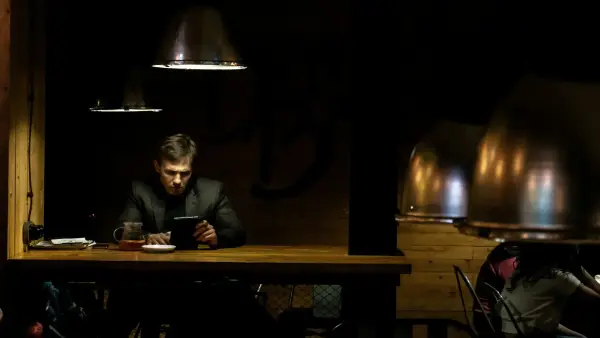
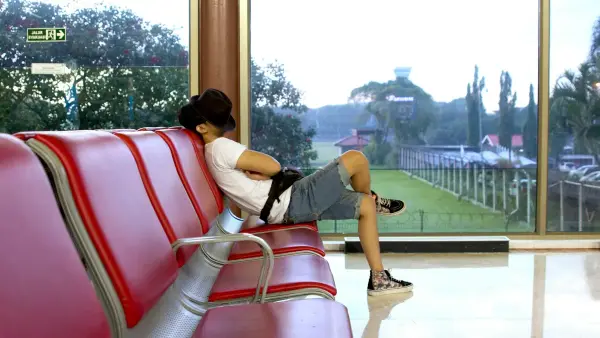
There is a way some women sit in every room they enter - perched on the edge of the sofa, bag still in their lap, coat within reach, weight shifted forward as though they might need to stand at any moment - and it is not nervousness and it is not good manners, it is the posture of a girl who was made to feel like a guest in every room she entered, including the rooms in her own home, and whose body at fifty-five has still never learned what it feels like to belong somewhere completely
I noticed it for the first time at my aunt’s house on a Sunday afternoon. I was maybe twelve, sitting cross-legged on the carpet, and my mother was on the sofa behind me.
Except she wasn’t on the sofa. She was on the front three inches of it.
Her purse was in her lap. Her coat was folded beside her, not draped over the back of the chair, not hung on the hook by the door where my aunt had told her twice to put it.
Her weight was forward, her feet flat on the floor, her body arranged as though she had somewhere to be in the next thirty seconds. She didn’t have anywhere to be. We were staying for dinner.
But my mother sat in her sister’s living room the same way she sat everywhere - perched. Ready. Never settled.
Like a woman who had learned, long before I was born, that the safest way to be in a room was to never fully arrive in it.
The posture that has no name
You know this woman. Maybe you are this woman.
She sits on the edge of the sofa at a friend’s house. Not the deep part, not the part where your back touches the cushion and your shoulders drop and your body finally admits it has nowhere else to go.
She sits on the front. Bag in her lap. Coat within arm’s reach.
At the doctor’s office, she holds her purse on her thighs like it’s a shield. At a dinner party, she keeps her jacket folded on the chair beside her rather than hanging it up.
At her daughter’s house - her own daughter, the child she raised - she perches on the kitchen stool and asks if there’s anything she can help with. Because standing at the counter is easier than sitting in the living room when you’re not sure the living room is really for you.
She never puts both feet up on anyone’s couch. She never spreads her things across the coffee table. She never takes up the amount of space that a person her size, with her history of showing up and earning her place ten thousand times over, actually deserves.
And the people who love her say things like, “You can put your bag down.” Or, “Relax, you’re not going anywhere.” Or, “Mom, just sit back.”
They think she’s being polite. They think it’s a habit. They think she could stop if she decided to.
She can’t stop. Her body doesn’t know how. Her body is still doing the thing it learned to do when she was six years old and the rooms she lived in told her, in a hundred wordless ways, that she was allowed to be there but never guaranteed a place.
Where the perching began
John Bowlby, the psychologist who gave us attachment theory, wrote extensively about what he called “felt security” - the deep, bodily sense that you are safe where you are and that the people around you want you present. He argued that this sense doesn’t come from being told you’re welcome.
It comes from being shown, over and over, in the small physical facts of daily life, that there is a space that is yours and it will still be yours tomorrow.
Some children never received that message.
Not because they were unloved. Not because their parents were cruel.
But because the home they grew up in operated on a system of conditional space. There were chairs that belonged to someone else. Rooms that were for adults.
A couch you could sit on but shouldn’t get too comfortable on. A bedroom that was technically yours but could be entered at any moment without knocking, rearranged without asking, given to a visiting relative without discussion because the guest needed it more.
The message was never spoken aloud. It didn’t need to be.
The furniture said it. The layout said it. The way the house was organized around the needs of everyone except you said it.
You were welcome, the house told you. But welcome is not the same as belonging. Welcome is what you extend to visitors.
And so the girl learned something her body never forgot - that she was a visitor in her own home.
The thousand small proofs
Here is what that looks like at fifty-five, when the girl has become a woman who owns her own house and has lived in it for twenty-five years.
She still gravitates toward the guest bedroom more than the master. Not to sleep in, necessarily, but to sit in. It feels more proportional to her.
The master bedroom with its king bed and its walk-in closet feels like someone else’s room - like a room for a woman who has fully claimed her life, and she isn’t entirely sure that’s her.
At restaurants, she sits with her bag on her lap or hooked over the back of her chair with the strap still looped around her wrist. She doesn’t spread out. She occupies the minimum amount of space, the way a person does when they have internalized the belief that the space is borrowed.
A 2018 study published in the Journal of Personality and Social Psychology examined what researchers called “environmental mastery” - one of Carol Ryff’s six dimensions of psychological well-being. They found that adults who reported low environmental mastery were significantly more likely to have grown up in households where personal space was inconsistent, conditional, or routinely overridden.
The feeling of “not being at home” was not metaphorical. It was architectural. It had been built into their bodies by the literal spaces they grew up in.
She keeps her coat draped over her arm at parties, even indoor ones, even ones she’s been looking forward to for weeks. She offers to help in the kitchen within four minutes of arriving anywhere.
Not because she is generous, though it looks like generosity and she has been praised for it her entire life. Because standing at a counter with a task is so much easier than sitting in a room where sitting requires the one thing she was never given - the physical conviction that the room wants her in it.
She never leans back. She never sprawls. She never takes up the full depth of a cushion the way her husband does, the way her children do, the way people do when their earliest experience of home was a place that held them without conditions.
The body’s memory
This is what most people don’t understand about posture. They think it’s a choice.
They think you sit the way you sit because of habit or preference or the shape of your spine.
But research in embodied cognition tells a different story. A 2021 study in Frontiers in Psychology found that postural patterns established in childhood persist into adulthood not as conscious decisions but as what the researchers called “relational postures” - physical positions that encode a person’s felt sense of their place within a social environment.
The body doesn’t just remember where it felt safe. It remembers where it didn’t. And it keeps arranging itself accordingly, decades after the original environment has disappeared.
Your mother’s perching isn’t a quirk. It’s a relational posture.
Her body is still encoding the felt sense of a six-year-old girl who understood, in the way children understand things they can’t articulate, that the rooms she lived in were not quite hers. That comfort was available but conditional.
And the heartbreaking part is that she has earned it. A thousand times over. She raised children and paid mortgages and showed up for decades of someone else’s crises and built a life that is, by any objective measure, entirely and completely hers.
But the body doesn’t deal in objective measures. The body deals in the oldest story it knows.
And her body’s oldest story is this: don’t unpack. Don’t spread out.
Keep your coat close. You might need to leave.
The moment someone notices
There is a particular kind of ache that comes when someone finally sees the perching for what it is.
It might be a friend. “You know you can put your bag down, right? You’re staying.” And the woman laughs and puts her bag on the floor and thirty seconds later picks it up again without realizing it.
It might be a daughter, sprawled the opposite way across the sofa. “Mom, why don’t you ever sit back? Like, all the way back? You always look like you’re about to leave.”
The woman feels something crack open in her chest that she can’t explain. The answer to the question is both very simple and impossibly complicated.
It might be a therapist. “Tell me about your room when you were growing up. Was it yours? Did it feel like yours?”
And the woman goes quiet for a long time. She realizes she has never once in her life had a room that felt truly, unconditionally, irrevocably hers.
The noticing hurts. But it hurts the way truth hurts - not because it wounds you but because it finds the wound that was already there and calls it by its right name.
What the perching was always about
I want to be careful here, because I don’t think the answer is to force yourself to sit back.
I don’t think you should push yourself deeper into the couch cushions and call it healing. Telling a woman who has spent fifty years perched to “just lean back” is like telling someone who has been holding their breath to “just breathe” - it addresses the symptom and ignores the entire nervous system underneath it.
The healing, I think, is quieter than that. It starts with recognition.
It starts with understanding that the way you sit is not a flaw. It is your body’s faithful record of what it learned in the earliest rooms of your life - that belonging was not a given, that space was conditional, that the safest posture was the one that could become standing in half a second.
Your body was protecting you. It is still protecting you. And there is something deeply worthy of respect in that.
Bowlby believed that earned security - the kind built in adulthood through relationships that are consistent and safe - could gradually soften the postures that insecure attachment created. Not erase them. Not override them.
But soften them. The way a door that has been stuck for years can, with patience, be coaxed open - not forced, not kicked, but shown that the frame has changed and the hinges still work.
Maybe for you, the softening looks like noticing the next time you perch. Not changing it. Just noticing.
Letting yourself think, “Oh. I’m doing it again. I’m sitting like a guest in a room where I live.”
Maybe it looks like putting your bag on the floor and leaving it there, even when your hands want to reach for it. Not because it’s wrong to hold your bag, but because the reaching is an old reflex and you’re allowed to wonder what it would feel like to stop.
Maybe it looks like sitting all the way back, just once, in your own living room, and letting the couch hold the full weight of you. Not because it proves anything. But because your body has been asking permission to land somewhere for fifty years, and the only person who can give that permission now is you.
You were never a guest. You were a child who deserved a home that felt like home.
And the fact that your body is still waiting to feel that - that is not weakness. That is the longest kind of patience there is.