7 things people who grew up without much money still do decades after they stopped needing to, that psychologists say have nothing to do with being frugal and everything to do with a nervous system that learned before age ten that the distance between enough and not enough was a distance the body never stops measuring
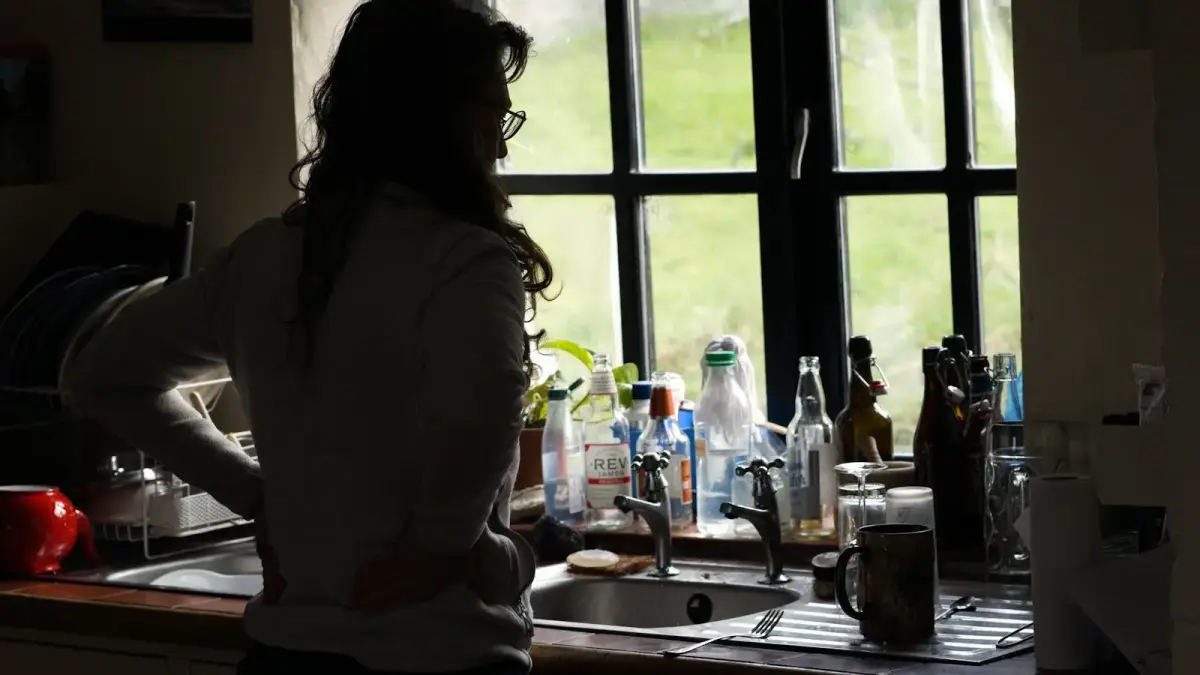
I was standing in the grocery store last Thursday, and my cart was half full, and I was doing the math.
Not roughly. Exactly. Item by item, running the total in my head the way you’d track a taxi meter - watching the number climb and feeling a tightening in my chest that had nothing to do with whether I could afford the groceries. I can afford the groceries. I’ve been able to afford the groceries for twenty years. But my hands still reach for the store brand. My eyes still flick to the unit price. And somewhere between the cereal aisle and the checkout, I am nine years old again, standing next to my mother while she puts back the orange juice because the milk was more expensive than she planned for.
She didn’t say anything. She just put it back. And I learned, in that silence, that wanting things and affording things were two separate languages, and the one our family spoke was the second one.
If you grew up in a household where money was something people measured in distances - the distance between the paycheck and the rent, between the gas tank and Friday, between the balance and the thing you needed - these seven behaviors will sound less like a list and more like a photograph of your Tuesday.
1. You know exactly how much gas is in the tank at all times
You don’t glance at the gauge. You read it. You know whether you’re at three-eighths or just below the halfway mark. You know how many miles you can get before the light comes on, and you know how many miles you can get after the light comes on, because you’ve tested it - not out of curiosity but out of necessity that became a habit that became a permanent feature of how your brain relates to a dashboard.
This started in a specific car. Maybe it was your mother’s, a sedan with a gauge that stuck, and she’d tap it with her knuckle before she turned the key. Maybe it was your father’s truck, and he’d calculate the drive to work and back and know - to the mile - whether he needed to stop. You watched that. You absorbed the arithmetic of it before you understood what arithmetic was.
Sendhil Mullainathan and Eldar Shafir, in their research on scarcity, found that financial constraint doesn’t just limit what people can buy - it restructures what they pay attention to. The brain under scarcity becomes a monitoring system. It tracks, counts, and measures automatically, the way a smoke detector doesn’t decide to listen for smoke. It just does.
You’re not obsessive about your gas tank. You’re running software that was installed when you were seven, and no amount of financial comfort has provided the update that would let you stop tracking.
2. You keep a running total of the grocery cart in your head
Not an estimate. A total. You round to the nearest dollar, you add the tax, and you know - before the cashier scans the last item - what the number is going to be. Give or take fifty cents.
This is the behavior most people mistake for thrift. It’s not thrift. Thrift is a choice. This is a reflex. It’s the thing your brain does in a grocery store the way other people’s brains hum a song without deciding to.
You learned this from watching a parent’s face at the register. There was a moment - maybe you were five, maybe you were eight - when the total came up and something shifted in their expression. Not panic. Something quieter. A recalculation. A quick sorting of what else would have to wait. You didn’t understand the math, but you understood the face. And your nervous system decided, right there in the checkout line, that you would never be surprised by a number again.
A 2021 study published in the Journal of Personality and Social Psychology found that adults who experienced childhood economic hardship showed heightened numerical vigilance in financial contexts - faster mental arithmetic, greater accuracy in price estimation, and elevated cortisol during purchasing decisions. The researchers noted that this vigilance persisted regardless of current income level. The body had learned a way of paying attention, and it refused to unlearn it.
3. You keep things other people throw away
Napkins from takeout. Condiment packets. Plastic bags. Rubber bands. The twist ties from bread loaves. A drawer somewhere in your kitchen holds a collection of objects that cost nothing and are worth nothing, and you cannot bring yourself to discard them.
This is not hoarding. This is not clutter. This is a very specific relationship with surplus - the belief, installed early, that anything free is something saved. Every ketchup packet in that drawer is a tiny insurance policy against a future that your adult brain knows is fine but your childhood brain still isn’t sure about.
I remember my grandmother’s kitchen. She had a margarine container filled with twist ties. A coffee can of rubber bands. A freezer bag of other freezer bags, washed and dried and folded. When I was small, I thought this was just what kitchens looked like. It wasn’t until I went to a friend’s house - a friend whose family had money - that I noticed their kitchen didn’t have a drawer like that. Their mother threw things away without pausing. And I understood, with the wordless comprehension of a child, that keeping things and needing to keep things were different, and our family lived in the second category.
Research on intergenerational transmission of scarcity behavior suggests these habits travel through families like recipes. A 2019 study in Frontiers in Psychology found that children who observed parents engaging in resource-conserving behaviors were significantly more likely to replicate those behaviors in adulthood - even when they reported no conscious memory of learning them. The behavior isn’t remembered. It’s inherited, passed down not through conversation but through the quiet choreography of a kitchen where nothing was wasted because nothing could afford to be.
4. You never order the most expensive thing on the menu, even when someone else is paying
The group is at dinner. Someone says, “Order whatever you want - it’s on me.” And you read the menu from the bottom up, scanning prices first, dishes second. You find the thing you actually want, note what it costs, and then order something two lines below it.
You’re not being polite. You’re obeying an instruction you received before you had language for it.
The instruction came from a specific dinner. Maybe the one time your family went to a restaurant that wasn’t fast food, and your mother leaned over and said, “Get the chicken.” Not because you wanted the chicken. Because the chicken was nine dollars and the steak was fourteen, and five dollars was the distance between a comfortable evening and a quiet car ride home where nobody talked about why.
You internalized a rule: never be the most expensive person at the table. Never let your appetite be the reason someone’s budget breaks. Even now, with your own money, with someone else’s money, with a corporate card and explicit permission - your hand still drifts to the middle of the price range. The ceiling of what you allow yourself to want was set in a vinyl booth when you were eleven, and you’ve never raised it.
5. You check the bank balance before buying something you can easily afford
Coffee. A book. A pair of socks that cost eight dollars. You open the app. You look at the number. You already know what the number is, roughly - you checked it this morning, and yesterday, and the day before that. But you check it again, because buying something without knowing the exact balance feels like stepping off a curb without looking.
This is what psychologists call economic vigilance, and in people who grew up with financial instability, it operates like a background process that never fully shuts down. You’re not worried about eight dollars. You’re performing a ritual that your nervous system requires before it will release the permission to spend.
The ritual started the day you understood that your parents checked the balance too. Not casually. Carefully. The way a person reads medical test results - scanning for the number that determines what happens next. Money wasn’t a resource in your household. It was a verdict. And the verdict changed daily, sometimes hourly, and the distance between okay and not okay was always a number your family was tracking.
Mullainathan and Shafir describe this as “tunneling” - the phenomenon where scarcity narrows cognitive bandwidth to focus almost exclusively on the scarce resource. In childhood, the tunnel was your parents’ focus on money. In adulthood, the tunnel has widened - you think about other things, you’ve built a life, you have enough - but the reflex to check, to verify, to make sure the number hasn’t moved, remains. You are checking the balance the way a person who grew up in earthquake country glances at the doorframe. Not because you expect disaster. Because your body learned that disaster doesn’t announce itself, and the only protection is constant measurement.
6. You keep the heat two degrees lower than comfortable
Sixty-eight instead of seventy. Sixty-six instead of sixty-eight. You tell yourself it’s fine, that you prefer it cooler, that you’ll put on a sweater. But the truth is more specific than a temperature preference. The truth is that somewhere inside you, the furnace clicking on still sounds like money burning, and your nervous system would rather be slightly cold than slightly expensive.
This one comes from watching a parent’s hand on the thermostat. The way they turned it down before bed. The way they turned it down when they left for work. The way they turned it down during the day when the kids were at school and the house sat empty and cold because heating an empty house was something families like yours couldn’t justify.
You absorbed the lesson without anyone teaching it: comfort has a cost, and the responsible thing is to keep the cost lower than your body wants. So you run a little cold. You sleep under an extra blanket. You wear socks in the house in July because the air conditioning is set to a number that satisfies your budget anxiety more than your skin.
A 2018 study published in Psychological Science examined what researchers called “comfort guilt” - the measurable discomfort people feel when spending money on their own physical ease. The study found that adults who experienced childhood financial hardship rated their own comfort needs as less important than participants from stable economic backgrounds, even when both groups had equivalent current incomes. You’re not choosing to be cold. You’re honoring an equation your childhood wrote: comfort equals cost, and cost equals risk, and risk is the one thing your family spent its whole life trying to reduce.
7. You buy the store brand even when the name brand is on sale
The Cheerios are two dollars off. The store-brand oat circles are still cheaper by forty cents. You reach for the store brand. You’ve always reached for the store brand. Not because you prefer it, not because you’ve done a taste comparison and found the difference negligible, but because the store brand is the one your mother bought, and the name brand is the one the other families bought, and somewhere in that gap - that forty-cent gap - lives an entire identity.
Buying the name brand feels like pretending. Like wearing someone else’s jacket. Like claiming a membership your family never held. And even though you could buy the Cheerios, even though the Cheerios are on sale, even though forty cents is an amount of money that has no meaningful impact on your life - reaching past the store brand feels like a small betrayal of the person who stood in this same aisle thirty years ago and made the calculation that kept your family fed.
This is perhaps the most misunderstood behavior on this list. People see it as frugality. Psychologists see it as loyalty. A 2022 study in the Journal of Consumer Psychology found that adults from low-income childhoods showed strong brand-level fidelity to the products their families purchased - not because of quality preference but because of what the researchers called “economic identity anchoring.” The store brand isn’t just cheaper. It’s yours. It’s the one your family could afford, and affording it meant surviving, and surviving meant your mother did the math right, and reaching for the name brand feels, in some quiet and irrational way, like saying her math wasn’t good enough.
It was good enough. It was more than good enough. Her math kept the lights on and the fridge full and the car running and you alive. And the fact that you still reach for the store brand - decades later, in a completely different financial life - isn’t a sign that you’re stuck. It’s a sign that your body remembers what it cost to keep you safe, and it honors that cost every time your hand moves across the shelf.
What the body remembers
None of these behaviors are flaws. None of them are damage. They are the architecture of a nervous system that learned, before you were old enough to question it, that the distance between enough and not enough was real and measurable and always, always worth tracking.
You learned that money was not abstract. It was the gas in the tank and the heat in the house and the food on the table and the answer to the question your parents asked each other with their eyes across the kitchen: are we going to be okay this month?
And your body - your brilliant, loyal, infuriating body - decided that it would never stop asking that question. Even after the answer became yes. Even after the answer had been yes for years. Because the body doesn’t update on logic. It updates on safety. And safety, for you, was always a number.
So you count. You check. You keep the napkins and the twist ties and the extra bags. You buy the store brand and keep the heat low and never order the most expensive thing. And people who didn’t grow up the way you did might look at these behaviors and see someone who’s careful with money.
But that’s not what this is.
This is a child who learned to measure the distance between safe and not safe, and an adult whose hands still reach for the ruler. Not because you need it. But because the child who did need it is still in there, still watching, still counting - and the most loving thing you can do is let them count, and then gently remind them that the math came out okay. That it’s been okay for a while now. That they did a good job. That the distance they spent their whole childhood measuring has finally, quietly, closed.