8 things people who always hold their coffee mug with both hands - who wrap every finger around the ceramic and pull it close to their chest even when the drink has gone cold, who cradle a cup of tea the way other people hold nothing at all - do according to psychology, because a child whose hands were never held learned to hold something warm instead
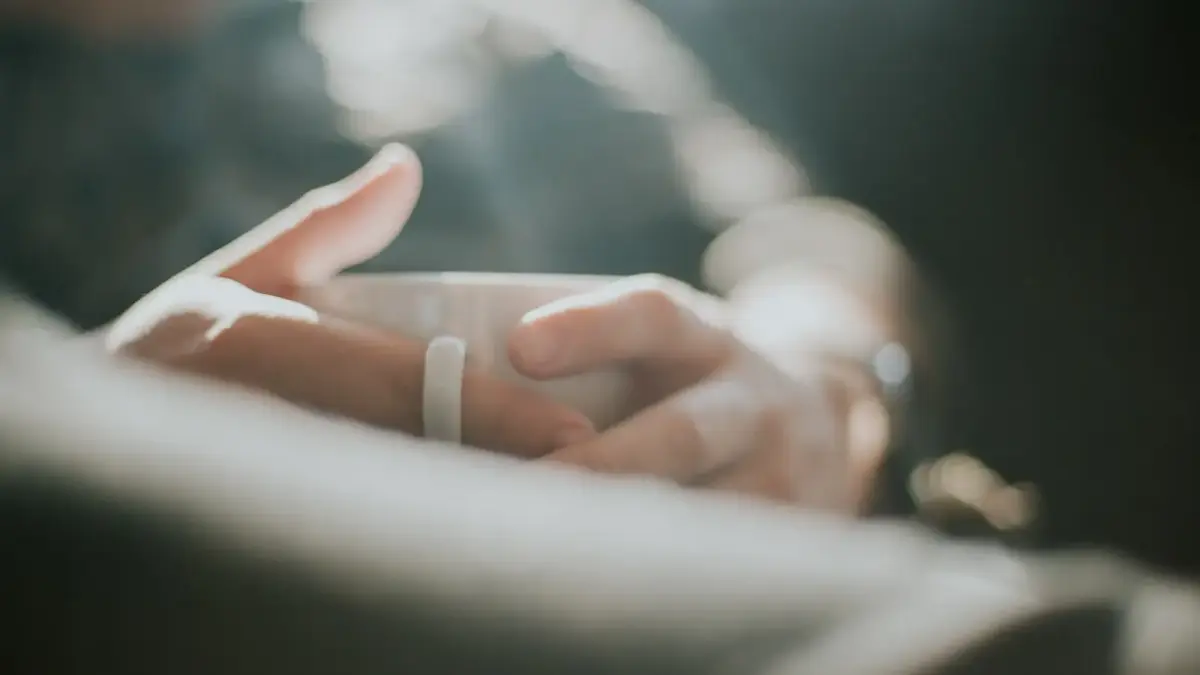
I noticed it about myself on a Tuesday morning last October. I was sitting at my kitchen table, the coffee already lukewarm, and I was holding the mug the way I always hold it - both hands wrapped around it, fingers laced together, pulled tight against my sternum like someone might take it from me.
My partner walked by and said, “You hold that thing like it owes you money.”
I laughed. But I also couldn’t let go.
I started paying attention after that. To myself, to friends, to strangers in coffee shops. And I noticed that the people who hold their mugs with both hands - who cradle them, who bring the ceramic close even when the drink is cold - tend to share something deeper than a preference for warm beverages. They share a history. A particular kind of childhood. A nervous system that learned early to find comfort where it could, because comfort wasn’t always offered.
This isn’t about coffee. It’s about what your hands learned to do when nobody else’s hands were available.
Here are eight things psychology tells us about people who hold their mug with both hands - and what that small, tender gesture reveals about the person underneath.
1. They self-soothe with physical warmth because emotional warmth was inconsistent
There’s a reason you reach for the mug before you reach for the person sitting next to you. Your body learned a long time ago that objects are more reliable than people.
A 2008 study published in Science found that holding a warm object - literally a cup of hot coffee - made people perceive others as emotionally warmer and more trustworthy. The researchers, led by Lawrence Williams and John Bargh, discovered that physical warmth activates the same neural regions as social warmth. Your brain doesn’t fully distinguish between the heat of a mug and the heat of being held.
If you grew up in a home where affection was unpredictable - where a parent was sometimes warm and sometimes unreachable - your nervous system adapted. It found warmth it could control. A mug doesn’t change its mind. A cup of tea doesn’t pull away when you need it most.
You’re not being dramatic. You’re being resourceful in a way you never had to name.
2. They struggle to receive affection without bracing for its withdrawal
Watch what happens when someone offers them a compliment. Or reaches for their hand unexpectedly. There’s a micro-pause. A slight stiffening. Not rejection - assessment. Their body is running a calculation it learned in childhood: is this real, and if it is, how long before it disappears?
People who cradle warm objects tend to have what psychologists call an anxious-preoccupied attachment style. A 2015 study in Journal of Personality and Social Psychology found that individuals with insecure attachment patterns showed heightened physiological responses to unexpected physical contact - not because they didn’t want closeness, but because closeness had historically arrived with conditions attached.
The mug is closeness without conditions. You hold it, it stays warm for a while, and then it cools - but the cooling is predictable. It doesn’t leave the room. It doesn’t slam a door.
If you hold your coffee with both hands, you probably also hold people at a slight distance until you’ve decided they’re safe. That’s not coldness. That’s a child who got burned learning to test the temperature first.
3. They are deeply attuned to the atmosphere of a room
You walk into a gathering and within thirty seconds, you know. Who’s tense. Who’s been crying. Who’s performing happiness. You feel the temperature of a room the way most people feel a draft - instinctively, physically, before you have language for it.
This isn’t a party trick. It’s a survival skill.
Children who grew up monitoring the emotional climate of their household - tracking a parent’s mood by the sound of their footsteps, the way they set down a glass, the length of a silence - develop what psychologist Edward Tronick calls “hypervigilant attunement.” Their sensory systems become exquisitely calibrated to shifts in emotional energy.
The same sensitivity that makes you wrap both hands around a warm mug is the sensitivity that makes you the first person in the room to notice when someone is struggling. You read atmospheres the way meteorologists read pressure systems. You feel the storm before anyone else hears thunder.
It’s exhausting. It’s also a kind of genius that nobody gave you credit for developing.
4. They have a nurturing instinct that extends to everything except themselves
You’re the friend who remembers what tea everyone drinks. You know who needs a blanket, who runs cold, who forgot to eat. You pour care into other people like your hands were built for it.
And then you sit alone on your couch at nine o’clock at night, holding a mug with both hands, and it doesn’t occur to you that you need the same tenderness you spent all day distributing.
Gabor Mate has written extensively about this pattern - the child who became a caretaker before they were old enough to need caretaking themselves. When nurturing isn’t modeled as something you receive but only as something you perform, the instinct develops in one direction only. Outward. Always outward.
The mug is the one moment where the care loops back. Where your hands are holding something warm for you. Not for a parent. Not for a friend who’s falling apart. Just for you.
If someone told you right now that holding your coffee with both hands is the kindest thing you do for yourself all day, you’d probably laugh it off. But you might also feel a quiet ache of recognition. Because it might be true.
5. They are devoted to rituals in a way that looks like preference but is actually protection
The same mug every morning. The same corner of the couch. The water has to be the right temperature. The tea has to steep for exactly the right amount of time. If the routine is disrupted, something inside you feels unsteady in a way that seems disproportionate to the disruption.
That’s not pickiness. That’s a nervous system that learned to organize chaos through repetition.
A 2019 study in Frontiers in Psychology found that ritualistic behaviors - especially those involving sensory consistency - serve a regulatory function for the autonomic nervous system. The predictability of a ritual tells your body that the environment is stable enough to relax. The sameness is the safety.
Children who grew up in unpredictable households - where dinnertime could be calm or catastrophic, where mornings could be gentle or volatile - learn to build their own predictability. They construct rituals that function as emotional architecture. The morning coffee isn’t just coffee. It’s the only part of the day that belongs entirely to them, that unfolds exactly the way they built it.
If you’ve ever felt irrationally upset when your routine was interrupted, it’s because the routine isn’t a luxury. It’s a load-bearing wall.
6. They form attachments to objects that other people would call ordinary
You have a mug you’ve had for eleven years. If it broke, you would grieve it. Not performatively. Genuinely. You would stand in your kitchen holding the pieces and feel something close to loss.
This isn’t materialism. It’s displacement of attachment onto the things that didn’t leave.
Object attachment theory, an extension of John Bowlby’s foundational work, suggests that people who experienced inconsistent caregiving often develop deep emotional bonds with inanimate objects. A 2012 study in Journal of Research in Personality found that adults with insecure attachment histories were significantly more likely to ascribe emotional significance to personal objects - and to experience distress when those objects were lost or damaged.
Your favorite mug survived every apartment you’ve lived in. It was there on your worst mornings. It doesn’t judge how late you slept or how little you accomplished. It’s warm when you need it to be and it waits for you when you forget about it.
Some people have never had a relationship that reliable. The mug isn’t a substitute. It’s evidence of what you’ve been looking for all along.
7. They carry a quiet self-containment that people mistake for independence
You don’t ask for much. You handle your own problems. You make your own comfort - literally, with your own two hands, every morning, wrapped around a mug that grounds you before the day starts pulling.
People call you independent. Self-sufficient. Low-maintenance.
What they don’t see is that the self-containment isn’t a personality trait. It’s a scar shaped like a skill. You became self-contained because relying on others was too expensive. The cost of needing someone - and being met with absence, or irritation, or the wrong kind of attention - taught your body to stop asking.
Susan Cain, in her research on temperament and solitude, distinguishes between people who are energized by alone time and people who retreat into it because the alternative was never safe enough. The second group looks calm. Collected. Fine. But underneath the composure is a child who learned that the safest pair of hands in the room were always their own.
Holding the mug with both hands is self-containment made visible. It says, “I’ve got this. I’ve always had this. I didn’t wait for someone to hand it to me.”
And it’s beautiful. And it’s a little bit heartbreaking.
8. They are loyal in a way that doesn’t announce itself
You don’t make declarations of loyalty. You don’t post about it. You just stay.
You stay through the difficult seasons. You stay when it would be easier to leave. You stay with the same coffee shop, the same brand of tea, the same people - not because you’re afraid of change, but because once something has proven itself safe, letting go feels like a betrayal of everything your younger self was searching for.
A 2020 study in Psychological Science found that individuals who experienced early relational instability often develop what researchers call “earned security” - an attachment style that isn’t inherited but built, painstakingly, through adult relationships that prove reliable over time. These individuals tend to be exceptionally loyal once trust is established, because they understand, on a cellular level, what it cost to arrive there.
The mug you’ve been holding with both hands for a decade is the smallest expression of this loyalty. You found something warm. Something that fits your hands. Something that doesn’t leave.
And you held on.
If you recognized yourself in this list, I want you to know something.
The way you hold your coffee isn’t a quirk. It isn’t a habit you need to explain or correct or laugh about when someone points it out. It’s your body remembering what it needed and quietly, faithfully providing it.
You learned to comfort yourself before anyone taught you the word. You built rituals out of nothing because nothing was what you were given. And now you sit in your kitchen on an ordinary morning, holding a warm cup with both hands, and you don’t realize that what you’re actually doing is parenting the child who still lives inside your nervous system.
That child figured it out. They found warmth. They made it reliable. They didn’t wait for permission.
And if no one has said this to you lately - the way you take care of yourself, even in the smallest ways, even in ways you barely notice, is not a sign of damage.
It’s proof that you survived something, and you turned it into tenderness.