8 things people who always keep their shoes on inside the house - who have never once felt fully comfortable barefoot on their own floors, who sit on the couch in sneakers and could not have told you why until someone asked the right question - do according to psychology, because a boy who needed to be ready to leave never told his feet the moment passed
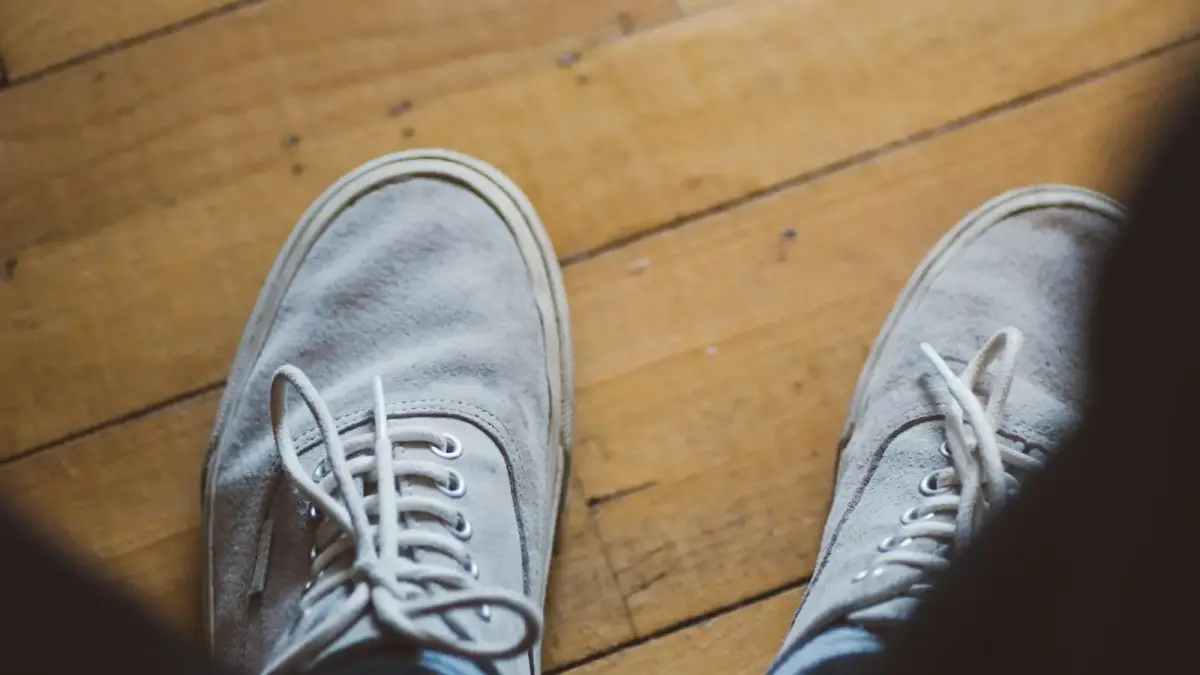
I noticed it about myself on a Tuesday afternoon. I was sitting on my couch, laptop open, coffee cooling on the table, and I looked down at my feet. Laced up. Tied tight. I had been home for three hours.
Nobody was coming over. I wasn’t about to leave. There was no errand, no appointment, no reason at all. And yet my shoes were on, the way they had been on every single day I could remember spending in every home I had ever lived in.
My girlfriend at the time used to tease me about it. She would pad around barefoot on the hardwood and ask why I treated our apartment like a waiting room. I laughed it off. Said I just liked wearing shoes. Said it was a comfort thing.
It wasn’t a comfort thing. It was the opposite of comfort. It was the residue of a childhood where being barefoot meant being caught off guard, and being caught off guard meant being helpless. And when I finally understood that - when I finally connected the laced-up sneakers to the boy who slept in his clothes in case he needed to move fast - something in my chest opened up that I hadn’t known was closed.
If you keep your shoes on inside the house, this might not be about preference. It might be about readiness. And readiness, when it never turns off, is just another word for a body that never learned it was safe.
Here are 8 things people who always keep their shoes on at home tend to do, according to psychology - because this habit is rarely about the shoes.
1. They mentally map the exits in every room they enter
You do it without thinking. You walk into a restaurant and your eyes find the back door. You sit in a waiting room and you already know which hallway leads outside. You visit a friend’s house and within thirty seconds your body has cataloged every way out.
A 2017 study published in the Journal of Anxiety Disorders found that individuals with histories of childhood unpredictability show heightened spatial vigilance - a persistent, unconscious scanning of environments for escape routes. This isn’t paranoia. It’s architecture. Your nervous system built a map of the world organized not by landmarks but by exits.
The shoes are part of that map. Bare feet slow you down. Shoes mean you’re ready. And your body decided a long time ago that ready was the only acceptable state.
2. They pack a bag even when they are not going anywhere
There is a bag by the door. Or in the car. Or in the closet, but always packed, always stocked with the essentials. You might not even think of it as a go-bag. You might call it your gym bag, your work bag, your “just in case” bag.
But it is always there. And you feel a low, humming anxiety when it is not.
This is preparedness that outlived its context. The child who might have needed to leave suddenly - whether because of a volatile parent, a sudden move, a home that changed shape without warning - learned that readiness was survival. That readiness became permanent. Your shoes stay on for the same reason that bag stays packed. Not because something is coming. Because something came once, and your body made a promise it never broke.
3. They struggle to fully relax in spaces they technically control
You own the apartment. You pay the rent. You chose the furniture. And still, somewhere beneath the surface, your body does not believe this place is yours.
There is a specific kind of tension that lives in people who grew up in homes that did not feel like theirs - homes where the atmosphere could shift in a second, where a parent’s mood was the real thermostat. A 2020 study in Frontiers in Psychology found that adults who experienced childhood emotional unpredictability often show reduced interoceptive awareness in safe environments. Meaning their bodies literally struggle to register safety, even when safety is all around them.
Your shoes stay on because taking them off requires a signal your nervous system never received. The signal that says: you can stop now. You are home. This one is yours.
4. They feel oddly vulnerable when barefoot
This one sounds small until you sit with it. Other people kick off their shoes the moment they walk in. They sink their toes into carpet. They feel the cool tile in the kitchen. They do not think about it at all.
You think about it. When you are barefoot, something is off. Not fear exactly, but exposure. A slight nakedness that has nothing to do with your feet and everything to do with what bare feet meant in the house you grew up in. Bare feet meant settled. And settled meant you had let your guard down. And letting your guard down was how you got hurt.
So you keep them on. Not because the floor is cold. Because the world taught you early that unprotected meant unprepared, and unprepared meant pain.
5. They are the last to sit down and the first to stand up
Watch how you enter a gathering. You stand near the edges. You hover by the kitchen counter. When everyone else sinks into the couch, you lean against the wall or perch on the arm of a chair.
When it is time to leave, you are already standing. You were always already standing.
This is postural hypervigilance - the body’s way of staying one motion away from action. Sitting deeply, settling your weight into a cushion, letting your muscles go slack - these require a kind of trust your body does not extend easily. Keeping your shoes on is the foot-level version of the same pattern. It is your body saying I am here, but I am not staying. I am present, but I am ready.
6. They sleep lightly and wake at every sound
The shoes come off at night. Usually. But the vigilance does not.
You hear the neighbor’s door close at midnight and you are awake. The furnace clicks on and your eyes open. A car idles outside and some part of you is already calculating whether it is a threat.
A 2019 study published in Psychological Science found that adults with adverse childhood experiences showed significantly higher rates of sleep fragmentation - their nervous systems remained partially activated even during rest. The researchers called it a failure of the “sentinel function” to downregulate. In simpler terms, the guard never comes off duty.
Your shoes during the day and your light sleep at night are expressions of the same thing. A body that learned to monitor, always, because the one time it stopped monitoring was the one time it needed to be ready.
7. They are uncomfortable receiving care without reciprocating immediately
Someone brings you soup when you are sick and you feel the urge to get up and wash the bowl before they have even left the room. Someone offers to drive you to the airport and you are already calculating how to repay the favor before accepting it.
This is not politeness. This is debt avoidance. A child who grew up needing to be ready to leave also grew up understanding that dependence was dangerous. If you owed someone something, you were tethered. If you were tethered, you could not move. And movement - the ability to leave, to go, to escape - was the only safety you had.
The shoes are the physical version of this emotional posture. You keep them on the way you keep your debts at zero. Not because you do not want to be cared for, but because receiving care requires the kind of stillness your body associates with being trapped.
8. They build beautiful homes they never fully inhabit
This is the one that breaks my heart, because I lived it for years.
You pick out the rug carefully. You hang art on the walls. You buy the good towels, the soft sheets, the candle that smells like cedar and rain. You make a home that looks, from the outside, like a place someone deeply settled lives in.
And then you sit on the edge of the couch with your shoes on and scroll your phone like you are in a hotel lobby.
A 2022 study in the Journal of Personality and Social Psychology explored what the researchers called “home ambivalence” - the experience of simultaneously craving domestic stability and feeling unable to surrender to it. They found it was disproportionately common in adults who had experienced housing instability, parental volatility, or frequent moves during childhood. The home becomes a performance of safety rather than the experience of it.
You build the home because you want to feel what other people seem to feel in theirs. You keep your shoes on because the wanting and the feeling are separated by a gap your body created decades ago, and you have not yet found the bridge.
I took my shoes off on a Thursday. Not because I decided to. Because I forgot. I was reading something on the couch and I looked down and my feet were bare on the hardwood and I had not noticed.
I sat with it for a while. The vulnerability. The strange, quiet feeling of my heels against the cool floor. Nothing happened. Nobody came. The house stayed the same. And for a few minutes, I was just a man in his home, with nowhere to go and no reason to be ready.
If you keep your shoes on, I am not going to tell you to take them off. Your body has its reasons, and those reasons kept you safe once. That matters. That deserves respect, not a lecture.
But I will tell you this. The moment passed. The thing you were ready for - it already happened, or it never came. And your feet, pressing against your own floors, are not a sign of weakness. They are a sign that you are finally in a place where you are allowed to arrive.
You do not have to be ready anymore. You are already here.