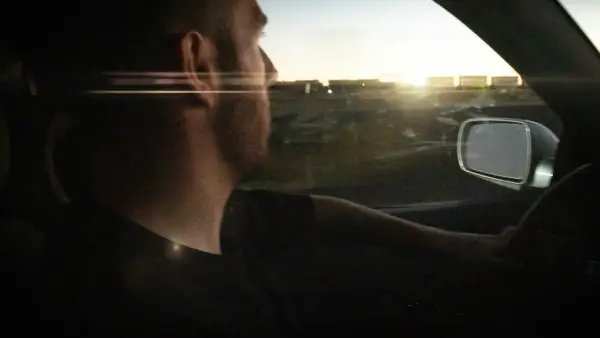
8 things people who cannot sit in the passenger seat of a car without watching the road as if they are the one driving do, according to psychology - because the woman at forty-nine who presses an invisible brake pedal, who tracks every mirror and tenses her entire body before every merge, is not a nervous passenger but a child who learned that the only way to survive a journey someone else was steering was to drive it from wherever she happened to be sitting

I noticed it on a road trip last fall. My partner was driving, doing everything right - checking mirrors, maintaining a perfect following distance, hands easy on the wheel. And I was sitting in the passenger seat with every muscle in my body engaged as if I were about to take a physics exam.
My right foot was pressed flat against the floor. My eyes were scanning the rearview mirror he couldn’t see me watching. My breathing had gone shallow somewhere around mile three, and by mile forty I had a headache from clenching my jaw.
He glanced over and said, “You okay?” And I said, “Yeah, fine.” But I wasn’t fine. I was driving the car from the passenger seat, and I’d been doing it for as long as I could remember.
If you recognize yourself in this, I want you to know something before we go any further. This isn’t a personality quirk. It’s not about being “type A” or controlling or difficult. It’s about a nervous system that learned very early that the only safe person to trust with the steering was you - even when you weren’t the one holding the wheel.
Here are eight things people like us do, and the psychology underneath each one.
1. They press an invisible brake pedal from the passenger seat
Your right foot pushes down hard against the floorboard when the car ahead slows down. You do it before the driver’s foot has even moved toward the actual brake. Sometimes you do it when there’s no real danger at all - just a tightening in traffic, a shift in speed, a feeling that something might be about to happen.
This is your body trying to control a situation your conscious mind already knows you can’t control. Stephen Porges’ polyvagal theory describes how the autonomic nervous system constantly scans the environment for threat - a process called neuroception. In people with heightened vigilance, that scanning system is turned up too high. Your body detects the threat before your brain has finished processing it, and the foot goes down because the foot has always gone down.
You’re not being dramatic. Your nervous system is doing exactly what it was trained to do.
2. They watch every mirror even though they can’t reach the steering wheel
You track the side mirrors. You monitor the rearview. You note the car in the blind spot that the driver hasn’t acknowledged yet, and your entire chest tightens until they either change lanes or the other car passes.
You do this even though you have no ability to act on any of it. You have no steering wheel, no turn signal, no brake. But your brain refuses to accept that reality because, for you, not watching has always felt more dangerous than watching.
A 2019 study published in the Journal of Anxiety Disorders found that individuals with elevated anxiety show increased attentional bias toward potential threats - they literally cannot stop scanning for danger, even in environments that are objectively safe. Your mirror-watching isn’t a choice. It’s your threat detection system working overtime, doing the job it’s been doing since you were small enough to sit in the back seat and still track everything happening on the road ahead.
3. They grip the armrest or door handle at every curve, lane change, or stop
The grip happens before the event. That’s the part most people miss. You’re not reacting to the curve. You’re bracing for it. Your hand finds the armrest or the door handle a full second before the car shifts, because your body has already computed the trajectory and decided that holding on is necessary.
This is a freeze-and-brace response - one of the lesser-discussed expressions of the fight-flight-freeze system. When you can’t fight and you can’t flee, your body does the only thing left. It anchors itself. It grabs something solid. It prepares for impact even when no impact is coming.
People who grew up in environments where sudden shifts happened without warning - a parent’s mood changing, a plan unraveling, a safe moment turning unsafe with no transition - develop this bracing pattern early. The car just happens to be one of the places where it’s most visible.
4. They can’t close their eyes or sleep in a moving car someone else is driving
Everyone else in the car dozes off on long drives. Your partner falls asleep in five minutes. The kids are out before you hit the highway. And you sit there, eyes open, watching every single mile pass as if letting your guard down would cause the whole thing to collapse.
You’ve tried to sleep. Maybe you’ve even pretended to sleep. But even with your eyes closed, you can feel the car decelerating and your brain snaps back online. Every turn registers. Every stop pulls you to the surface.
This isn’t insomnia. This is the inability to surrender consciousness when someone else is in control. Sleep requires trust - not just trust in the driver, but trust in the idea that the world will still be safe when you open your eyes again. And for some of us, that trust was broken long before we ever sat in a car.
Research on hypervigilance published in Psychological Science has found that individuals who experienced unpredictable childhood environments show reduced ability to disengage from threat monitoring, even during rest. Your body learned that falling asleep while someone else was steering - the car, the family, the household - was not a safe option. And it never unlearned it.
5. They navigate silently in their head - tracking turns, knowing the route, always aware of where they are
You know the route. Even when you’re not the one driving, even when you didn’t plan the trip, you are mapping. You note the turn that should be coming up. You register when the driver takes an unfamiliar road. You are always, quietly, aware of exactly where you are in space.
You don’t say anything about it. This isn’t backseat driving. You’re not giving directions or correcting anyone. You’re just… keeping a parallel version of the navigation running in your head, as if you might need to take over at any moment.
This is locus of control in action - a concept developed by psychologist Julian Rotter in the 1950s and explored in decades of research since. People with a strong internal locus of control believe that outcomes depend on their own actions. When that belief becomes rigid - when it calcifies because life taught you that no one else could be relied on to get you where you needed to go - it shows up as this quiet, invisible navigation. You’re always tracking the route because you were always the one who had to know the way home.
6. They tense before the driver sees the hazard - because their body detected it first
The car ahead taps its brakes and your shoulders are already at your ears. A pedestrian steps toward the crosswalk three blocks up and your stomach drops before the driver has even noticed them. A truck drifts slightly in its lane and your whole body goes rigid.
You see the danger first. Every time. And the gap between when you see it and when the driver responds feels like the longest, most unbearable silence in the world.
This is neuroception again - Porges’ term for the way the autonomic nervous system evaluates risk below the level of conscious awareness. Your system is faster than the driver’s because it has been practicing for decades. It was fast when you were eight and your parent was driving erratically. It was fast when you were twelve and learning to read adult moods the way other kids read chapter books. That speed kept you safe once. Now it keeps you tense in a car with someone who is driving perfectly well.
Your body isn’t wrong for detecting the hazard. It’s just still operating under the old rules, the ones where detection was the only protection you had.
7. They feel genuine physical relief when they’re the one driving instead
When you slide into the driver’s seat, something uncoils. Your shoulders drop. Your breathing deepens. Your jaw unclenches. It’s not that you love driving - it’s that driving is the only position in the car where your nervous system can finally relax, because it has what it needs most: control.
This is the thing that confuses people. They assume you must be a nervous driver too. But you’re not. You’re calm behind the wheel. Confident, even. Because the anxiety was never about the car. It was about not being the one steering.
A 2017 study in the Journal of Research in Personality found that perceived control significantly moderated the relationship between anxiety and physiological stress responses. When participants believed they had control over a stressful situation, their cortisol levels were markedly lower - even when the situation itself was identical. You don’t need the road to be safer. You just need to be the one holding the wheel.
That distinction matters. It tells you everything about where this pattern actually comes from.
8. They carry a childhood template where someone else being in control was never safe enough to relax
This is the one underneath all the others.
You grew up in a home where the person steering - emotionally, logistically, physically - was not reliable. Maybe they were distracted. Maybe they were volatile. Maybe they loved you deeply but were drowning in their own pain, and the ship listed and rocked and you learned to brace for it because no one was going to steady the wheel for you.
You became your own co-pilot. At seven, at ten, at thirteen. You tracked moods the way you now track traffic. You scanned for danger the way you now scan the mirrors. You calculated routes - not on roads but through conversations, through dinners, through the hours between school and bedtime - and you filed them away in case you needed to navigate yourself to safety.
The passenger seat of a car is just the most literal version of a position you’ve been sitting in your whole life: next to someone else who’s driving, unable to fully trust that they’ll get you there safely.
Gabor Mate has written about how the body stores the patterns of early survival long after the original danger has passed. Your body doesn’t know the difference between your mother’s unpredictable driving and your partner’s perfectly steady highway cruise. It only knows the position - passenger - and the position was never safe.
If you read this list and felt a slow, creeping recognition in your chest, I want to say this clearly: there is nothing wrong with you.
Your nervous system developed an extraordinary skill set. It learned to track, to anticipate, to brace, to navigate, to never fully let go - and it learned all of that because it had to. Those responses kept you safe in a world that didn’t offer safety freely.
The work now isn’t about forcing yourself to relax in the passenger seat. It’s not about willpower or breathing exercises or telling yourself to stop being ridiculous. The work is slower and gentler than that. It’s about letting your body discover - one car ride at a time, one quiet mile at a time - that maybe, just maybe, someone else can hold the wheel and you can still arrive in one piece.
You learned to drive from the passenger seat because you had no other choice. That’s not a flaw. That’s survival. And the fact that you’re still here, still riding, still showing up for the journey even when your body is screaming to grab the wheel - that’s not anxiety.
That’s courage wearing an old, familiar disguise.