8 things people who squeeze the toothpaste tube from the bottom and roll it flat as they go - who press the tube against the counter edge to push the last stripe toward the cap, who cannot bring themselves to replace it while there is still a ghost of paste inside the fold - do according to psychology, because a boy who watched his father get the last bit from everything that cost money learned that nothing is ever truly empty until it has been asked, one more time, to give what it has left
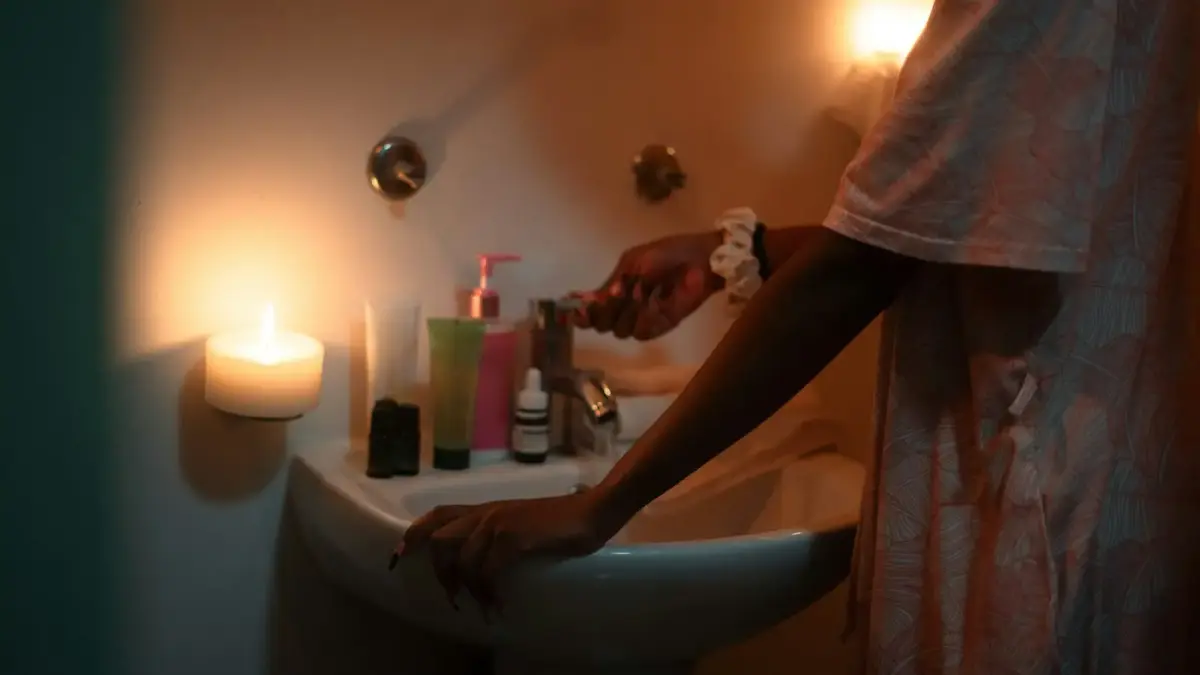
I watched my father cut a bar of Ivory soap in half once, standing at the kitchen sink on a Saturday morning, using a butter knife because he didn’t want to dirty a good one. The halves weren’t even. He put one back under the sink in a plastic bag from the bread loaf we’d finished Thursday. The other he pressed into the soap dish in the bathroom, where it would sit, lopsided and cracked, for three more weeks.
He wasn’t poor. Not by the time I was watching him do this. But his hands didn’t know that.
There was a drawer in our kitchen that held flattened squares of aluminum foil, rubber bands saved from the morning paper, and twist ties sorted by length. My mother called it the junk drawer. My father never called it anything. He just opened it when he needed something, found it, and closed it again without commentary.
I am forty-seven years old, and last Tuesday I pressed a toothpaste tube against the edge of the bathroom counter with the heel of my palm, working the last pale ribbon toward the cap. My wife had already put a new tube in the cabinet. I knew it was there. I used the old one anyway, because something in me refuses to call a thing finished while there’s still something left inside it.
If you recognize this, I want to tell you what psychology says about you. Not because you need a diagnosis - but because you deserve to understand where this comes from, and why it’s not small.
1. You add water to the shampoo bottle when it stops pouring
This is the one that gives you away at someone else’s house. You tip the bottle, nothing comes out, and your first instinct is not to reach for a new one but to run water into the old one, shake it, and use what appears. That thin, diluted lather is enough. It has always been enough.
A 2019 study published in the Journal of Consumer Psychology found that people raised in resource-scarce environments develop what researchers call a “scarcity mindset” - a persistent orientation toward extraction and preservation that operates below conscious decision-making. It doesn’t turn off when the scarcity ends. The body remembers shortage the way it remembers how to ride a bicycle.
You don’t add water to the bottle because you can’t afford shampoo. You add water because your nervous system still categorizes “almost gone” as “still here.”
2. You scrape the peanut butter jar until the glass is nearly clean
You’ve held a butter knife at an angle that would make a surgeon proud, working the curved walls of a jar that most people would have dropped in the recycling bin two breakfasts ago. You’ve gotten toast out of what looked like an empty container. You’ve eaten crackers with a translucent smear and called it a snack.
This is not about peanut butter. This is about a learned relationship with objects that hold something. You were taught - not with words but with watching - that a container is not done until you have asked it, respectfully and thoroughly, whether it has anything left to give.
The people who threw things away while there was still something inside them were people who lived differently than your family lived. You noticed that early. You may not have had the language for it, but you had the feeling.
3. You cannot throw away a container that still has product in it
There’s a bottle of lotion on your nightstand right now with a quarter-inch of product pooled at the bottom. You’ve been turning it upside down for four days, letting gravity do the work overnight, squeezing it each morning with both hands like you’re performing some kind of compression ritual.
Your partner, if they’re from a different background, finds this baffling. They see a nearly empty bottle. You see an obligation.
Psychologist Sendhil Mullainathan, co-author of Scarcity: Why Having Too Little Means So Much, describes how scarcity doesn’t just change what you do - it changes what you see. People shaped by scarcity literally perceive remaining resources differently. That quarter-inch of lotion doesn’t look negligible to you. It looks like three more days.
4. You keep plastic bags inside other plastic bags
There is a bag of bags somewhere in your home. Maybe it’s under the sink. Maybe it’s in a closet. It is a soft, rustling mass of grocery bags nested inside one larger grocery bag, and you have never once questioned its existence.
You know exactly what those bags are for. They’re for everything. Trash can liners. Lunch bags. Wet swimsuits. Wrapping shoes before you put them in a suitcase. The fact that you can buy purpose-made products for all of these tasks is not relevant. The bags are free. The bags are already here. Using something you already have instead of buying something new is not a decision you make consciously. It is a posture toward the world.
A 2021 study in Frontiers in Psychology found that resource conservation behaviors learned in childhood persist across decades and income levels, functioning more like personality traits than economic choices. The researchers described it as “habituated thrift” - behaviors that outlast their original context because they’ve been absorbed into identity.
You don’t keep the bags because you’re thrifty. You keep them because throwing them away would feel like a small betrayal of the person who taught you to see usefulness where other people see trash.
5. You eat the bruised part of the fruit
Someone at work brings in a basket of peaches. You take one, and there’s a soft brown spot near the stem. Most people put it back and reach for a perfect one. You bite around the bruise, or you eat through it, because a bruised peach is still a peach.
This extends to everything. The bread with one stale end - you eat the fresh slices and toast the stale one. The banana that’s gone spotty - it becomes banana bread, or you eat it anyway, because ripeness is a spectrum, not a binary.
You learned this from someone who could not afford to see food as disposable. Who understood that a bruise is damage, not death. Who picked around the bad part and ate the rest without commentary, because commentary would mean admitting that the fruit wasn’t perfect, and in a household that counted its groceries, imperfect food was still food and still a blessing.
6. You feel a low pulse of anxiety when someone else wastes something
This is the one you probably don’t talk about. Your friend tears off a length of paper towel to wipe up a small spill, and you feel it in your chest - a quick, involuntary tightening that has nothing to do with paper towels and everything to do with the physics of watching someone use more than what the task requires.
You’ve watched someone pour half a glass of milk down the sink and had to look away. You’ve seen someone leave food on a plate at a restaurant and felt something close to grief, though you’d never call it that.
Brene Brown has written about how shame attaches to class markers in ways that are nearly invisible to people who didn’t grow up counting. The anxiety you feel watching someone else waste something is not judgment. It’s a reflex. Your body is responding to a violation of rules that were never spoken aloud but were enforced in every room of the house where you grew up.
7. You repair things that would be cheaper to replace
The sole of your shoe is separating. A tube of shoe glue costs four dollars. A new pair of shoes costs forty. You buy the glue. Not because you can’t afford the shoes - you probably can, now - but because the idea of discarding something that can still be fixed feels physically wrong.
A 2020 study in the Journal of Research in Personality found that adults who grew up in lower-income households scored significantly higher on measures of “object attachment” - an emotional orientation toward possessions that treats them as relationships rather than transactions. You don’t throw away the shoes because they’re not done being your shoes yet.
This is the inheritance that no one puts in a will. Your father didn’t teach you to fix things because he wanted to raise a handyman. He fixed things because replacing them was a luxury, and over time, the act of repair became its own kind of devotion. The mended thing carries a second history - the history of someone who refused to give up on it.
8. You feel proud, almost privately, when you get the last bit from something
This is the quiet one. The one that lives closest to the bone.
When you roll that toothpaste tube flat and squeeze one final, improbable brushing out of what looked like nothing - there’s a small pulse of satisfaction. Not triumph. Something quieter. Something that feels like competence and respect and memory all compressed into a single, ordinary moment at the bathroom sink.
You are not celebrating saving forty cents. You are honoring an entire orientation toward the world - one that says nothing should be taken for granted, nothing should be discarded carelessly, and everything deserves to be used fully before it’s let go.
Psychologist Adam Grant has described how the deepest values aren’t the ones people talk about but the ones they practice without thinking. Your father never gave a speech about waste. He just flattened the aluminum foil and put it back in the drawer. He just pressed the tube against the counter. He just used what was left.
And you watched. And your hands learned.
There is nothing wrong with you.
The way you press the toothpaste tube against the counter edge isn’t a quirk. It isn’t a personality flaw your partner gets to joke about at dinner parties. It is the living signature of someone who was raised by people who understood that enough is not a number - it’s a practice.
You carry their hands in your hands. Every time you tilt the bottle, scrape the jar, or smooth the tube flat against the counter with the side of your palm, you are performing a small, unconscious ritual of remembrance.
A 2022 study in Psychological Science found that behaviors inherited from caregivers - particularly those related to resource management - activate the same neural pathways as emotional bonding. The researchers suggested that for many people, habituated thrift functions as a form of attachment behavior. You’re not saving the toothpaste. You’re staying close to someone.
Your father’s hands taught you that nothing is truly empty until it has been asked, one more time, to give what it has left.
And that might be the most generous lesson anyone ever passed down without saying a word.