She is 61 and just realized she has saved every plastic bag from every grocery trip for her entire adult life - not because she is frugal or environmentally conscious but because a girl who watched her mother fold and flatten every bag from the store into a drawer beside the refrigerator learned that nothing that enters a house leaves without a second purpose, and a woman with three kitchen drawers full of bags she has never once reused is not hoarding but honoring the only economy her mother ever trusted
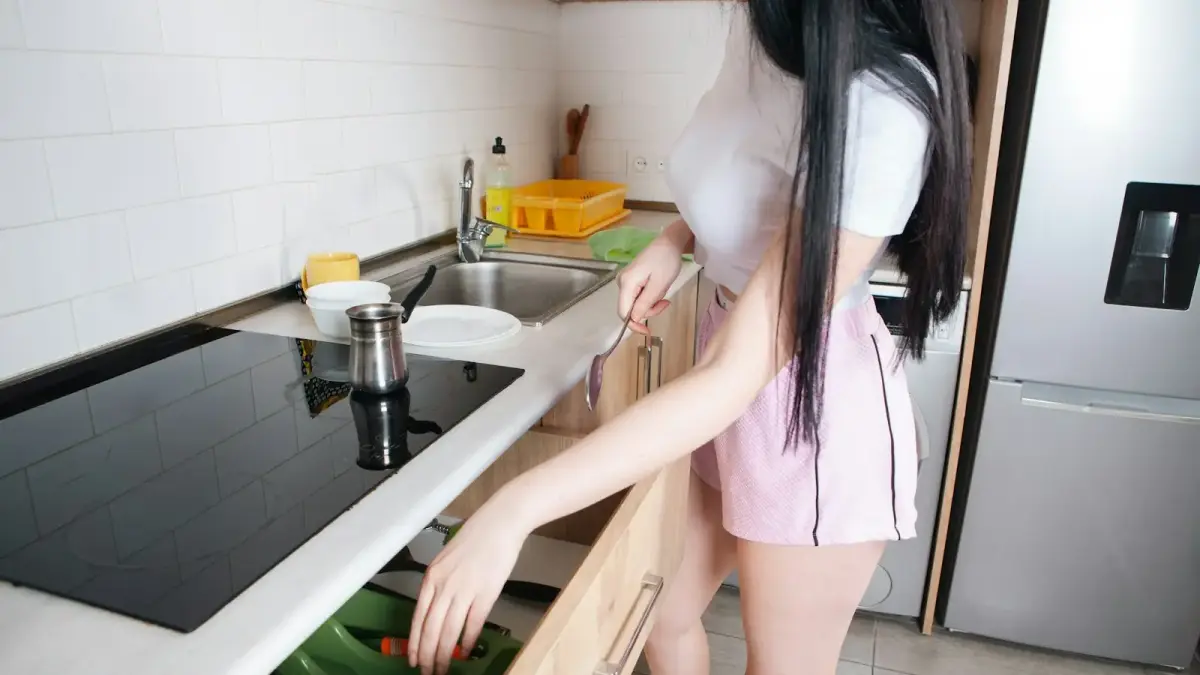
I opened the drawer last Tuesday morning to find a twist tie and couldn’t close it again. Three hundred plastic bags - maybe more - pressed against the wood like they were trying to escape. Kroger bags, Target bags, the thin translucent ones from the produce section that you can never get open on the first try. I stood there with my hand on the drawer, pushing it shut with my hip, and something in my chest went very still.
I am sixty-one years old. I have saved every single one of these bags. Not one has ever been reused.
I don’t know when this stopped being practical and became something else entirely. But standing in my kitchen with the morning light cutting across the counter, I realized I wasn’t looking at a drawer full of plastic. I was looking at my mother’s hands.
The Drawer Beside the Refrigerator
My mother had a system. Every bag that came through the front door got folded into a neat triangle - she’d smooth it flat on the counter, fold it lengthwise twice, then tuck it into itself starting from the bottom. Like a flag. Like something that mattered.
The drawer beside our refrigerator was always full. Perfectly full. Not overflowing, not half-empty. My mother maintained it the way other women maintained their hair or their flower beds. It was a point of pride she never would have called pride.
We weren’t poor in the way that makes for dramatic stories. We were poor in the way that makes you vigilant. The kind of poor where the lights stay on but the thermostat stays low. Where dinner happens every night but seconds don’t. Where you learn, before you can articulate it, that everything in a house exists on borrowed time.
In that house, a plastic bag was not garbage. It was a trash can liner, a lunch bag, a way to carry wet shoes, a covering for the bathroom trash, a method of storing leftovers when the Tupperware was already spoken for. To throw one away was not wasteful in some abstract environmental sense. It was foolish. It was careless. It was a failure of imagination about what you might need tomorrow.
What Scarcity Teaches a Child
A 2019 study published in the Journal of Personality and Social Psychology found that people who experienced resource scarcity in childhood continue to hoard and conserve resources well into adulthood - even when their financial circumstances have fundamentally changed. The researchers called it a “scarcity mindset,” but that phrase makes it sound like a setting you can toggle off. It’s not a mindset. It’s a body memory.
I grew up watching my mother extract every last molecule of usefulness from every object in our house. Aluminum foil got washed and reused. Butter containers became leftover containers. Bread bags became freezer bags. The ends of soap bars got pressed together to form a new bar. Nothing left the house until it had been fully exhausted.
This wasn’t a philosophy she talked about. She never sat me down and said, “We must be frugal.” She just did it. Every single day. And I absorbed it the way children absorb everything - not through instruction but through atmosphere.
By the time I was eight, I was folding bags too. Not because she asked me to. Because that was what you did when a bag came into the house. You folded it. You put it in the drawer. The drawer stayed full. The world stayed manageable.
The Inheritance Nobody Talks About
Here’s what I’ve never told anyone. I have plenty of money now. My husband and I both worked good jobs. The mortgage is paid. There’s a retirement account that would have made my mother cry. I buy the good olive oil. I don’t check the price of gas before I fill the tank.
And I still cannot throw away a plastic bag.
I’ve tried. I’ve stood at the garbage can with a bag in my hand and my brain has produced a complete inventory of reasons to keep it. You might need it for the bathroom trash. What if the dog gets sick in the car? What about wet swimsuits after the pool?
These reasons sound practical. They are not practical. They are the voice of a girl who learned that running out of something useful was not an inconvenience - it was a catastrophe. Because in my mother’s house, running out of bags meant running out of solutions. And running out of solutions meant we were exposed. Vulnerable. One small emergency away from a problem we couldn’t patch.
Gabor Mate writes about how the body stores the emotional logic of childhood long after the mind has moved on. Your conscious brain knows you can afford a box of trash bags. Your nervous system knows that the drawer must never be empty.
Three Drawers Full
I have three drawers now. The one beside the refrigerator - my mother’s spot, even in a kitchen she never saw - and two more in the laundry room. My daughter found them last Thanksgiving and laughed. “Mom, you could open a bag store,” she said. She meant it kindly. She grew up in a house where the thermostat was set to seventy-two and seconds were always available.
She doesn’t fold bags. She throws them away without thinking about it. This used to bother me, and I couldn’t explain why. It felt disrespectful, though I never would have used that word. What it actually felt was dangerous. Like watching someone leave the front door unlocked. Like watching someone be careless with something they might need later.
A 2021 study from the University of Michigan found that adults who grew up in lower-income households are significantly more likely to keep “just in case” items - bags, containers, rubber bands, twist ties, boxes - than those who grew up with financial stability. The researchers framed it as a behavioral adaptation. But that clinical language misses the emotional truth entirely.
Those bags are not an adaptation. They are a loyalty. A way of saying: I still live by the rules of the house I came from, even though I left that house forty years ago.
The Morality of Throwing Things Away
My mother never used the word “waste.” She used the word “shame.” It would be a shame to throw that away. That phrase carried the full weight of her economic worldview. Waste wasn’t just impractical. It was immoral. It was a betrayal of the effort it took to acquire things in the first place.
I carry that morality in my bones. When I throw away a container that could hold something, I feel a flicker of guilt so fast I almost can’t catch it. When I see my neighbor drag a half-full garbage can to the curb, something in me flinches. Not judgment exactly. More like vertigo. The dizziness of watching someone operate without a net.
Brene Brown talks about how shame gets transmitted between generations without anyone meaning to pass it along. My mother didn’t want me to feel guilty about plastic bags. She wanted me to survive. The bag-folding was survival technology dressed as housekeeping. And I inherited both the technology and the feeling that abandoning it would be a kind of treason.
What the Full Drawer Actually Means
I understand now what those bags represent. They are not about frugality. They are not about environmentalism. They are not even about my mother, exactly.
They are about the difference between a house that has enough and a house that might not. When the drawer is full, some ancient alarm in my body goes quiet. When I imagine the drawer empty - truly empty, no bags at all - my chest gets tight. Not because I need the bags. Because an empty drawer feels like the beginning of running out. And running out was the thing my entire childhood was organized to prevent.
A 2017 study in Psychological Science demonstrated that early experiences of scarcity create what researchers called “resource monitoring” - a persistent, often unconscious attention to supply levels that continues regardless of actual abundance. The subjects in the study weren’t anxious people by nature. They were people whose childhoods had installed a monitoring system that never got an off switch.
That’s the drawer. That’s three hundred bags I’ll never use. That’s me, at sixty-one, still keeping watch.
The Economy She Trusted
My mother died nine years ago. Her kitchen was immaculate. The drawer beside her refrigerator was full of neatly folded bags - triangles pressed flat, arranged like they were waiting for inspection. I didn’t clean that drawer out for six months. When I finally did, I sat on her kitchen floor and cried in a way I hadn’t cried at the funeral.
Because the bags were her. The bags were her answer to a world that didn’t give her enough and her refusal to let that world see her come up short. Every fold was an act of dignity. Every full drawer was proof that she could manage. That she could take what little came through the door and stretch it, repurpose it, honor it until it had nothing left to give.
I don’t fold my bags into triangles. I stuff them into the drawer the way you stuff a pillow into a case - quickly, without ceremony. My mother would not have approved of my method. But she would have understood the impulse. She would have recognized the drawer.
I’m not going to clean them out. I know that now. Maybe my daughter will, someday, after I’m gone. Maybe she’ll stand in my kitchen and wonder why her mother kept three hundred bags she never used. Maybe she’ll laugh and throw them away. I hope she does. I hope throwing things away is easy for her. I hope she never understands.
But if she pauses - if she holds one bag and feels something she can’t quite name - she should know it’s not a bag. It’s a prayer her grandmother folded into plastic. A small, quiet promise that there would always be enough.
Even when there wasn’t.