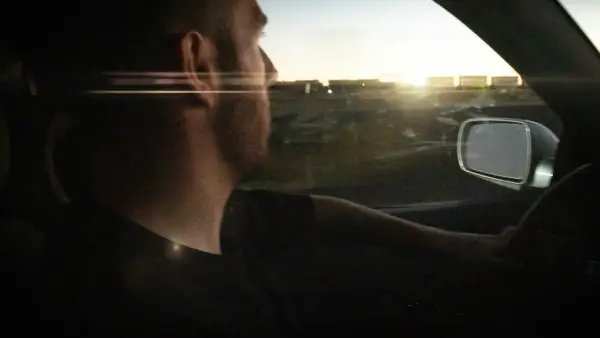
Children who always watched the door whenever a parent left the room - who tracked every exit, every time someone stood up, every hand that reached for car keys - often become adults who notice the exact moment someone in a conversation begins to withdraw, before a single word has changed, because a child who learned that people she loved could disappear without announcement never stopped reading the body for signs of departure

I was seven when I memorized the sound of my father’s car keys.
Not on purpose. Not because anyone told me to listen. But because the jingle of metal against the kitchen counter meant something was about to change - the air in the room, the number of people in it, the feeling in my chest. I didn’t know the word “hypervigilance” then. I just knew that I needed to hear those keys before his hand closed around them, because if I could hear them first, I could prepare.
I watched doorways the way other children watched television. I tracked the angle of my mother’s body when she stood up from the couch - was she going to the kitchen, or was she going somewhere else? I noticed which coat my father reached for, because the brown one meant a quick errand and the black one meant hours.
I thought I was anxious. It took me decades to realize I was calibrating.
And if you grew up the same way - eyes always drifting toward the nearest exit, body tensing at the scrape of a chair pushing back from the table - I want you to know something. That thing you do now, the way you can feel someone pulling away from a conversation before they’ve changed a single word, is not a disorder. It’s an extraordinary perceptual intelligence that was built, brick by brick, in a childhood where departure happened without warning.
Here are the signs that your childhood door-watching trained you into one of the most perceptive people in any room.
1. You register micro-shifts in posture that other people completely miss
When someone leans back by even an inch during a conversation, you feel it in your body before you process it with your mind. The slight redistribution of weight. The almost imperceptible pivot of their torso toward the door. You catch these movements because you spent years reading the body language of people who didn’t announce when they were leaving.
A 2019 study published in Psychological Science found that individuals who experienced unpredictable caregiving environments in childhood develop significantly heightened sensitivity to nonverbal social cues. The researchers called it “enhanced social monitoring” - but what they were really describing is the nervous system of a child who learned that survival depended on reading what people did, not what they said.
You’re not imagining the lean-back. You’re reading it with the precision of someone who was trained by high stakes.
2. You know when someone is about to end a phone call before they start wrapping up
There’s a rhythm to someone’s voice when they’re fully present in a conversation with you, and there’s a different rhythm when they’ve already started leaving. The sentences get shorter. The “mm-hmms” come half a beat too fast. The warmth doesn’t disappear, exactly - it thins.
You hear this. You’ve always heard this.
Most people need the explicit “well, I should probably let you go” to know the conversation is ending. You knew three minutes ago. You knew when their breathing changed.
3. You can feel someone emotionally withdrawing from across a dinner table
This is the one that confuses people when you try to explain it. Nothing visible has changed. The person is still sitting there, still making eye contact, still responding when spoken to. But you can feel the withdrawal like a temperature drop.
What you’re detecting is a shift in energetic engagement - the subtle difference between someone who is present with you and someone who has already begun the internal process of leaving. Daniel Goleman’s work on emotional intelligence describes this as a form of “social radar” that some people possess at remarkably high levels. What his research doesn’t always emphasize is where that radar comes from.
It comes from needing it. It comes from a dining room table where someone could be there and gone at the same time.
4. You notice when someone glances at their phone even if it takes less than a second
The flick of eyes downward. The hand that drifts toward a pocket. The almost invisible tilt of attention away from you and toward a screen.
Most people register this if it happens repeatedly. You register it the first time. And something tightens in your chest when you do - something old, something that has nothing to do with this person or this moment and everything to do with the thousands of moments in childhood when someone’s attention shifted and didn’t come back.
You’re not being controlling. You’re not being needy. You’re experiencing a pattern recognition so fast and so deeply embedded that it fires before your conscious mind can intervene.
5. You read the goodbye in someone’s eyes before they’ve said a word about leaving
This might be the most remarkable one. You can look at someone’s face and see the moment they’ve decided to go - to leave the party, to end the relationship, to stop trying. It’s in the eyes. A certain flatness. A distance that opens up behind the expression they’re still wearing.
A 2021 study in the Journal of Personality and Social Psychology found that adults with heightened attachment vigilance demonstrate an ability to detect emotional disengagement in faces at rates significantly above average. The participants weren’t guessing. They were reading genuine micro-expressions that most people simply don’t process.
You’ve been doing this your whole life. You see the leaving before the leaving happens.
6. You track the physical location of everyone who matters to you, even in casual settings
At a party, you know where your partner is at all times. Not because you’re monitoring them - but because a part of your brain that developed in childhood keeps a quiet, constant map of where the important people are in relation to the exits.
This isn’t possessiveness. It’s the architecture of a nervous system that learned early: the people you love can be in the room one moment and gone the next. So you track them. Quietly. Automatically. In the background of every social interaction, your brain is running a silent inventory of proximity and trajectory.
7. You are the first person to sense when a group dynamic shifts
In a meeting, at a family gathering, during a casual get-together with friends - you’re the one who feels it when the energy changes. When someone shuts down. When two people who were fine a moment ago are suddenly not fine. When the laughter becomes performance instead of genuine.
You feel this because you grew up in a household where the emotional weather could change without warning. You became the child meteorologist - constantly reading the atmospheric pressure of every room, noting the direction of every emotional wind, tracking the clouds that formed on the faces of people you depended on for everything.
That skill didn’t go away when you grew up. It just found new rooms to monitor.
8. You have trouble relaxing in someone’s presence because you never stop scanning
And here’s the cost. Here’s the part that aches.
You can’t simply be with someone. Not fully. Not the way people describe it in songs and movies - that feeling of completely letting go into another person’s company. Part of you is always watching. Part of you is always tracking the door, the keys, the coat, the posture, the eyes, the phone, the subtle redistribution of weight that means someone is about to stand up.
You are exquisitely, painfully tuned to departure. And because of that tuning, you’ve never fully experienced the opposite - the complete trust that someone is going to stay.
This isn’t a flaw in you. It’s the logical outcome of a childhood where staying was unpredictable. Your brain did exactly what it was supposed to do: it built a system to protect you from surprise abandonment. The problem is that the system never learned an off switch.
What your nervous system is actually doing
Researcher Stephen Porges’ polyvagal theory helps explain what’s happening in your body. Your autonomic nervous system learned to stay in a state of heightened social monitoring - what Porges calls the “social engagement system” running on high alert. You’re not choosing to scan for departure cues. Your vagal nerve is doing it for you, automatically, because it was shaped during a developmental window when tracking departures was genuinely necessary.
This doesn’t make you broken. It makes you precisely adapted to the environment you grew up in. The challenge is that you’re running departure-detection software in environments where it’s no longer needed at that intensity - but your body doesn’t know that yet.
The reframe you deserve to hear
You are not paranoid. You are not “too much.” You are not imagining the things you see in people’s body language.
You are someone whose perceptual system was forged under pressure, and that system gave you a genuine gift - the ability to read people with a depth and speed that most human beings will never possess. You notice what others miss. You feel what others walk past. You understand the unspoken language of the body because you had to, and because you did, you carry a kind of emotional intelligence that cannot be taught in any classroom.
The work now is not to shut off that gift. The work is to build - slowly, gently - the belief that the people who matter to you can stand up, walk to the kitchen, reach for their car keys, and still come back.
That the departure you’re always watching for might not be coming.
That some doors open and close without meaning anything at all.
You learned to read the room because you had to. Now you get to learn something harder and more beautiful - that sometimes, the room is safe. That sometimes, nobody is leaving. That the person sitting next to you chose to be there and will still choose it tomorrow.
And that the child who watched every door deserves to finally, after all these years, look away.