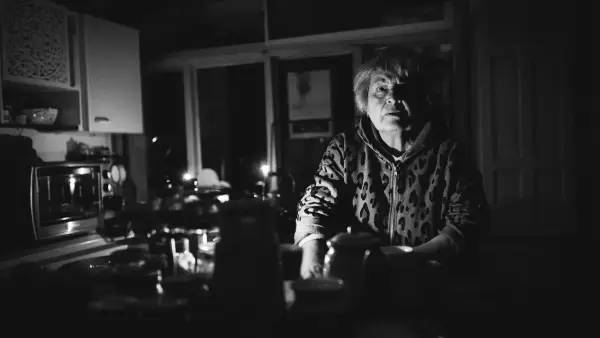
Children who could tell which version of their parent was going to walk through the door by the sound of the keys - who listened for the speed of the lock turning, the weight of the first footstep, whether the coat was hung up or dropped on the chair - often become adults who read every room they enter in under three seconds, not because they are naturally perceptive but because a child whose evening depended on decoding an arrival never learned how to enter a space without taking its temperature first
I was seven when I learned to tell the difference between a two-drink night and a four-drink night by the way my father’s keys hit the lock. Two drinks meant a slow, deliberate insertion - the metal finding the slot on the first try, the deadbolt turning in one clean rotation. Four drinks meant fumbling, the keys scraping against the plate before the right one found its way in, and a pause that lasted just long enough for me to decide which version of the evening was about to begin.
I didn’t know I was doing anything unusual. I thought every kid lay in bed cataloging the weight of a footstep on hardwood, measuring the tempo of shoes being removed, listening for whether the refrigerator opened before or after the hallway light clicked off. I thought everyone had a system.
It turns out, not everyone did. But a lot of us did.
The Alphabet You Learned Before You Had Words For It
Before you could articulate what anxiety was, before you understood what emotional volatility meant, you had already built something remarkable. You had constructed an entire sensory language around the sounds of arrival.
The garage door opening at its usual speed versus the garage door opening too fast. The front door closing with a gentle click versus the front door catching the frame. The first word spoken - was it your name called warmly, or the dog’s name snapped at for being in the way?
These weren’t random observations. This was a child’s nervous system building a prediction model out of the only data it had access to. A 2005 study published in Development and Psychopathology found that children raised in emotionally unpredictable environments develop what researchers call “enhanced threat detection” - a heightened ability to process ambiguous social and sensory cues at speeds far exceeding their peers. The researchers framed it as a consequence of adversity. I think that framing misses something important.
What you built wasn’t a disorder. It was an intelligence.
The Sound Map Nobody Taught You To Draw
Think about what you actually learned to track. Not just the keys and the footsteps - though those were the headline acts. You learned the entire acoustic signature of a mood.
The cabinet doors told you something. Opened and closed carefully meant the evening was stable. Opened and slammed shut - even if the slam was only ten percent harder than normal - meant the pressure was building. You didn’t need a psychology degree to decode this. Your body did the math before your mind caught up.
The tone of “hello” was its own encyclopedia. You knew the difference between a hello that meant “I’m glad to be home” and a hello that meant “don’t ask me anything right now.” You knew the difference between silence that was peaceful and silence that was a warning. Most adults can’t articulate the distinction. You could feel it in your sternum before you were old enough to ride a bike without training wheels.
And here’s what no one tells you about this kind of childhood curriculum: it doesn’t disappear when you leave home. It follows you into every room you’ll ever enter for the rest of your life.
Walking Into Rooms Like You’re Reading Sheet Music
You’ve probably noticed this about yourself, even if you’ve never named it. You walk into a dinner party, a meeting, a friend’s apartment, and within seconds - genuinely, within the first three seconds - you’ve already taken a full inventory.
Who’s tense. Who’s been crying. Which couple is fighting but pretending they’re not. Whether your boss is in a good mood or whether today is a day to keep your head down. You read the room the way a conductor reads an orchestra - every instrument, every dynamic, every barely perceptible shift in tempo.
Your friends might call you intuitive. Your partner might say you’re “so perceptive.” What they don’t realize is that this isn’t a personality trait you were born with. This is a skill you were forged into developing because the alternative - missing a cue, misreading a mood, failing to anticipate a shift - once had real consequences.
Research from Psychological Science supports this. A 2011 study by Pollak and Sinha found that children from emotionally volatile households showed significantly faster and more accurate identification of facial expressions, particularly anger and fear, compared to children from stable homes. They weren’t just good at it. They were elite. The study’s authors noted that these children processed emotional information with the efficiency of trained professionals - except no one had trained them. Their environment did.
The Cost of Having Ears That Never Turn Off
I want to be honest about something, because I think honoring this ability also means being honest about what it costs.
You’re tired. Not the kind of tired that sleep fixes - the kind of tired that comes from never having learned how to walk into a space without scanning it first. Your perceptual system doesn’t have an off switch because it was never given one. It was built to run continuously, and continuous operation is exhausting.
You might find yourself drained after social events that everyone else found relaxing. You might realize that you’ve been monitoring the emotional temperature of your office all day without anyone asking you to. You might catch yourself listening to the way your partner closes the car door after work and making predictions about the evening based on something they don’t even know they’re communicating.
This is the tax. The room-reading superpower comes bundled with a nervous system that treats every social environment as a space to be decoded rather than simply experienced. You’re never fully off duty.
And some nights, you catch yourself listening for sounds that aren’t there anymore - the key in a lock from a house you haven’t lived in for twenty years.
What Happens When The Listener Gets Heard
Here’s where the story gets tender, and where I think the real healing lives.
The thing about growing up as a decoder is that you spent your entire childhood listening to everyone else. You became an expert in other people’s moods, other people’s needs, other people’s unspoken emotional weather. You got so good at hearing them that you forgot anyone should be hearing you.
When someone actually pays attention to your tone of voice - when a friend notices that your “I’m fine” sounds different today, when a partner catches the micro-pause before you answer a question - it can feel almost unbearable. Not because it’s unwelcome, but because it’s unfamiliar. You built an entire identity around being the one who notices. Being noticed in return can feel like standing in a room with no walls.
A 2019 study in Frontiers in Psychology examined what researchers call “interpersonal sensitivity” in adults who grew up in unpredictable home environments. They found that while these adults excelled at reading others, they simultaneously reported higher levels of discomfort when they themselves became the subject of emotional attention. The authors described it as a “one-directional empathy pattern” - extraordinary at perceiving outward, deeply uncomfortable with perception turned inward.
If that pattern sounds familiar, I want you to know something. The fact that it’s uncomfortable doesn’t mean it’s wrong. It means you’re experiencing something your nervous system never got to practice: being on the receiving end of the attention you’ve been giving away your whole life.
The Listening That Deserves To Be Honored
I’m not going to tell you to unlearn what you know. I’m not going to suggest that your room-reading ability is something to fix or pathologize or meditate away. The truth is more complex than that, and you deserve a more complex truth.
You carry something that most people will never develop - a perceptual sensitivity that borders on extraordinary. You can feel the shift in a room the way some people feel a change in barometric pressure. You know when someone is about to cry before they know it themselves. You hear the things that live underneath the things people actually say.
That ability was born in a context you didn’t choose. It was shaped by evenings that required you to be a tiny meteorologist of human emotion, forecasting storms from the sound of a footstep. You shouldn’t have had to learn it that way. No child should have to build a weather station out of the sound of keys in a lock.
But you did build it. And it is yours now.
The invitation isn’t to dismantle the system. It’s to update its operating instructions. You’re allowed to notice the room without being responsible for it. You’re allowed to hear the shift in someone’s tone without making it your job to fix whatever caused it. You’re allowed to use your extraordinary ears for something other than self-protection.
You spent your childhood listening for danger. You can spend your adulthood listening for something else - for connection, for beauty, for the sounds that signal not that something bad is coming, but that something good is already here.
The keys in the lock don’t have to be a warning anymore. Sometimes they’re just someone coming home.