Children who grew up in apartments with thin walls and neighbors below them - who learned before they could spell the word 'neighbor' that a dropped toy or a raised voice could bring a fist on the ceiling - often become adults who close cabinet doors with both hands, set glasses down without a sound, and still walk on the balls of their feet through a house that sits on solid ground
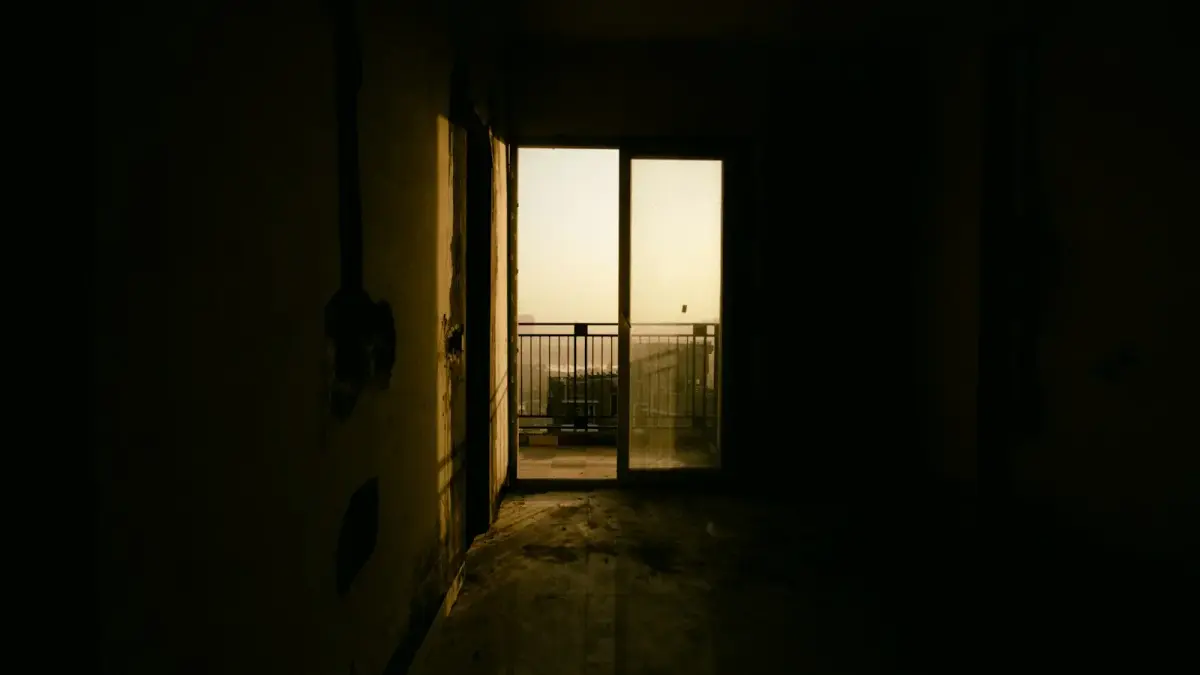
I catch myself doing it in hotel rooms.
I’ll set my suitcase down slowly, both hands guiding it the last inch to the floor, and then stand perfectly still for a moment - listening. Not for anything in particular. Just listening for the knock. The complaint. The muffled voice from below telling me I exist too loudly.
I’m fifty-one years old. I own a house now. There is no one beneath me. And still, every time something slips from my hand and hits the floor, my stomach drops a half-second before the object does.
If you grew up in an apartment building - the kind with radiators that clanked and ceilings that were someone else’s floor - you might know exactly what I’m talking about. Not the nostalgia of shared walls. The training of them.
1. You close cabinet doors with both hands
You learned this one early. A cabinet door that swings shut on its own makes a sound that carries straight through drywall. So you developed the technique without anyone teaching it to you - one hand on the door, the other bracing the frame, guiding it closed until the latch catches with barely a whisper.
You do this in every kitchen you’ve ever stood in. Your own. Your friend’s. The rental cabin on vacation where the nearest neighbor is a quarter mile through the trees. It doesn’t matter. Your hands already know their positions before your brain has time to say “nobody’s listening.”
A 2019 study published in the journal Body, Movement and Dance in Psychotherapy found that repetitive physical behaviors learned in childhood environments become what researchers call “embodied memory” - patterns stored not in conscious thought but in muscle and tendon and bone. Your body learned the choreography of quiet before you understood why quiet mattered.
2. You set glasses down like they’re made of something more fragile than glass
Watch yourself the next time you place a cup on a counter. You don’t just set it down. You lower it. There’s a controlled descent, a deliberate moment where your fingers stay wrapped around the base even after it’s touched the surface - absorbing the impact, muffling the contact.
Other people put their coffee mugs down and you can hear it from the next room. You put yours down and it’s silent. Not because you’re careful by nature. Because at seven years old, you learned that the sound of a glass meeting a table at 9 PM was enough to start a confrontation you had no power to finish.
This isn’t delicacy. This is a survival behavior dressed up as good manners.
3. You walk on the balls of your feet through your own home
This is the one that gets me. Because I didn’t even know I was doing it until my husband pointed it out a decade into our marriage. “You walk like you’re sneaking through your own house,” he said. And he was right.
I don’t put my heels down first. I land on the ball of each foot and roll forward, distributing weight the way a person does when they’re trying not to be detected. I do it at 2 PM on a Tuesday. I do it when I’m the only person home.
Dr. Bessel van der Kolk, whose research on trauma and the body has reshaped how we understand stored experience, has written extensively about how the body retains adaptive responses long after the environment that required them has changed. The muscles don’t get the memo that you’ve moved. They keep rehearsing the old choreography because no one ever told them the show was over.
I grew up on the third floor of a building in Queens. The woman below us - Mrs. Petrov - had a broom handle she used on her ceiling like a gavel. Two thumps meant we were too loud. Three meant she was coming upstairs. My brother and I learned to play on the carpet in socks, stepping over the creaky board by the bathroom like it was a tripwire.
My feet still know where that board was. They just don’t know it’s gone.
4. You flinch when something drops
Not a startle exactly. More like a full-body wince - a contraction of the shoulders, a pulling-in of the breath, an immediate glance downward as though you need to assess the damage. Not damage to the object. Damage to the peace.
When your child drops a toy, your first instinct isn’t “I hope that didn’t break.” It’s “I hope no one heard that.” Even in your own house. Even when you are the only authority in the building. Even when there is literally no one to hear.
A 2021 study in Frontiers in Psychology examined how chronic environmental vigilance in childhood - the constant monitoring of sound, movement, and the reactions of nearby adults - creates what researchers described as a “persistent readiness state.” The nervous system stays tuned to a frequency it first picked up decades ago. Your body is still scanning for the knock on the door, the note in the mailbox, the broom handle from below.
You’re not anxious. You’re trained.
5. You lower your voice the moment you step indoors
Outside, you can be full volume. Something about open air gives your nervous system permission. But the second you cross a threshold - any threshold - your volume drops. Automatically. Without decision.
You whisper in hallways. You speak softly in stairwells. You modulate your voice in restaurants the way other people modulate it in libraries. Because when you were small, the hallway was shared territory. The stairwell echoed. Every sound you made in a common space was evidence of your existence, and existence was something you learned to apologize for with volume control.
Your partner has probably said it to you: “You can talk louder, you know.” And you nod, and you know they’re right, and then you keep doing exactly what you were doing. Because knowing isn’t the same as undoing.
6. You’re hyper-aware of the sounds you make in other people’s homes
Visiting someone’s house is an exercise in acoustic surveillance. You notice which stairs creak. You register the thickness of the walls. You calculate, unconsciously, how far sound might carry.
You flush the toilet at a friend’s house in the middle of the night and lie awake wondering if you woke someone. You shift in the guest bed slowly, testing the springs. You eat breakfast at their table and set the spoon in the bowl like you’re defusing something.
This isn’t politeness. It’s a form of hypervigilance that just happens to look like good manners. And because it looks like good manners, no one ever names it for what it is: a nervous system still scanning for threat in the acoustics of every room it enters.
7. You notice when other people are loud, and it unsettles you
Your roommate closes a door and it bangs shut and something in your chest tightens. Your partner drops a pan in the kitchen and you feel a rush of something - not anger, not fear exactly, but a kind of urgent discomfort, a need for the sound to not have happened.
You’ve probably been called “sensitive to noise.” Maybe you’ve even been diagnosed with misophonia or wondered about it. But it’s not that you can’t tolerate sound. It’s that sound was the early warning system of your childhood, and your body never decommissioned it.
Research by Dr. Stephen Porges on polyvagal theory suggests that the auditory system is deeply wired to our threat detection. Children who grew up in environments where sound triggered social consequences develop an auditory vigilance that persists - listening not for content, but for volume. Not for what’s being said, but for how loudly.
8. You feel guilty taking up space with sound
This is the deeper one. Underneath all the specific behaviors - the soft footsteps, the careful hands, the modulated voice - there’s a belief that lives in the body more than the mind. The belief that your natural volume is an imposition. That the unedited sounds of your existence are a problem for other people.
You apologize when your chair scrapes the floor. You cringe when your child yells at the playground near an apartment building. You cannot bring yourself to play music without headphones, even alone, even in the middle of the afternoon, even in a house with no shared walls and no one for acres.
The child who was shushed by strangers through the ceiling learned something about their right to exist at full volume. They learned that the safest self is the smallest self. The quietest version. The one that can be in a room without the room knowing.
And at fifty-three, that lesson still lives in the hands that close the cabinet door gently, the feet that land softly on the hardwood, the voice that drops to half-volume the moment it steps inside.
What the body remembers
Here’s what I want you to hear, if any of this landed somewhere specific in your chest.
You’re not “too sensitive.” You’re not “overly cautious.” You’re not neurotic about noise. You are a person whose body learned a very specific set of physical rules in a very specific kind of childhood, and your body has been faithfully following those rules ever since - not because it’s broken, but because it was brilliant enough to learn them in the first place.
The kid who figured out how to walk without making the floor creak was solving a real problem. The kid who learned to close doors with both hands was protecting the peace of a household that had very little of it to spare. That was intelligence. That was adaptation. That was survival dressed in socks on a carpet at 8 PM on a school night.
You don’t have to unlearn it if you don’t want to. You don’t have to stomp around your own house to prove a point. But maybe you can let yourself notice it - the next time you catch your hand bracing a cabinet, the next time you realize you’re walking on the balls of your feet through a kitchen that belongs to you.
Notice it, and be gentle with the kid who taught you that.
They were doing their best with the floor they were given.