Psychology says people who always sleep with one foot outside the blanket are not regulating temperature - they are people whose nervous system learned to keep one part of the body ready to move at all times, because a child who grew up in a house where safety could change without warning never fully trusted that it was safe to be completely still, and the foot at fifty-three is not a sleep habit but the last outpost of a nervous system that never received the message that the danger is over
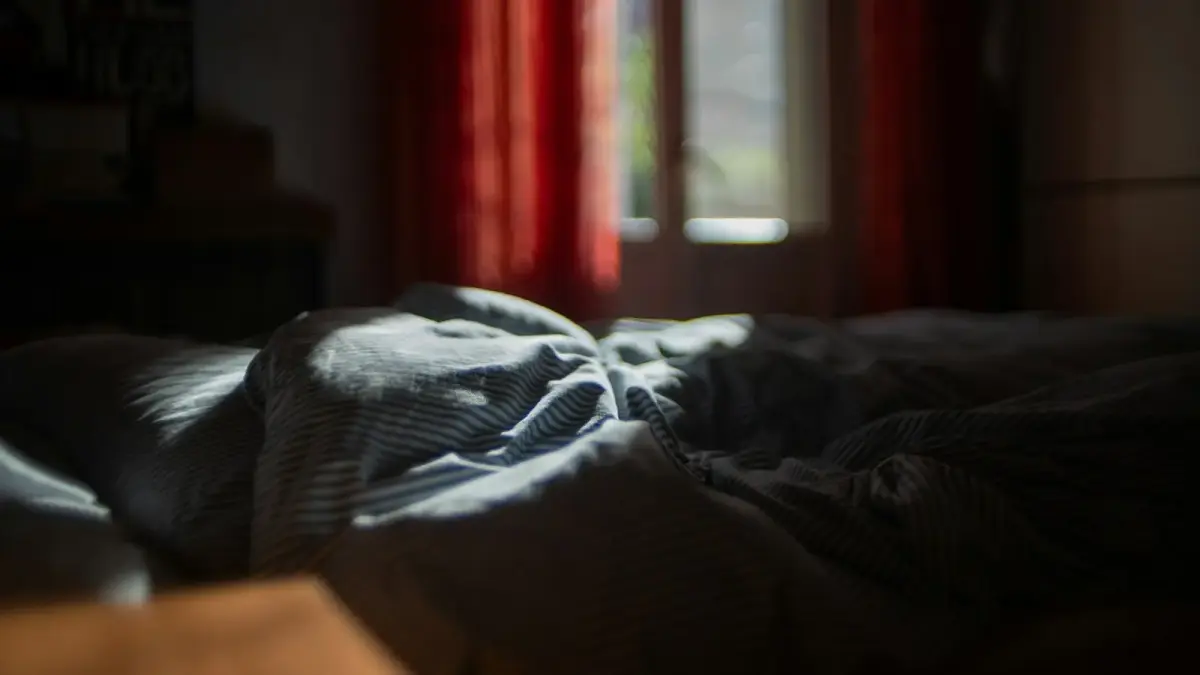
I woke up at 3 a.m. last Tuesday and noticed it before I noticed anything else.
My left foot was outside the blanket. Not dangling dramatically off the edge of the bed - just out. Resting on top of the duvet like it had its own quiet agenda. The rest of me was cocooned, warm, tucked in the way a body is supposed to be at three in the morning. But that one foot was bare against the cool air, toes slightly flexed, as if it had somewhere to be.
I’ve done this my entire life. I assumed everyone did. I told myself it was a temperature thing - the body’s clever little thermostat, venting heat through the extremities. And for some people, maybe it is exactly that. But when I started reading the research on how childhood environments shape adult sleep patterns, I found something that made me sit very still for a long time.
Because for some of us, that foot isn’t cooling anything down. It’s standing guard. It’s the last piece of a child’s emergency system, still running decades after the emergency ended.
The body doesn’t forget what the mind decides to forgive
Here is what I want you to understand before we go any further: your conscious brain and your nervous system are not the same thing. Your conscious brain can move across the country, build a stable life, lock the doors every night, and say with complete honesty, “I’m safe now.” Your nervous system doesn’t care what your conscious brain thinks.
Your nervous system learned its lessons in the first decade of your life, and it learned them in the body, not in language. It learned them in footsteps on the stairs. In the particular quality of silence that meant someone was about to start yelling. In the sound of a car pulling into the driveway at an hour that meant the night was about to go sideways.
Stephen Porges’ polyvagal theory describes this with a precision that lands like a fist. Porges found that the autonomic nervous system doesn’t simply toggle between “calm” and “stressed.” It operates on a hierarchy - a ladder of responses that the body climbs depending on how safe it perceives the environment to be. At the bottom is shutdown. In the middle is fight-or-flight. At the top is what Porges calls the “ventral vagal state” - the place where your body genuinely believes it is safe enough to rest, connect, and let its guard down completely.
Children who grow up in unpredictable homes - not necessarily abusive, just unpredictable - often never fully reach that top rung. Their nervous system gets stuck somewhere in the middle. Alert. Scanning. Ready.
And the foot outside the blanket? That’s the body’s compromise. It’s rest without full surrender. Sleep without complete stillness. The nervous system saying: fine, you can close your eyes, but I’m keeping one part of you ready to move.
What “unpredictable” actually means to a child’s body
I want to be careful here because when people hear “unpredictable childhood,” they often picture something extreme. Violence. Neglect. The kind of stories that make the news.
But the nervous system is not calibrated for headlines. It’s calibrated for patterns. And a child’s nervous system is asking one question, over and over, thousands of times a day: can I predict what happens next?
A parent whose mood shifted without warning. A household where the emotional weather changed between breakfast and dinner. A father who was warm on Tuesday and withdrawn on Thursday for reasons no one explained. A mother who was fine until she wasn’t, and the transition happened so fast that the child learned to watch for micro-signals the way a meteorologist watches pressure systems.
None of this has to be anyone’s fault. Sometimes unpredictability is just what happens when adults are overwhelmed, stretched thin, carrying their own unprocessed pain. The parent doesn’t have to be a villain for the child’s nervous system to learn that stillness is risky.
And that’s the part that’s hard to sit with. Because the lesson the nervous system learns isn’t “my parents are dangerous.” The lesson is “complete stillness is dangerous.” Complete surrender is when you’re most vulnerable. So the body builds in a small, quiet exception. One foot out. One limb uncovered. One part of you that never fully lets go.
The science of sleeping with one eye open
A 2017 study published in Sleep Medicine Reviews examined hyperarousal in adults who reported childhood environments characterized by unpredictability. The researchers found that these individuals showed elevated sympathetic nervous system activity during sleep - higher heart rates, more frequent micro-awakenings, and a tendency toward what the study called “partial vigilance postures.” The body, even in sleep, maintained a readiness the person had no conscious awareness of.
This isn’t insomnia. These people fall asleep fine. They just don’t sleep the way someone whose nervous system fully trusts the dark does. There’s a difference between sleeping and surrendering to sleep, and that difference lives in the body, not the mind.
Bessel van der Kolk, whose work on trauma and the body changed the way we understand these patterns, puts it bluntly: the body keeps the score. What he means is that experiences the mind has processed, contextualized, filed away as “the past” still live in the body as present-tense instructions. Your mind knows you’re fifty-three and safe in your own house. Your body is still eight and listening for the sound of the garage door.
The foot outside the blanket is your body’s way of keeping one ear open. It’s not a preference. It’s not a quirk you picked up somewhere. It’s a policy your nervous system wrote a long time ago, and no one ever told it the policy could be retired.
The difference between knowing you’re safe and your body believing it
This is the gap that trips people up. Because you do know you’re safe. You’ve done the work. You’ve maybe even done therapy, read the books, had the conversations. You can articulate exactly what happened in your childhood and why it affected you. You have language for it.
But your nervous system doesn’t speak language. It speaks sensation. Temperature. Muscle tension. The position of your limbs in space. And in the language of the body, that foot outside the blanket is a complete sentence. It says: I am resting, but I am not gone. I am here, but I can move. I am trusting this moment, but not the next one.
This isn’t a failure of healing. This is how deep the body’s learning goes. You can’t think your way out of a pattern that was never stored in thought. You can’t reason with a foot that slips out from under the covers every single night while you’re unconscious.
And honestly? Maybe you shouldn’t try.
Your body made a promise, and it’s keeping it
Here’s what I’ve come to believe about that foot.
It’s not broken. It’s not a symptom that needs fixing. It’s the body’s way of honoring a promise it made when you were very small and very alert and very alone in the dark - the promise that it would never let you be caught completely off guard.
That promise kept you safe. It kept you ready. It got you through nights when ready was the only thing between you and something you couldn’t control. The fact that the danger has passed doesn’t make the promise less real. It just means your body loved you before you had the words to ask it to.
I think about this when I wake up at odd hours and find my foot resting on top of the duvet, cool and bare and quietly vigilant. I used to tuck it back under. I used to feel vaguely annoyed at myself, like I was doing sleep wrong.
Now I just notice it. I let it be there. Sometimes I even say something to myself that would sound ridiculous if anyone heard it, but I’ll tell you anyway: thank you for watching. I’m okay now.
The foot doesn’t tuck itself back under when I say that. The nervous system doesn’t update its policy based on a single reassurance. That’s not how this works.
But something shifts - something very small and very quiet - when you stop treating your body’s vigilance as a flaw and start treating it as evidence that you survived something. That you built systems to protect yourself when no one else was building them for you. That your body, even now, even decades later, is still showing up for the child who needed someone to stay awake.
You’re not regulating temperature. You’re not doing sleep wrong. You’re not weird for needing one foot free.
You’re a person whose body learned to keep watch a long time ago. And the foot at fifty-three is not a habit. It’s a loyalty. The deepest kind - the kind the body keeps even when the mind has moved on. Even when the house is quiet. Even when the danger is over.
Especially when the danger is over. Because that’s when the body whispers, just in case.