Psychology says people who clap when the airplane lands are not unsophisticated and they are not naive - they are people whose relationship with safe arrival was never guaranteed, and the applause is not a lack of worldliness but the last surviving dialect of a gratitude so deep it bypasses language and speaks directly through the hands
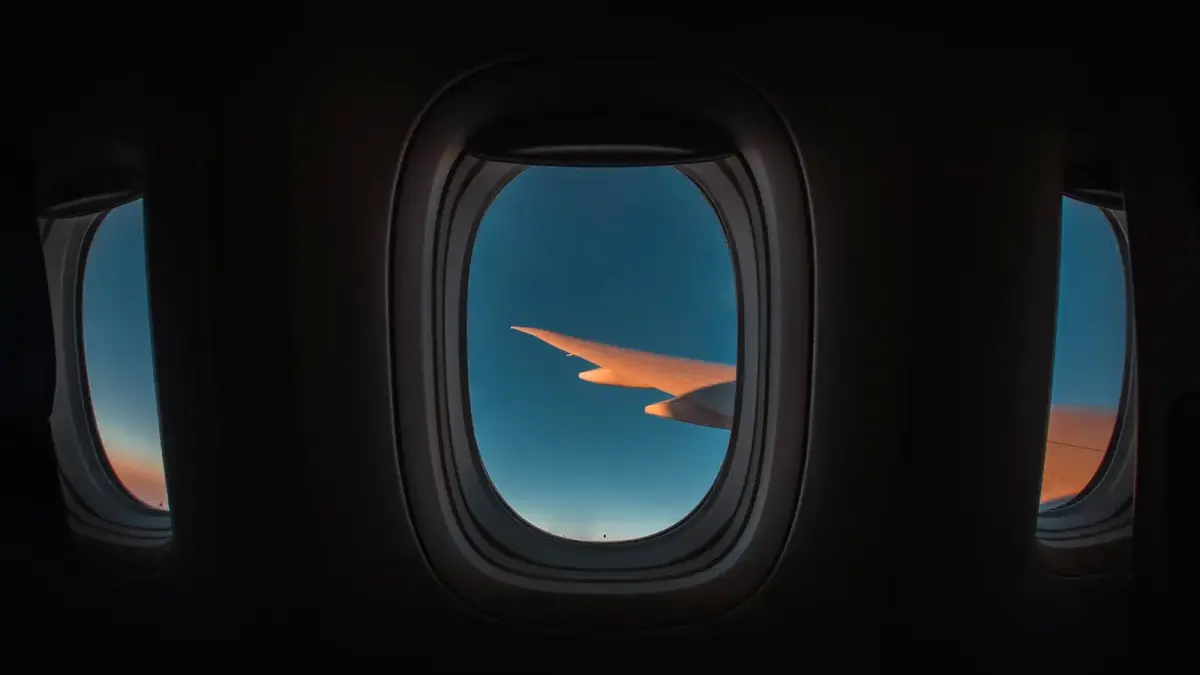
The first time my mother flew, she wept
I was fourteen when my mother boarded her first airplane. She was fifty-one. She gripped my father’s hand during takeoff so hard that his knuckles turned white, and when we touched down in Denver three hours later, she did something that made me want to disappear into my seat.
She clapped.
Not politely. Not ironically. She clapped with her whole chest, her eyes wet, her face split open with a relief so enormous it filled the cabin. A few rows ahead of us, a man in a sport coat turned around and smirked. His wife covered her mouth. I remember the heat crawling up my neck - the specific shame of being fourteen and watching your mother be sincere in a space that punishes sincerity.
I didn’t understand then what I understand now. My mother wasn’t clapping because she didn’t know better. She was clapping because she knew something the rest of us had forgotten.
She knew that arriving alive somewhere far from home is not a small thing. She knew it in her body before her mind could shape the words.
The body remembers what sophistication teaches us to forget
There is a concept in psychology called embodied cognition - the idea that our physical bodies don’t just carry out the instructions of the brain but actively participate in how we process and express emotion. Our hands know things our vocabulary doesn’t.
A 2010 study published in Psychological Science demonstrated that physical actions can shape emotional processing in ways that bypass conscious thought. Participants who performed gestures associated with specific emotions showed measurable shifts in mood and perspective - even when they weren’t aware of what the gesture meant.
The clapping on an airplane is this principle in its purest form.
It is not a cognitive decision. Nobody sits at 30,000 feet thinking, “When the wheels touch ground, I shall initiate applause to signal my satisfaction with the pilot’s performance.” The clapping is pre-verbal. It rises from somewhere below strategy, below self-consciousness, below the part of us that has learned to monitor how we look to strangers.
It is the body doing what the mouth cannot - releasing a pressure of relief and gratitude that has no other exit.
And the people who mock it are not wrong because they’re unkind. They’re wrong because they’ve lost access to the thing that makes the clapping happen. They’ve become so accustomed to safe arrival that they can no longer feel how extraordinary it is.
Familiarity is not wisdom - it is numbness
Robert Emmons, one of the leading researchers on gratitude at UC Davis, has spent decades studying why some people feel grateful for things others take entirely for granted. His work consistently shows that gratitude is not a personality trait you either have or don’t. It is a function of awareness - and awareness erodes with repetition.
The more familiar something becomes, the less we feel it. Psychologists call this hedonic adaptation. It is the mechanism by which a miracle becomes a commute.
Think about what flying actually is. You sit in a metal tube that weighs half a million pounds and it lifts off the earth. It carries you through the atmosphere at 500 miles per hour, above weather systems and mountain ranges and entire countries, and sets you down in a place your grandparents might have needed weeks to reach by ship or train.
That is not ordinary. We have simply decided to experience it as ordinary because we do it often.
The frequent flyer who rolls their eyes at the clapping is not more sophisticated. They are more numb. They have made enough safe landings that the landing itself has disappeared into routine. And routine is comfortable, but it is not a higher form of consciousness.
The person who claps has not yet surrendered that awareness. Their nervous system still registers the weight of what just happened. They are, in the most literal neurological sense, more present than the person in 4A checking their email before the seatbelt sign turns off.
This is really about class, and we know it
Let’s say the quiet part. The mockery of airplane clappers is one of the most consistent and socially accepted forms of casual class snobbery in modern life.
The people who mock the clapping tend to be people who have always flown. People for whom airports are an inconvenience, not an event. People whose parents flew, whose grandparents flew, for whom the mechanics of modern travel have always been part of the assumed architecture of life.
The people who clap tend to be people for whom this is not true. First-generation flyers. Immigrants. People from countries where infrastructure is not guaranteed. People old enough to remember when a plane ticket represented months of saving. People from families where a trip to the airport was the most extraordinary thing that happened all year.
A 2018 study in the Journal of Personality and Social Psychology found that social class significantly shapes norms around emotional expression. People from working-class backgrounds were more likely to express emotions openly and physically, while those from upper-middle-class backgrounds were more likely to regulate and suppress outward emotional displays - and to judge others who didn’t.
The judgment of the clapper is not about sophistication. It is about which emotional norms you were trained in. And the norms that say “suppress your relief, act like you’ve been here before, never let them see that this matters to you” are not superior norms. They are just the norms of people who have had enough that they can afford to be casual about it.
Gratitude that lives in the hands
There is something beautiful about a form of expression that can’t be faked.
You can fake a smile. You can write a thank-you note you don’t mean. You can say “I’m so grateful” in a tone that communicates nothing. But the clapping - the spontaneous, full-bodied clapping that erupts at the moment of contact with solid ground - that comes from a place beyond performance.
It is what psychologists who study embodied emotion would call a motor expression of affect. The emotion is too large, too fast, too visceral for language. So the body handles it. The hands come together because the heart has nowhere else to send what it’s feeling.
I think about my mother’s clapping differently now. I think about what she carried onto that airplane that I, at fourteen, could not see. A childhood where long-distance travel meant something had gone wrong. A family history where arriving safely was never the assumption. A lifetime of watching planes cross the sky above her town and wondering what the world looked like from up there.
When she clapped, she wasn’t being naive. She was being honest. She was letting her body say the thing that a lifetime of not-having had made too big for words: We made it. We’re here. This is real.
The people who never lose the capacity for wonder
Brene Brown talks about how vulnerability is not weakness but the most accurate measure of courage. The airplane clapper is vulnerable in a way that the eye-roller will never be. They are willing to feel something openly, in public, surrounded by strangers who might judge them. And they do it anyway - not because they don’t notice the judgment, but because the feeling is bigger than the fear of looking foolish.
That is not a deficit of worldliness. That is an excess of aliveness.
There is a particular kind of poverty in learning to be unmoved by things that deserve awe. Hedonic adaptation research from a 2021 study in Frontiers in Psychology suggests that people who maintain the ability to feel gratitude for everyday experiences show higher levels of life satisfaction, stronger social bonds, and better psychological resilience than those who have adapted to viewing the same experiences as routine.
The clappers are not behind. By every psychological metric that matters, they may actually be ahead.
They have preserved something that frequent travel, affluence, and the social pressure to appear unbothered have trained the rest of us to discard. They still feel the weight of a safe landing. They still recognize the miracle inside the mundane. They still have access to a gratitude so immediate and so physical that it doesn’t need to be translated into words before it can be expressed.
What the hands are really saying
I fly often now. I have become, in many ways, the person my fourteen-year-old self wished my mother could have been - composed, quiet, already reaching for my bag before the plane has stopped moving.
But sometimes, when the wheels hit the runway and there’s that shudder of contact, that unmistakable return to solid ground, I feel something rise in my chest that I don’t let out. A relief. A gratitude. A fleeting awareness that I am alive and I have arrived and this is not nothing.
I don’t clap. I’ve been trained out of it. But I notice now, with something closer to reverence than embarrassment, when someone else does.
Because they are not doing something wrong. They are doing something the rest of us have forgotten how to do. They are letting their bodies speak a language that predates frequent flyer miles and noise-canceling headphones and the cultivated indifference of people who have been everywhere and felt nothing.
The clapping is not a lack of sophistication.
It is the last surviving dialect of a gratitude so honest it doesn’t know how to be quiet. And if you have ever been in a cabin where it erupted - sudden, unplanned, full of an emotion nobody scheduled - then some part of you already knows.
That sound was never about the pilot.
It was about what it means to be human and still capable of being moved by the simple, staggering fact of having arrived.