Children who grew up in homes where the sound of a car pulling into the driveway changed the entire atmosphere of the house often become adults who can hear footsteps approaching a room and feel their whole body shift before the door opens, because a nervous system that learned at six to track arrivals never received the message that not every entrance is a threat
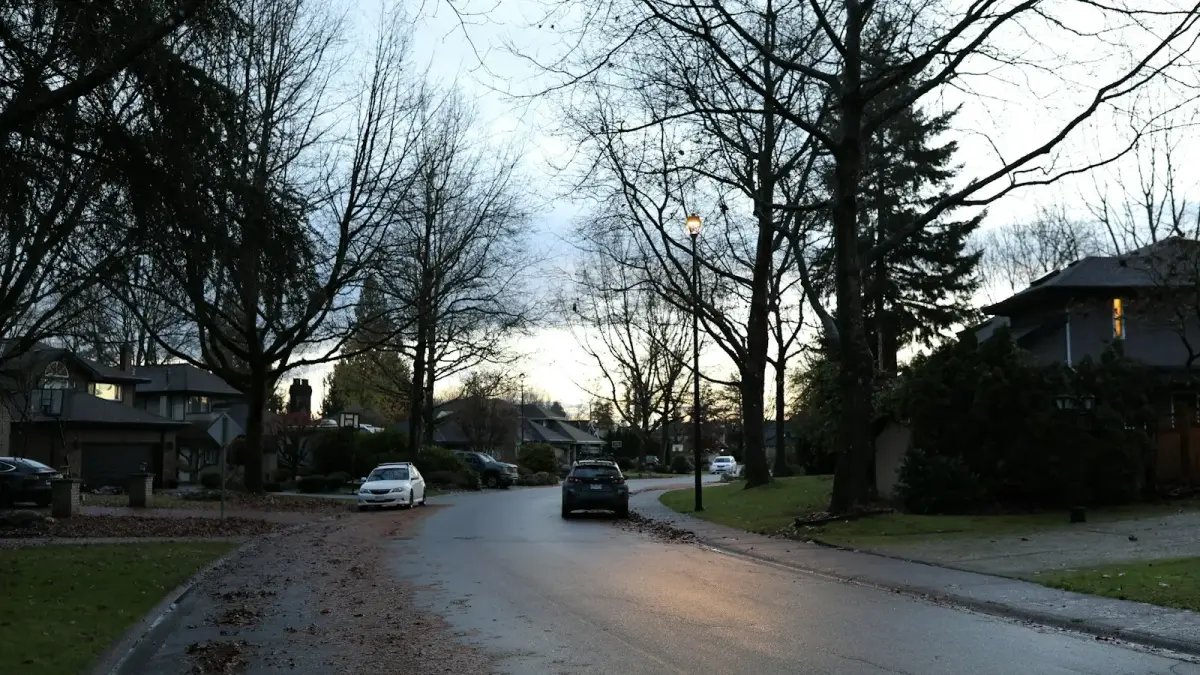
I was six the first time I learned to read a driveway.
Not the pavement itself. The sound. The particular crunch of tires on gravel that meant my father was home, and the way that sound moved through the house like a weather front. My mother’s hands would stop mid-motion over whatever she was doing. My older brother would turn the television down - not off, just down, just enough. The dog would stand up from wherever she had been sleeping and walk to the back of the hallway, which I later realized was as far from the front door as she could get without leaving the house.
Nobody said a word. Nobody had to. The whole organism of the family just shifted, the way a school of fish changes direction all at once - not because any single fish decided to turn, but because the current changed and every body in it felt the change at the same level of bone.
I learned to hear that car three houses away. I learned to distinguish my father’s engine from the neighbor’s. I learned that the speed at which a car pulled in told you something about the evening you were about to have - slow meant tired, fast meant something had already gone wrong before he walked through the door.
I am forty-seven years old. My father has been dead for eleven years. And last Tuesday, when my husband came home from work and I heard his key in the lock, my shoulders climbed up to my ears before I could stop them.
The child who became a seismograph
You were not born anxious. You were built into a detection system.
In homes where a parent’s arrival changed the emotional weather, children learn to do something extraordinary. They learn to read the vibration before the earthquake. The sound of an engine. The weight of a footstep. The specific way a door closes - pulled shut gently versus pushed shut with the flat of a hand. These are not things a child should need to catalog. But you cataloged them anyway, because the information was survival-grade.
A 2014 study published in Current Biology by researchers at the University of Wisconsin-Madison found that children raised in volatile home environments developed heightened auditory threat detection - their brains processed ambiguous sounds faster and with greater amygdala activation than children from stable homes. The researchers described it as a form of neural adaptation. The brain, faced with an unpredictable environment, did what brains do. It got better at predicting.
You did not develop an anxiety disorder. You developed a skill. A terrible, necessary, exhausting skill that kept you safe in a house where safety depended on knowing what was coming before it arrived.
The problem is that the skill never expires. Your nervous system does not have a settings menu. There is no toggle that says: “You moved out twenty-five years ago, you can stop listening for the driveway now.” The software keeps running because no one ever told it the threat was gone. And in some quiet, unexamined part of your body, it is still 1987 and you are sitting on the living room floor with one ear tuned to the garage.
What your body does before you know it is doing it
You are at a dinner party. The conversation is easy. You are laughing. Then someone enters the room behind you and your entire posture changes in less than a second.
Your shoulders tighten. Your breathing gets shallow. Your hands, which were resting open on the table, close or move to your lap. You might turn your head slightly - not all the way, just enough to catch the shape of whoever just walked in. And then you run a scan so fast and so automatic that you do not even register it as a conscious thought: Who is it? What is their energy? Is this room still safe?
All of that happens before you identify the person. Before you know whether it is a friend or a stranger. Before your thinking brain has any involvement at all.
Dr. Stephen Porges, whose polyvagal theory has reshaped our understanding of the autonomic nervous system, calls this process neuroception - the body’s ability to evaluate safety or danger without conscious awareness. In people who grew up tracking arrivals, neuroception is finely calibrated to one specific trigger: the sound or sensation of someone approaching.
Your partner walks into the kitchen while you are cooking and you flinch. Your coworker comes up behind your desk and your whole back goes rigid. Someone enters the room at a pace that is slightly faster than normal and something inside you braces for impact.
You have been doing this for so long that you think it is just how you are. You call yourself jumpy. Tightly wound. A little high-strung. You do not connect it to a six-year-old sitting cross-legged on a bedroom floor, listening for the sound of a car.
The specific sounds that never stop meaning something
Here is what nobody tells you about auditory hypervigilance: it is not general. It is precise.
You do not startle at every sound. You startle at certain sounds. The ones that mapped onto your childhood alarm system. A car door shutting. Footsteps on stairs. The particular cadence of someone walking heavily versus lightly. The jingle of keys. A door handle turning. The creak of a specific floorboard that sits between the hallway and the room you are in.
You might not flinch at a fire truck siren or a thunderclap. Those are loud but they are not relevant to the detection grid your childhood installed. What gets you is the quiet stuff. The sounds that carry information about whether someone is coming, how fast, and in what mood.
A 2017 paper in Psychological Science demonstrated that adults with childhood adversity showed selective auditory enhancement - their brains did not process all sounds with heightened sensitivity, but showed significantly increased neural response to sounds associated with human approach and interpersonal threat. The researchers noted that this selectivity was remarkably stable over time, persisting even in adults who had lived in safe environments for decades.
Your body remembers what your mind has moved past. It keeps a library of sounds filed under “warning” that your conscious self has not opened in years. But the library is not closed. It is just running in the background, cross-referencing every footstep against the archive.
The exhaustion of a room that never feels finished
Living like this is tiring in a way that is almost impossible to explain to someone who did not grow up this way.
You walk into a restaurant and you choose the seat facing the door. You do not think about why. You sit in a meeting and you track every person who enters or leaves. You are at your child’s school play and you hear someone in the row behind you shift in their seat and a part of you catalogs it, files it, runs it through the old system before discarding it.
This is not paranoia. You are not scanning for assassins. You are scanning for mood. For temperature change. For the almost imperceptible shift that happens when someone enters a room carrying something heavy that they have not yet put down - frustration, resentment, a bad day they are about to make everyone else hold.
You learned to read that weight before you could read chapter books. You learned that the first thirty seconds after someone walks through a door tells you everything you need to know about the next three hours. And your body still believes that reading is mandatory. That if you stop paying attention, you will miss the signal. And if you miss the signal, you will not have time to adjust, to accommodate, to become whatever version of yourself makes the room survivable.
The exhaustion is not from the scanning itself. It is from the fact that the scanning never produces a final answer. No room ever stays assessed. Every entrance resets the equation. You can never just be somewhere. You are always monitoring somewhere.
You are not broken - you are still running the old program
I want to tell you something that might change the way you think about this pattern.
You were not damaged by your childhood. You were shaped by it. And the shape you took was intelligent. A child in an unpredictable home who learns to track arrivals, read moods from the sound of a footstep, and adjust their entire body before a door opens is not a child with a disorder. That is a child who figured out the physics of their environment and built a response system that worked.
The problem is not the system. The problem is that the system is still deployed in rooms where it is not needed. You are running military-grade surveillance in a kitchen where the most dangerous thing that might happen is your spouse asking what you want for dinner.
And here is what makes it harder: the system does not feel like a system. It feels like you. It feels like personality. You have been the person who notices everything, who reads every room, who knows what someone is feeling before they say it, for so long that you cannot imagine yourself without it. Taking it away would feel like removing a sense.
But it is not a sense. It is a strategy. One that a very young, very alert child invented in a house where the sound of a car in the driveway changed everything. And strategies, unlike senses, can be updated. They can be softened. They can be told, gently and repeatedly, that the driveway they are listening for belongs to a house you have not lived in for a very long time.
You may never stop hearing the footsteps. But you can learn, slowly, to let the door open without bracing for what comes through it. Not because you have forgotten what it used to mean. But because you have finally started to believe that this house - the one you built, the one you chose, the one where the car in the driveway belongs to someone who is safe - runs on a different weather system entirely.
And the six-year-old who taught herself to read the atmosphere deserves to know that the forecast has changed.