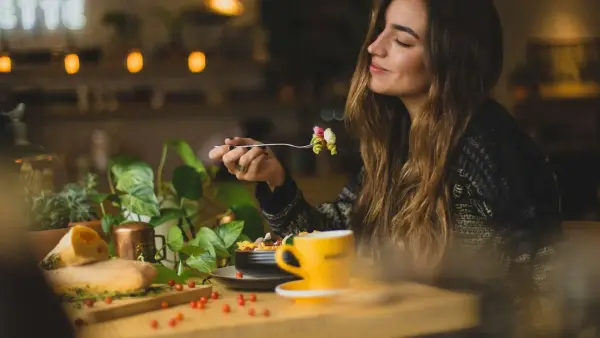
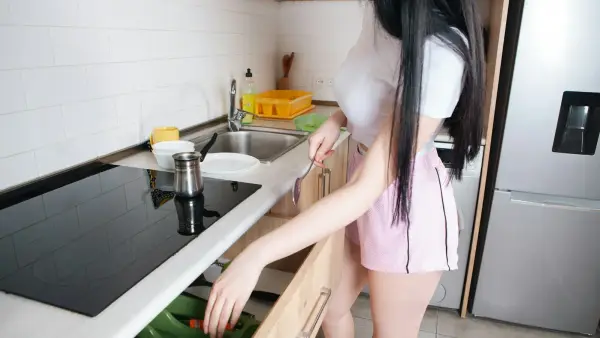
Children who grew up watching their mother serve everyone else's plate first and eat whatever was left standing at the kitchen counter often become adults who still cannot order what they actually want at a restaurant, because a girl learned at a crowded kitchen table that her appetite was the first thing that should be made smaller when there was not quite enough
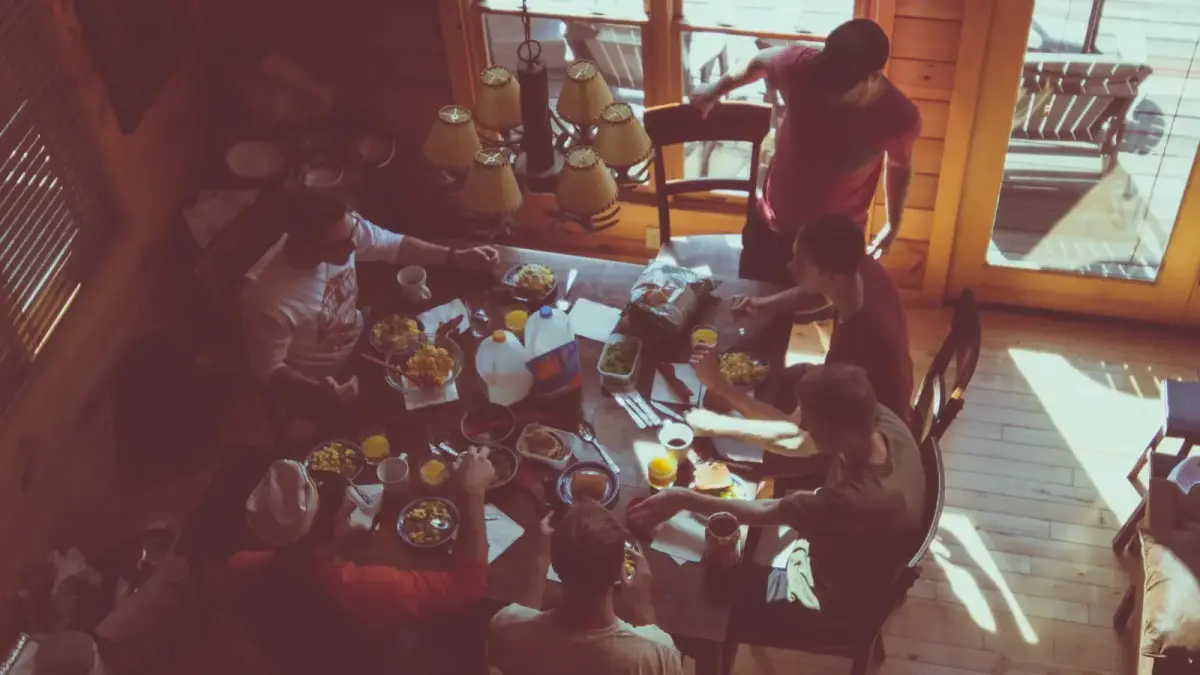
My mother never sat down during dinner.
I didn’t realize this until I was thirty-six, hosting Thanksgiving in my own apartment, and my husband found me standing at the kitchen counter eating turkey off the cutting board while twelve people sat at the table I’d spent two days preparing. He said my name like a question. I looked down at the plate in my hand - not a real plate, a paper one, the kind you give children at a picnic - and understood that I had done something I’d been watching someone else do my entire life.
She served my father first. Then my brothers. Then me and my sister. Then she’d stand at the counter with whatever was left, eating quickly, almost furtively, as though she was getting away with something by feeding herself at all. She never complained about this. She never named it. It was just the physics of our kitchen - food moved outward from her hands to everyone else’s mouths, and by the time it circled back, there was a heel of bread and the smallest piece of chicken and whatever nobody else had wanted.
I thought this was just what mothers did. I thought it was love. It was love. But it was also an arithmetic lesson I absorbed before I could do long division, and the equation was simple: when there is not quite enough, you are the variable that adjusts.
The counter where she stood was not a table
There is a specific posture that belongs to a woman eating what’s left. She doesn’t sit. She stands, usually near the sink or the stove, her body oriented toward the room rather than toward her own meal. She eats quickly. She eats standing up. And she watches - not the food on her plate, but the people at the table, checking whether anyone needs more, whether the bread basket has gone around, whether her husband’s glass is empty.
This is not relaxation. This is surveillance dressed as hospitality.
I watched my mother do this thousands of times. Not once did I see her sit down and eat a full plate of food she had chosen for herself, served at the temperature it was meant to be eaten, without interruption. Her meals were composed of remainders - the burnt edge, the broken piece, the serving that was slightly too small for anyone else but just right for someone who had already decided she didn’t need much.
A 2019 study published in the journal Appetite examined what researchers called “maternal food deference” - the pattern in which mothers in resource-limited households systematically prioritize their children’s and partner’s nutritional intake over their own. The study found that this behavior was rarely consciously decided. Mothers described it as automatic, instinctive, obvious. But their daughters - the ones who watched - described it differently. They called it a lesson.
And what they learned was not about food.
The right side of the menu
You can identify us in restaurants. We are the ones who open the menu and look right first.
Not at the descriptions. Not at the appetizers or the specials or the chef’s recommendations. We look at the prices. We scan the column of numbers on the right-hand side, and we do the math before we do the wanting. We find the ceiling - the price above which ordering feels reckless - and then we read the descriptions of everything below it.
This happens even when we can afford anything on the menu. Even when someone else is paying. Even when the person across the table says order whatever you want and means it genuinely and we know they mean it genuinely and it still doesn’t matter, because the reflex is older than the relationship.
I have a good career. I make more money than my mother ever did. And last Tuesday I sat at a restaurant with colleagues and ordered the chicken instead of the salmon because the salmon was six dollars more, and I felt a small pulse of virtue about this - as though choosing the cheaper option was evidence of my character rather than evidence of something unresolved living in my chest.
The wanting is there. It’s always there. I wanted the salmon. But wanting and ordering are two different actions, and between them sits a girl at a kitchen table in 1991, watching her mother calculate portions with her eyes, and understanding - in the way children understand things, without words, just body knowledge - that the wanting is the part that should be made smaller.
Frugality is a compliment that hides an inheritance
People praise this quality. They call it responsible. They call it modest, practical, down-to-earth. Your friends say you’re so good with money. Your partner says you never ask for anything for yourself like it’s a beautiful trait rather than a scar shaped like a budget.
And you accept the compliment, because it is easier than saying what is actually true, which is: I cannot spend money on myself without hearing my mother’s math.
Not her voice. Her math. The silent calculation that ran behind every meal she cooked - how much per person, who needs more, who can have less, where the line is between enough and not quite. That math didn’t live in a spreadsheet. It lived in her hands, in the way she portioned rice, in the way she cut the casserole into pieces that were almost equal but not quite, because the almost was where she lived.
A 2017 study published in the Journal of Research in Personality found that adults who grew up in households with limited resources showed persistent patterns of what the researchers termed “resource hypervigilance” - an automatic and ongoing tracking of costs, portions, and availability that continued long after the scarcity had ended. Participants reported being unable to stop the counting. The study described it as a cognitive pattern that had become fused with identity - not a habit they performed but a lens through which they experienced the world.
Your mother’s math became your math. Her scarcity became your operating system. And the most insidious part is that everyone around you thinks it’s a personality trait. They think you’re careful. They don’t understand that careful is just what survival looks like after the emergency is over.
Serving everyone first looks like hospitality
You do it at your own dinner parties. You serve everyone else before you sit down. You refill glasses. You check the oven. You ask if anyone needs anything three separate times before your own food gets cold enough that eating it becomes an act of indifference to yourself.
And if someone tries to serve you first, you feel it in your body - a wrongness, like standing on the wrong side of a mirror. The food doesn’t taste right when you haven’t earned it by making sure everyone else is fed. The chair doesn’t feel like yours until you’ve exhausted every possible reason to remain standing.
This gets described as being a good host. As being generous. As being thoughtful and selfless and all those words that sound like praise but function as a cage, because what they really mean is: you cannot receive before you have given everything, and you have absorbed so deeply the idea that your hunger comes last that sitting down first feels like a kind of theft.
I watched my mother build this cage, plank by plank, meal after meal, across two decades of dinners. And I stepped into it without ever being asked, because daughters don’t need to be told how to disappear. They just need to watch someone they love do it long enough.
The last portion belongs to no one and everyone
There is a specific paralysis that lives in the body of a person who grew up watching food get carefully divided. It activates around the last portion of anything - the final slice of pizza, the remaining piece of cake, the last scoop of whatever is in the bowl.
You cannot take it.
Not because you don’t want it. You want it. But wanting the last portion means admitting that your appetite is large enough to claim something that might belong to someone else, and your entire childhood was a lesson in making your appetite smaller so other people’s could be full-sized.
So you wait. You say I’m fine, you have it. You perform a casualness about the remaining food that is the opposite of how you actually feel, which is: desperate for someone to notice that you haven’t eaten enough and offer it to you, because taking it for yourself would break a rule you can’t even articulate.
A 2021 study published in Frontiers in Psychology examined the intergenerational transmission of resource anxiety and found that children who witnessed parental self-sacrifice around food developed what the researchers called “appetitive guilt” - a persistent association between their own hunger and the deprivation of others. Even in abundance, these adults reported feeling that satisfying their own appetite came at someone else’s cost. The neural pattern mirrored early attachment responses, suggesting the association was encoded at the same depth as the bond to the caregiver.
The last portion sits on the table and you orbit it like a planet that cannot land. Not because you learned not to eat. Because you learned that your eating has a cost, and the cost is someone else’s fullness, and you would rather go home slightly hungry than make anyone else slightly less fed.
The girl at the kitchen table is still doing math
Here is what I want to say to the woman who still checks the price before she checks her appetite, who serves everyone before she sits, who cannot eat the last bite of anything without a flutter of guilt behind her sternum.
You learned this honestly. You learned it from watching someone you loved reduce herself, meal after meal, day after day, in a kitchen that smelled like garlic and onions and the particular warmth of a mother who was always near the stove and never in the chair. You learned that love looks like going last. That a good woman’s plate is composed of whatever remains.
And the learning went so deep that it stopped being a behavior and became a body. Your body. The one that stiffens when someone offers you the bigger piece. The one that says I’m not that hungry when you are. The one that clears plates before dessert because standing up feels safer than sitting still and being fed.
Your mother was doing the best math she knew. She was solving for everyone else’s fullness with the only variable she was willing to sacrifice, which was herself. And you, sitting at that table, watching her stand at the counter with the smallest portion and the most tired smile - you solved the same equation the only way a child knows how. You made yourself the variable too.
You are allowed to order the salmon. You are allowed to sit down first. You are allowed to eat slowly, at the table, from a plate you filled with the things you actually wanted, without checking whether everyone else has enough before you take your first bite.
Your appetite is not the thing that needs to be smaller. It never was. That was just the math of a kitchen where love and scarcity shared the same cupboard, and a mother who couldn’t feed everyone fully decided that the person who should go without was the one doing the cooking.
You can put down her equation now. You can sit in the chair. The table is big enough, and there is - finally, improbably, after all these years - enough.