Children who learned to walk through the house without making a sound - who knew which stair creaked third from the top, which section of hallway made the floorboards groan, who could open and close any door with a turn of the wrist so slow that the latch never once clicked - often become adults who move through every room they enter with a quietness that strangers call grace, because a girl who learned before the age of eight that the sound of her footsteps could wake something she was not prepared to face has spent her entire life making sure her body never announces its arrival before she has had time to determine whether the room is safe
I still walk on the balls of my feet.
I am forty-three years old. I own my own home. Nobody in it is going to hurt me, and nobody in it is waiting for a reason. But when I get up for water at two in the morning, my body does what it has always done. It distributes my weight across the outside edges of my feet. It avoids the board near the bathroom threshold that shifts under pressure. It finds the quiet path without consulting me, the way your lungs find air without you telling them to breathe.
I did not learn this from a dance teacher. I learned it from a house where sound had consequences.
If you know what I mean - if you read that and your chest tightened just slightly - then you already know the rest of what I am about to say. You know the specific geography of noise in a house that was not always safe. You know what it feels like to have your body memorize danger before your mind had a name for it.
And you probably know that other people call the way you move graceful. They have no idea what they are actually looking at.
The Map You Drew Before You Could Read
Every child who grew up in a volatile home carries a map.
Not a visual map. Not something drawn on paper or remembered in images. It is a map stored in the muscles and the bones and the bottoms of the feet. It is a map of sound.
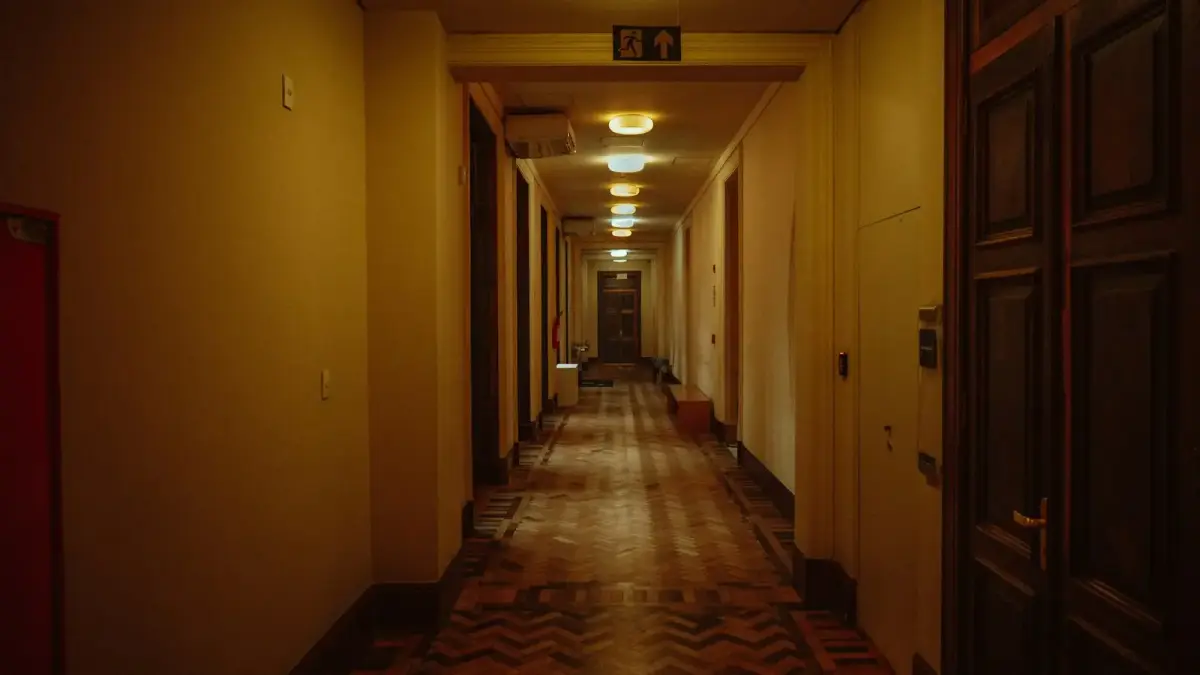
You knew the third stair from the top would creak if you stepped in the center but stay quiet if you pressed your weight against the left edge near the wall. You knew the hallway runner muffled your footsteps but the kitchen tile did not. You knew the bathroom door would click unless you turned the handle all the way before pulling, holding the latch in place with your thumb while you eased the door open one inch at a time.
This was not casual knowledge. This was survival cartography - a floor plan measured not in square feet but in decibels. Every surface was classified: safe or dangerous, silent or announcing. And you tested them the way a soldier tests a minefield. Carefully. Repeatedly. With everything at stake.
A 2005 study published in Development and Psychopathology found that children raised in unpredictable or threatening home environments develop heightened sensory processing - particularly for auditory cues - at rates significantly higher than their peers. The researchers described it as a kind of perceptual recalibration. The brain, under stress, turns up the volume on everything. You hear more because hearing more kept you alive.
But what the research does not always capture is how specific this learning becomes. You did not just become alert to noise in general. You became the world’s foremost expert on the acoustics of your own house. You could have drawn a sound map of every room with your eyes closed. You still could.
A Body That Learned Before the Mind Did
Here is what makes this different from an ordinary memory.
You did not decide to walk quietly. Your body decided for you. The knowledge lives below conscious thought, in what neuroscientists call procedural memory - the same system that stores how to ride a bicycle or tie your shoes. It is not something you recall. It is something you do automatically, without choosing, without even noticing.
Dr. Bessel van der Kolk’s research on trauma and the body has shown that traumatic experiences are stored not only in the brain’s narrative centers but in the body itself - in posture, in movement patterns, in the way muscles hold tension decades after the original threat has passed. The body, he writes, keeps the score. And for children who learned to move in silence, the score is written in the way their feet meet the floor.
This is why you cannot simply decide to stop. You cannot logic your way out of a movement pattern that was encoded before you had language for what was happening. Your seven-year-old self did not think, “I should walk more quietly to avoid triggering an outburst.” Your seven-year-old self simply noticed that quiet feet meant a quiet night, and her body filed that information in the same place it filed how to swallow and how to blink.
By the time you were old enough to understand what you were doing, the pattern was already infrastructure. It was not a habit. It was architecture.
What They Call Grace
The adult version is almost invisible.
You move through offices without anyone hearing you approach. You appear in doorways and people startle - not because you were sneaking, but because your body never learned how to arrive loudly. You close cabinets with both hands. You set glasses down instead of placing them. You lower yourself into chairs rather than sitting.
Colleagues have called you graceful. Partners have said you move like a cat. Friends have joked about how you materialize out of nowhere, as if you were not walking down the same hallway they were.
What they are seeing is not elegance. It is a body that was trained, before conscious memory, to treat every footstep as a potential trigger.
And the thing is, it does look graceful. That is the strange cruelty of it. The hypervigilance presents as poise. The fear presents as refinement. Nobody looks at a woman who moves that quietly and thinks, “she learned that because sound was dangerous.” They think she is simply careful. Composed. Gentle in the way she handles the physical world.
You might even think that yourself. You might not have connected the way you move to the house you grew up in. You might have assumed it was personality - that you were just a quiet person, a careful person, someone who naturally takes up less space.
But there is a difference between choosing to be quiet and having been trained to be silent.
The Floor Plan That Follows You
You have lived in your current home for years. Maybe a decade. Maybe longer.
And you still know which floorboard near the bedroom door makes noise. You still step around it without thinking. You still turn handles slowly. You still distribute your weight when walking down the hallway at night, even though the only person you might wake is someone who loves you and would not mind.
This is not a quirk. This is your body still navigating the floor plan of a house you left twenty or thirty years ago.
A 2017 study in Psychological Science found that individuals with histories of childhood adversity showed persistent alterations in sensorimotor processing well into adulthood - even when they reported feeling safe in their current environments. The body’s alarm system, once calibrated to threat, does not automatically recalibrate when the threat is removed. It stays on. It stays listening.
So you walk through your safe house the way you walked through your unsafe one. You monitor the acoustics of every room you enter. You know, within the first few seconds, which surfaces will carry sound and which will absorb it. You adjust without thinking. You have been adjusting for so long that you do not remember a time when your body was not doing this math.
And when someone says, “You’re so quiet - I didn’t even hear you come in,” you smile. Because what else would you do? The truth is not something you say at dinner parties. The truth is that your body has been rehearsing that entrance since you were six.
What Your Quietness Actually Holds
I want to say something to you, if this is your story.
Your quietness is not weakness. It is not timidity. It is not a lack of presence or a failure to take up space. What you carry in the way you move is one of the most sophisticated forms of spatial intelligence a human body can develop.
You read rooms through your feet. You process acoustic environments in real time, without conscious effort, with a precision that most people will never need and could never replicate. You know what surfaces announce you and which ones keep your secret. You navigate physical space with a tenderness that is breathtaking when you understand where it comes from.
That is not a disorder. That is a girl who understood, long before she should have had to understand anything, that her safety depended on her silence. And she built an entire system of movement - elegant, efficient, invisible - to keep herself safe.
The fact that it still runs is not a sign that something is wrong with you. It is a sign that the system worked. It did exactly what it was designed to do. It kept you alive in a house where being heard was a risk you could not afford to take.
What you can do now - gently, slowly, on your own timeline - is let your body know that the house has changed. Not through logic. Not through telling yourself to stop. But through the small, patient work of letting your feet land a little heavier. Of closing a door without holding the latch. Of walking down a hallway without mapping its acoustics first.
Not because the silence was shameful. But because you deserve to hear the sound of your own footsteps in a house where no one is listening for them.
You learned to move through the world without disturbing it. That was never grace. That was love - the fierce, desperate, bodily love of a child who would do anything, even disappear into her own silence, to keep the peace.
You do not have to disappear anymore.
The floor is yours. Walk on it however you want. And if you still find yourself stepping around the creaky board near the bedroom door - in a house you have lived in for fifteen years, in a life that is finally your own - be tender with yourself about that.
Your body is still protecting you. It just has not gotten the memo that you are safe now. It will. Give it time. You have already done the hardest part, which was surviving the house that taught you to be this quiet in the first place.