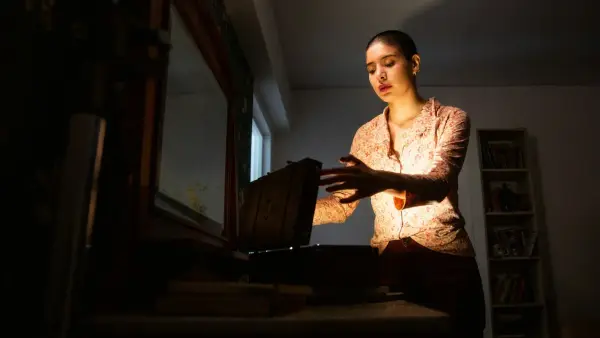
Children who were praised every time they didn't cry - who heard 'you're so brave' when they swallowed their tears and 'that's my tough girl' when they stitched their face into something steady - often become adults who feel nothing at funerals and weddings but sob alone at two in the morning watching a commercial about a dog finding its way home, because their body learned to delay grief until it found a container small enough that nobody would be inconvenienced by it

I sat through my grandmother’s funeral without shedding a single tear.
I gave the eulogy. My voice didn’t crack. Afterward, people squeezed my arm and told me how strong I was, how well I was holding it together, and I nodded and said thank you and drove home and made dinner and watched television and went to bed. Three weeks later, I was sitting on the kitchen floor at midnight watching a video of a golden retriever being reunited with its owner at an airport, and I cried so hard I couldn’t breathe.
My husband found me there. He looked confused. “Are you okay?” And I couldn’t explain it - couldn’t say that this wasn’t about the dog, that it was about my grandmother, that my body had been holding something for weeks and had only just now found a crack small enough to let it through.
That was the night I started wondering why I’d always been like this. Why I could stand steady through the moments that should break you open but come undone over something so small that admitting it out loud felt embarrassing.
The answer, I eventually realized, went all the way back to childhood. Back to a phrase I heard so often it became the wallpaper of my emotional life: “You’re so brave.”
1. You were rewarded for dry eyes, and the lesson stuck deeper than anyone intended
It usually started with something small. A scraped knee. A lost toy. The first day of school when all the other kids were crying and you weren’t. Your parent crouched down, beaming, and said, “Look at you. Not even a tear. That’s my tough girl.”
And something clicked. Not consciously - you were four, or six, or eight. But your nervous system filed it away: dry eyes equal love. Wet eyes equal disappointment.
A 2017 study published in the Journal of Personality and Social Psychology found that children who received consistent positive reinforcement for emotional restraint developed what researchers called “contingent emotional regulation” - meaning they didn’t stop feeling. They stopped showing. The feelings went underground, rerouted to a place where they wouldn’t cost the child anything.
Your parents probably weren’t trying to do harm. They were probably proud. Maybe even relieved. But what you absorbed wasn’t “it’s good to be resilient.” What you absorbed was “my tears make people uncomfortable, and my composure makes them love me.”
That’s a devastating trade for a child to internalize.
2. You feel nothing at the moments when everyone else is weeping
The funeral. The hospital room. The goodbye at the airport. The wedding where your daughter is walking down the aisle and everyone around you is dabbing their eyes and you’re standing there feeling - what? Nothing. Or something muffled. Like the emotion is happening behind a thick pane of glass and you can see it but you can’t quite touch it.
You’ve worried about this. You’ve wondered if something is wrong with you. If you’re cold, or broken, or incapable of feeling the things that obviously matter.
You’re none of those things.
What’s happening is that your body recognizes these as high-stakes emotional moments - moments where people are watching, where your reaction will be witnessed and interpreted. And your nervous system, trained decades ago, does exactly what it was trained to do. It locks down. It keeps you steady. It performs composure because that’s what earned love when you were small.
Neuroscientist Dr. Jaak Panksepp’s research on affective neuroscience demonstrates that suppressed emotional responses don’t disappear. They get stored in the body as unprocessed arousal. The emotion is there. Your system simply won’t release it when the audience is too large or the stakes are too visible.
3. You cry at commercials, songs, and sunsets - and then feel ridiculous about it
Here’s where it gets confusing. Because you absolutely do cry. Just never when it makes sense.
A commercial about a father teaching his daughter to ride a bike. A song from the 1990s that you haven’t heard in twenty years. A sunset that catches you off guard while you’re driving home from the grocery store. And suddenly your throat tightens and your eyes burn and you’re crying, really crying, in a way that feels completely disproportionate to the trigger.
It’s not disproportionate. It’s displaced.
Your body has been holding grief, tenderness, loss, longing - all the feelings it couldn’t release at the appropriate time. And it waits. It waits for a container small enough that nobody will be alarmed. A commercial is perfect. A song is perfect. A sunset doesn’t ask you to explain yourself.
This is what I call the small-container phenomenon. Your nervous system learned that big feelings in big moments drew attention. So it reroutes those feelings to small moments - moments where the trigger is so minor that if someone catches you, you can wave it off. “Sorry, I don’t know what that was about.” And everyone moves on. And no one is inconvenienced by your grief.
4. You apologize before your tears even arrive
If you do start to cry in front of someone - and it happens sometimes, despite your best efforts - the first words out of your mouth aren’t about what you’re feeling. They’re an apology.
“I’m sorry, I don’t know why I’m crying.” “Sorry, this is so stupid.” “I’m fine, I’m fine, ignore me.”
You’re not apologizing because you think crying is wrong in some abstract sense. You’re apologizing because your body remembers, viscerally, that your tears were an imposition. That when you cried as a child, the praise stopped. The warmth shifted. Someone’s face changed from proud to uncomfortable, and you felt, in that moment, like you’d failed.
A 2020 study in Frontiers in Psychology on emotional display rules found that adults who were consistently praised for stoicism in childhood were three times more likely to experience what the researchers termed “preemptive shame” around crying - shame that arrives before the tears do, sometimes preventing them entirely.
You learned to apologize for crying the way other people apologize for stepping on someone’s foot. Reflexively. Without thinking. Because somewhere in your wiring, tears feel like something you’re doing to someone else.
5. You describe yourself as “not a crier” and genuinely believe it
It has become part of your identity. You tell people at work, at dinner, at the movies: “I’m just not a crier.” You say it matter-of-factly, maybe even with a small shrug, like it’s a personality trait on the same level as being left-handed or preferring tea over coffee.
But “not a crier” isn’t who you are. It’s who you were shaped into.
Children who were praised for emotional composure don’t grow up to lack emotion. They grow up to lack permission. The feelings are fully operational. The release valve was welded shut by years of reinforcement that said: the people who love you prefer you dry-eyed.
Researcher and author Brene Brown has written extensively about how emotional numbness isn’t the absence of feeling but the presence of an extremely effective defense mechanism. You can’t selectively numb, she argues. When you shut down grief, you also muffle joy, tenderness, awe. The system doesn’t know the difference. It just knows the rule: keep the surface still.
So you move through life believing you’re simply not emotional. And then you’re blindsided at 2 a.m. by a thirty-second commercial and you realize the feelings were always there. They were just waiting for a door that didn’t have anyone standing on the other side of it.
6. You have a complicated relationship with the word “brave”
People still use it about you. Your friends. Your partner. Your boss. “You’re so strong.” “I admire how you handle things.” And every time, you feel a flicker of something that isn’t quite pride and isn’t quite nausea but sits somewhere between.
Because you know the truth. You know that what looks like bravery is actually obedience. Your body learned a script forty years ago and it’s still performing it. Not because you chose composure, but because the alternative was never presented as an option.
Real bravery, you suspect, might look more like the person at the funeral who is sobbing openly, who doesn’t care what anyone thinks, who lets grief have its full, messy, inconvenient expression. That person terrifies you. And also, secretly, you envy them.
Gabor Mate writes about the connection between emotional suppression and the body’s stress response. When feelings are consistently rerouted rather than expressed, the body bears the cost - through tension, through fatigue, through the vague sense that something is always slightly wrong but you can’t name what. The bravery you were praised for as a child isn’t free. Your body has been paying the bill quietly for decades.
7. Your grief arrives late, disguised, and always when you’re alone
This might be the most telling pattern of all. You don’t process loss in real time. You process it weeks, months, sometimes years later - in a car, in a shower, in bed at night, in any setting where you are entirely alone and entirely unobserved.
Your grief shows up late because it was taught to wait in line. It was taught that other people’s comfort matters more than your release. It was taught that the appropriate amount of crying is zero, and anything above that is a burden you’re placing on the room.
A 2022 study published in Psychological Science on delayed emotional processing found that individuals with high childhood praise for stoicism showed significantly longer latency periods between emotional events and their subjective emotional responses. In plain language: the feelings come. They just come late. Because the body has to verify, first, that the coast is clear.
And so your grief arrives in disguise. It arrives as a lump in your throat during a phone commercial. As tears during a nature documentary about elephant mothers. As a strange heaviness on a Tuesday afternoon that you can’t trace to any source. It arrives in small containers because your body never learned that it was allowed a big one.
I want to say something to you, if you recognized yourself in any of this.
You are not cold. You are not broken. You are not a person who doesn’t feel enough. You are a person who was taught, very young, that feeling too visibly would cost you something essential - a parent’s pride, a family’s stability, the quiet assurance that you were the good one, the easy one, the brave one.
Your body did something remarkable. It built an entire system for managing grief in a way that kept everyone around you comfortable. That’s not a flaw. That’s an adaptation. A survival strategy designed by a child who was doing the very best they could with the information they had.
But you’re not that child anymore. And the people in your life now - the ones worth keeping - don’t need you to perform composure. They don’t need you dry-eyed and steady. They need you real.
The next time you feel tears rising and your first instinct is to swallow them, to apologize, to reroute them to some quieter moment when no one is watching - I hope you’ll pause. I hope you’ll let yourself consider, even for a second, that the bravest thing you’ve ever done might not be holding it together.
It might be letting someone see you fall apart.