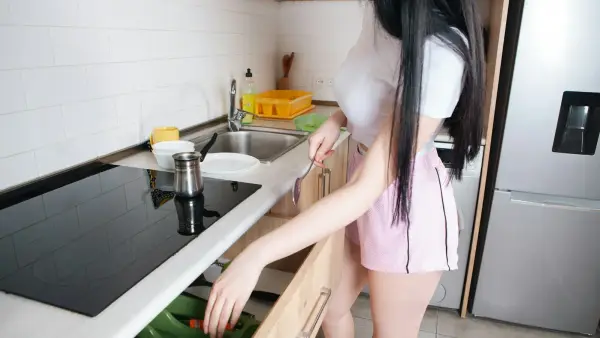
Children who watched their mothers save every container - the margarine tubs rinsed and stacked, the glass jars lined up under the sink, the plastic bags folded into triangles inside another plastic bag - often become adults who cannot throw away anything that still has one more use in it, not because they are hoarders or cannot afford new things but because a child raised by someone who survived scarcity learned that waste was the language of people who had never been afraid
I was standing at my kitchen sink last Tuesday, rinsing out a pasta sauce jar, when my husband walked past and said, “We have a hundred of those.”
He wasn’t wrong. Under my sink, there are fourteen glass jars of various sizes, nested together like a family that refuses to spread out. In the cabinet above the stove, a stack of margarine tubs I haven’t bought margarine for in years. In the drawer next to the fridge, a collection of twist ties so dense it looks like a small metal nest.
I stood there holding that jar under warm water, scrubbing the label off with my thumbnail, and I could not put it in the recycling bin. Not because I had a plan for it. Not because I’m frugal in any organized way. But because somewhere deep in the architecture of who I am, a voice that sounds exactly like my mother’s said: you don’t throw away something that still works.
That voice is not about jars. It never was.
The cabinet that tells a story no one asked to hear
If you grew up in a household where your mother saved containers, you already know what I’m describing. You know the specific geography of it - the Cool Whip tubs that held leftover rice for years after the Cool Whip was gone. The bread bags, shaken out and folded, reused for school lunches until the printed lettering wore away. The aluminum foil, carefully peeled off a baking sheet, wiped clean, folded into a neat square, and placed back in the drawer.
You know the rubber bands looped around the kitchen doorknob. The twist ties collected in a cup by the phone. The plastic grocery bags folded into tight triangles and stuffed inside another plastic bag that hung from a hook inside the pantry door.
None of this was organized in the way a lifestyle magazine means when it says organized. It was organized in the way a person who has been hungry organizes things - by potential. Every object was evaluated not for what it was but for what it could become.
A margarine tub was never a margarine tub. It was tomorrow’s lunch container, next week’s paint cup, a place to keep buttons, a vessel for bacon grease that would season a cast iron pan that would cook dinners for the next thirty years.
Your mother did not see trash. She saw time she had already paid for.
8 things you probably still do if your mother saved everything
1. You rinse containers before you can think about it
It is not a decision. It is a reflex that lives in your hands. The jar is empty, and before your conscious mind has even registered the moment, you are already running water inside it, already scrubbing with your fingertip, already setting it upside down on the drying rack next to the dishes.
Your partner may have asked you, more than once, why you’re washing trash. You don’t have a good answer because the honest one - because my mother’s hands did this ten thousand times and my hands learned by watching - sounds like something that belongs in a therapist’s office, not a Tuesday night kitchen conversation.
2. You keep plastic bags in a way that would confuse anyone who didn’t grow up like you
There is a bag of bags somewhere in your home. You know exactly where it is. It may be hanging from a cabinet knob, stuffed under the sink, or crammed into a dispenser someone gave you as a gift that you secretly think is unnecessary because the bag-inside-a-bag system worked fine for forty years.
A 2019 study published in the Journal of Consumer Psychology found that people who grew up in resource-scarce environments develop what researchers call “product retention tendency” - a measurable reluctance to discard items that retain even marginal utility. The researchers framed it as a bias. But bias assumes there is a correct answer, and the correct answer depends entirely on whether you have ever watched your mother count coins on a kitchen table.
3. You feel a physical discomfort when someone throws away a container in front of you
Your daughter tosses a perfectly good yogurt cup into the trash without rinsing it, without even glancing at it, and something tightens in your chest. You know it’s a yogurt cup. You know you don’t need it. You know your kitchen has enough containers to survive a modest apocalypse.
But the discomfort is not about the cup. It’s about what the cup represents - a casualty of ease. Your mother never had ease. Ease was for other families, the ones with matching Tupperware and trash bags that weren’t reused grocery sacks.
4. You save wrapping paper, ribbon, and gift bags with a reverence other people reserve for heirlooms
You open a gift and you fold the paper. You have always folded the paper. You roll the ribbon around your fingers and tuck it into a drawer that is already full of ribbon from Christmases your children don’t remember.
The gift bags get flattened, tissue paper smoothed and stacked. You have given the same gift bag to your sister three times. She has given it back to you twice. Neither of you has ever mentioned this.
5. You have a drawer or shelf that functions as a museum of potential
Rubber bands. Twist ties. The plastic clips from bread bags. Small pieces of string. A collection of pens from hotels, banks, and doctor’s offices. Birthday candles that have been used once and still have two-thirds of their length remaining.
None of these items have a purpose right now. But every single one of them could have a purpose, and in the economy your mother taught you, could is enough. Could is the entire point. You don’t save things because you need them. You save them because needing something and not having it is a feeling your body remembers even when your mind has moved on.
6. You buy new things and feel guilty about it in a way you can’t fully explain
You stand in the aisle at Target holding a set of glass storage containers - the kind with the snap lids, the kind that look clean and intentional on a shelf - and you feel a strange pull of betrayal. As if buying something new is a judgment against the woman who made Cool Whip tubs work for thirty years.
Research by psychologist Sendhil Mullainathan, co-author of Scarcity: Why Having Too Little Means So Much, demonstrates that growing up in resource-limited environments creates cognitive patterns that persist long after the scarcity itself has ended. The brain, shaped by years of careful allocation, continues to treat every resource as potentially the last one. Buying new containers when old ones still function feels, at a neurological level, like a kind of recklessness your body was trained to avoid.
7. You know the difference between frugal and poor, and it lives in your posture
Frugal is a choice. Frugal is a lifestyle blog with a woman in a clean kitchen talking about how she meal preps on Sundays. Frugal is something you opt into from a position of having enough.
What your mother did was not frugal. What your mother did was arithmetic - daily, invisible, exhausting arithmetic. She saved the margarine tub not because she valued simplicity but because the dollar she didn’t spend on Tupperware was the dollar that kept the lights on through Friday.
You carry this distinction in your body. In the way you hesitate before ordering at a restaurant. In the way you mentally calculate the cost per unit of everything you put in a cart. In the way abundance still feels, after all these years, like something that could be revoked.
8. You cannot hear someone call it hoarding without feeling something close to fury
This is the one that cuts deepest. Someone - a friend, a spouse, a well-meaning child - looks at your cabinet of saved containers and says the word hoarder, and something in you goes cold.
Because hoarding implies pathology. Hoarding implies irrationality. And there was nothing irrational about what your mother did. Every washed container, every folded bag, every ribbon saved from a birthday gift was a rational response to an irrational situation - the situation of being a woman raising children without enough.
A 2021 study in Frontiers in Psychology examined what researchers call “intergenerational transmission of economic behaviors” and found that the saving and conservation patterns of parents who experienced poverty were reliably reproduced in their adult children, even when those children had achieved financial stability. The behaviors persisted not because the children couldn’t afford to change but because the behaviors had become part of their identity - woven into their understanding of who they were and where they came from.
The container is never just a container
Here is what people who grew up with enough don’t understand: the saved container is not about the container.
The saved container is a conversation. It is a daughter saying, I remember what you did to keep us fed. It is a woman in her fifties standing at her sink, washing a jar she doesn’t need, and feeling - for a moment so brief it barely registers - connected to a mother who may no longer be alive but whose hands are still moving inside her own.
When you save the jar, you are not being stubborn. You are not being outdated. You are not failing to keep up with a culture that throws things away as fast as it buys them.
You are honoring an economy that was never about money. It was about love expressed through conservation. It was about a woman who looked at a margarine tub and saw not trash but possibility - one more lunch packed, one more leftover saved, one more day navigated without asking anyone for help.
What your hands already know
You don’t need me to tell you that it’s okay to keep the jars.
You already know that. You’ve known it every time you’ve felt that small, defiant refusal to throw something away that someone else would toss without a second thought. You’ve known it in the way your hands move without being told - rinsing, folding, stacking, saving.
What you might need to hear is that the guilt can soften. You are allowed to buy the new containers and keep the margarine tubs. You are allowed to live in abundance without betraying the woman who taught you to survive without it. These two things can exist in the same kitchen, on the same shelf, inside the same person.
Your mother saved everything because she had to. You save everything because she is still with you - in your hands, in your hesitation, in the way you look at an empty jar and see something worth keeping.
That is not clutter. That is not a disorder. That is a daughter who learned, before she had words for it, that love sometimes looks like a cabinet full of washed containers and a woman who made everything last because the alternative was a kind of fear she never wanted you to feel.
You felt it anyway. But you also learned the antidote - that nothing is worthless if someone cares enough to save it.
Including you.