She is 57 and has just understood why she cannot bring herself to throw away a single ketchup packet - not the ones from drive-throughs or the soy sauce from takeout or the sugar packets from diners she visited three states ago - because a girl who grew up in a kitchen where running out of something small was the thing that finally made her mother sit down at the table and stop pretending everything was fine learned that free meant safe, and the drawer at fifty-seven is not clutter but the last remaining archive of a child who swore she would never live in a house where there was not enough of anything, not even ketchup
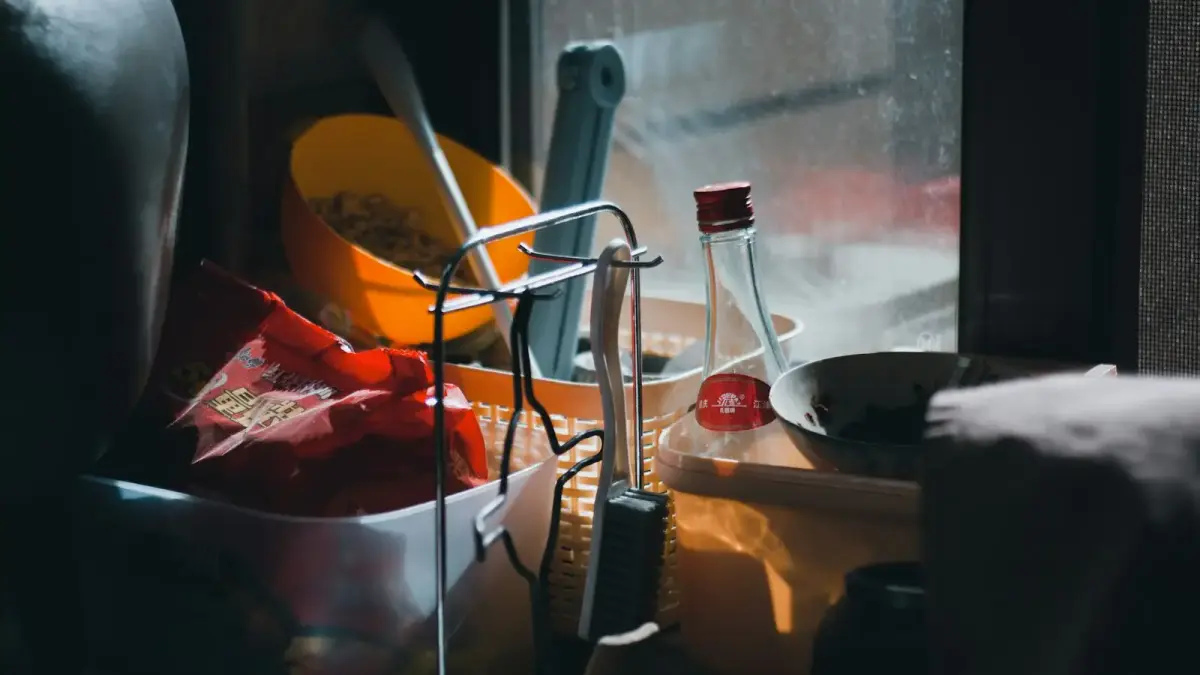
My husband opened the junk drawer last Sunday looking for a pen, and he stood there for a moment with this expression I have seen a hundred times but never once been able to explain.
“Julia,” he said, holding up a fistful of soy sauce packets. “Some of these expired in 2019.”
I know they did. I know exactly which ones. The soy sauce is from a Thai place we ordered from when we still lived in Virginia. The ketchup packets - there must be forty of them - are from drive-throughs in three different states. There are sugar packets from a diner in Asheville we visited the summer our daughter turned twelve. She is twenty-nine now.
I took the soy sauce from his hand and put it back in the drawer and closed it and changed the subject. And later that night, sitting alone at the kitchen table after he’d gone to bed, I opened the drawer again and looked at everything inside it and understood, for the first time, that I was not looking at condiments.
I was looking at proof.
The kitchen where small things held everything together
I grew up in a house where we did not run out of big things. We were not hungry. The lights stayed on. There was always something for dinner, even if something meant rice with butter three nights in a row or soup made from whatever was left in the vegetable drawer on Thursday.
But the small things - that was where everything lived.
The ketchup bottle that was empty. The salt shaker that needed filling but we’d used the last of the box. The sugar bowl that sat on the counter with a half-inch of crystite at the bottom because no one had bought a new bag. These were the things that undid my mother. Not the rent. Not the car that made sounds it shouldn’t. Not the fact that my father worked double shifts and still came home to a checkbook that didn’t balance.
It was the ketchup.
I remember the night she sat down. Not dramatically. Not crying. Just - sat. We were having hot dogs, which was a good dinner in our house, a dinner that meant things were okay. And my brother reached for the ketchup and turned the bottle upside down and squeezed and nothing came out. Just air and a thin red noise.
My mother looked at the empty bottle the way you look at a bill you cannot pay. And she pulled out a chair and sat down at the table and put her hands flat on the surface and was very, very still.
She didn’t say anything. She didn’t need to. The empty bottle had said it for her. We have come to the end of something again, and I do not have another one behind it.
What free means to a child who was always counting
After that night, I started taking things.
Not stealing. Taking the things that were free. The ketchup packets at McDonald’s - I would grab a handful every time, more than we needed, more than anyone needed for a single meal. The sugar packets at diners. The soy sauce from the Chinese place on Route 9 that put extra packets in the bag without you asking. The salt and pepper from hotel breakfast rooms on the one vacation we took when I was eleven.
I brought them home and put them in a drawer and I never told anyone what they meant to me.
A 2021 study published in the Journal of Personality and Social Psychology found that children who grew up in financially unstable households developed what the researchers called “resource vigilance” - a heightened awareness of available supplies that persisted decades after the original scarcity had resolved. The behavior wasn’t hoarding in any clinical sense. It was closer to what the study described as “emotional provisioning” - the gathering of small, free items as a way to build a buffer against a disaster the conscious mind no longer expected but the body still prepared for.
That is exactly right. I was not collecting ketchup. I was collecting distance between myself and the bottom of a bottle that had broken my mother’s composure on a Tuesday night in 1978.
Free meant safe. If it was free, it couldn’t cost us. If it was free, it was surplus - and surplus was the opposite of everything I had grown up inside. Surplus meant there was enough. Surplus meant no one had to sit down at the table and go still.
The drawer is an archive, not a mess
I am fifty-seven years old. I have a house with a full pantry and a refrigerator that hums with abundance. There are three bottles of ketchup on the shelf right now - I checked this morning, the way I check every morning, the way I have checked every morning for forty years without ever once connecting the checking to the counting to the girl who watched her mother break over an empty bottle.
And still, the drawer stays.
My daughter has tried to clean it out. My husband has suggested, gently, that we might not need soy sauce from a restaurant that closed during the pandemic. My sister, who grew up in the same kitchen I did, does not keep a drawer like this. She dealt with it differently - she spends freely, almost aggressively, as though spending is the opposite of what happened to us and therefore the cure.
But I cannot throw the packets away. I have tried. I have stood at the trash can with a handful of ketchup packets from a Wendy’s that no longer exists and felt a panic in my chest that is entirely out of proportion to what I am holding. Because what I am holding, to the part of me that still lives in that kitchen, is not a condiment. It is a promise. It is the thing that stands between this house and the moment when you reach for something and it isn’t there.
Brene Brown has written about how the things we accumulate often carry stories we haven’t yet been willing to tell ourselves. The clutter that resists logic, the collections that don’t make sense to anyone else - these are sometimes the physical form of an emotional truth we’ve been storing in the margins of our lives, waiting for the day we’re finally ready to read it.
I was not ready for a long time. I am beginning to be ready now.
The girl who made a promise in the kitchen
Here is what I understand now that I did not understand for most of my life.
That girl - the one who watched her mother sit down at the table over an empty ketchup bottle - made a decision that night. She did not make it consciously. She was nine years old and she did not have the language for what she was deciding. But the decision settled into her bones the way decisions do when you are young enough to absorb them whole.
She decided she would never live in a house where there was not enough. Not enough of anything. Not even the smallest, cheapest, most insignificant thing. She would build a life where the bottle never ran out, where the drawer was always full, where the small things - the things other people threw away without thinking - were gathered and kept and stored against the possibility that one day the abundance might stop and she would need them.
A 2019 study published in Frontiers in Psychology examined the connection between childhood economic instability and adult “provision behaviors” - the tendency to stockpile common items well beyond practical need. Researchers found that the behavior was most pronounced with items that were inexpensive or free, suggesting that the impulse was not about the monetary value of the objects but about the psychological function they served. Each item was a small deposit in what the researchers called an “emotional safety account” - a tangible reserve that the nervous system could reference when anxiety about scarcity surfaced.
The drawer is not a mess. It is not disorganization. It is not the sign of someone who can’t let go of things.
It is the most organized thing in my house. Every packet in that drawer is filed under the same heading: we will not run out. I am not my mother at that table. This kitchen has enough.
What the counting was really about
My mother was not a fragile woman. I need to say that because it would be easy to read this and think she was someone who crumbled over small things. She was not. She was a woman who held an extraordinary amount together with an ordinary amount of resources, and she did it every day, and she did it without complaint, and the ketchup bottle was simply the place where the weight finally touched the ground.
That is what scarcity does. It doesn’t announce itself with the big things. The rent gets paid because the rent has to get paid. The car gets fixed because the car has to run. The kids eat because kids have to eat. These are the non-negotiables, and a parent in a tight household will move heaven to meet them.
But the small things - the condiments, the extras, the things that are supposed to just be there without thinking about them - these are where the cracks show. Because the small things are the proof of margin. When you have enough, you don’t think about ketchup. When you don’t have enough, ketchup is the thing that tells you exactly how close to the edge you are standing.
My mother sat down that night because the ketchup told her the truth. There was no margin. There was no buffer. There was nothing between the hot dogs on the table and the bottom of everything, and the empty bottle made that visible in a way she could not fold up and put away.
I never wanted to see that expression on a face again. Not hers. Not mine. Not anyone’s.
So I started filling a drawer.
The drawer at fifty-seven
I am not going to end this by telling you I threw the packets away. I didn’t. I don’t know if I will.
But I will tell you what I did do, last Sunday night, sitting alone at the kitchen table with the drawer open in front of me. I picked up a ketchup packet - one from a Burger King we stopped at on a road trip in 2014 - and I held it in my hand and I let myself feel the full weight of what it actually was.
It was a nine-year-old girl watching her mother go quiet. It was the sound of an empty bottle in a kitchen where empty meant the day had beaten her. It was a promise made in a language too old for words: I will never be without. I will carry extra. I will keep the free things because free things cannot be taken from the budget and the budget is the only wall between this family and the thing no one wants to name.
I held the packet and I cried. Not because I was sad. Because I was fifty-seven years old and I had finally read the letter I’d been writing to myself for forty-eight years, one ketchup packet at a time.
The drawer is still full this morning. Maybe it will be full tomorrow, too. But something has shifted - not in the drawer but in the girl who filled it. She knows now what she was doing. She knows the promise she made. And she knows that even if she empties it someday, even if she lets the packets go, the promise itself was never the problem.
The promise was love. The promise was a child saying, in the only way she knew how, that what happened at that kitchen table would not happen again. Not on her watch. Not in her house. Not even once.
And there is nothing in that drawer that needs to be thrown away.