He's 51 and has quietly realized the reason he always orders the second cheapest wine on the menu is not modesty and it is not practical taste, it is a boy who learned at eleven that wanting the thing he actually wanted was the fastest way to hear the word no, and forty years later his hand still reaches for the safe choice before his mind can stop it
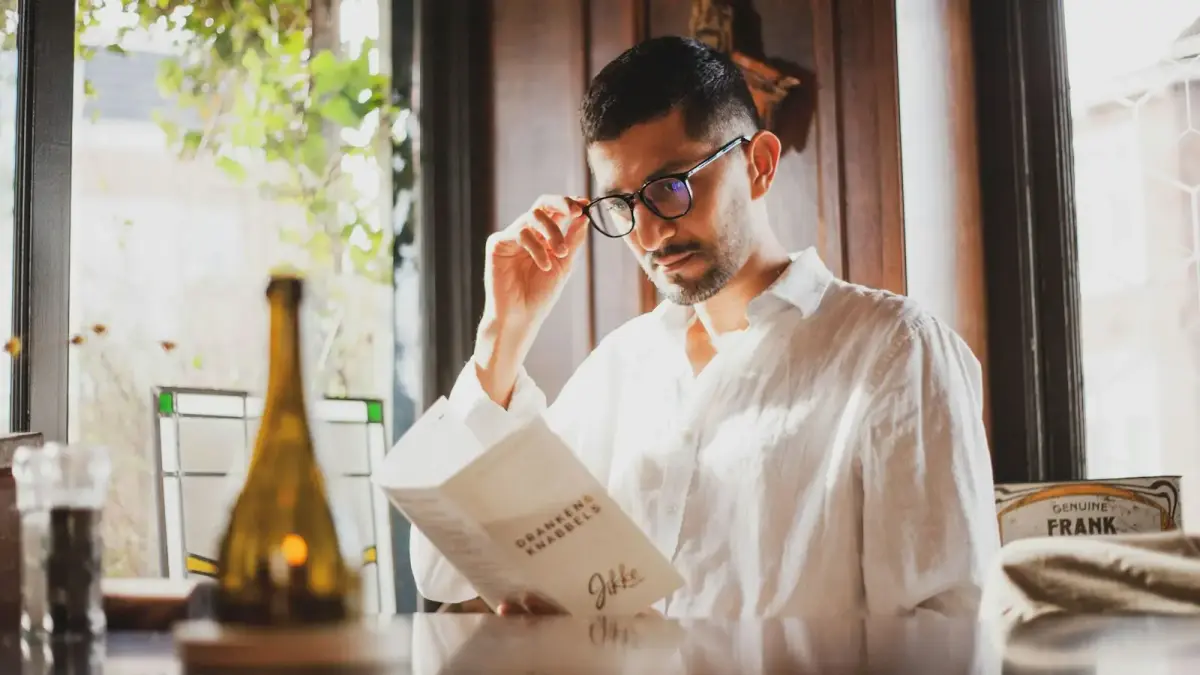
The hand that moves before the mind
I watched a friend order wine last week. He’s done well for himself - runs a consultancy, owns his house outright, takes his family to Portugal every summer. The waiter handed him the list and his eyes did something I recognized instantly because mine do the same thing.
They dropped to the bottom. Found the cheapest bottle. Then moved up exactly one line.
He ordered the second cheapest wine without reading a single description. Without checking the grape or the region or whether it paired with anything on his plate. His hand had already pointed. His mouth had already spoken. The whole decision took maybe four seconds.
His wife smiled and said, “You’re so easy.” And I thought - no. He’s not easy. He’s performing a calculation that was written into his body before he was old enough to understand what money meant. And it runs so fast now, so automatically, that it looks like personality.
I know because I’ve done the same thing for thirty years. At restaurants. At hotel booking pages. At rental car counters. Everywhere a menu presents options arranged by price, my nervous system has already made the choice before my conscious brain shows up to the meeting.
The arithmetic of an eleven-year-old
I was eleven when I learned the shape of the word “no” on my mother’s face. Not the angry version - the tired one. The one where her mouth stayed still but something behind her eyes retreated, like she was doing math she didn’t want me to see.
I wanted a particular pair of sneakers. Not the most expensive pair. Just not the ones from the discount bin that every other kid in my neighborhood wore. The ones in the middle, with the stripe that went a slightly different direction.
She didn’t say no right away. She picked them up and turned them over and looked at the price sticker on the sole, and in that pause - that three-second pause where her thumb pressed into the rubber and her jaw shifted half a millimeter to the left - I learned something that would run my purchasing decisions for the next four decades.
I learned that wanting cost something beyond money. It cost her composure. It cost the family a small, invisible piece of peace. And I decided, right there in the fluorescent aisle of that store, that I would never be the reason for that pause again.
So I pointed at the discount bin and said, “Actually, I like these better.”
And her face relaxed. And I filed away the lesson: desire is a luxury that people like us repay with guilt.
The second cheapest - a very specific geography of avoidance
Here is what’s interesting about the second cheapest choice. It’s not the cheapest. The cheapest would be too obvious - it would announce something about you that you’ve spent your whole life learning to keep quiet. The cheapest says “I can’t afford this.” The cheapest invites pity.
But the second cheapest says “I’m being reasonable.” It says “I’m not fussy.” It says “I know what I like and I don’t need to show off.” It occupies a very precise emotional position - close enough to the bottom that your childhood nervous system feels safe, but far enough from it that nobody asks questions.
A 2019 study published in the Journal of Consumer Research found that individuals who grew up in lower socioeconomic households displayed persistent “economic vigilance” in spending contexts decades after achieving financial stability. The researchers called it a kind of economic muscle memory - behavioral patterns that outlast the conditions that created them by twenty, thirty, sometimes fifty years.
I make more money now than my parents made combined in their best year. I know this intellectually. I can say the number out loud. But when I sit down at a restaurant and the waiter hands me a wine list, my body doesn’t know that. My body is still standing in that store aisle, watching my mother’s thumb press into the rubber sole.
What everyone calls it versus what it is
People call this quality different things depending on how close they are to you.
Colleagues call it practical. Friends call it low-maintenance. Partners call it modest, and sometimes they mean it as a compliment and sometimes they mean it as a gentle complaint, as in - “Would it kill you to want something nice for once?”
And the answer is complicated. Because yes, actually, for a very long time, wanting something nice felt exactly like a small death. Not of the body. Of belonging. The boy learned early that families like his stayed intact by keeping desire compact. You wanted what was offered. You were grateful for what arrived. You did not browse. You did not linger. You did not let your hand rest on the thing you actually wanted long enough for anyone to notice.
Psychologist Sendhil Mullainathan, whose research on scarcity reshaped how we understand poverty’s cognitive effects, has written about how financial stress doesn’t just limit choices - it restructures the decision-making architecture itself. The brain under resource pressure develops shortcuts, and those shortcuts persist long after the pressure lifts.
That’s what the second cheapest wine is. It’s a shortcut. A forty-year-old shortcut that fires before conscious thought can intervene.
The hotel room, the rental car, the jacket
It isn’t just wine. Once I started paying attention, I found it everywhere.
Hotels. I will scroll past a dozen options and book the one that sits just above the budget tier. Not because I’ve compared amenities. Not because I’ve read reviews. Because something in my chest tightens when my cursor hovers over the mid-range option, and the tightness only releases when I click something cheaper.
Rental cars. I have never once upgraded at the counter, even when the difference is fifteen dollars and I’ll be driving for six hours. The attendant offers, and my mouth says “the standard is fine” before the offer is fully formed. It’s not a decision. It’s a reflex.
Jackets. I own exactly zero pieces of clothing that I bought because I loved them. Every item in my closet was chosen for the same reason - it was acceptable. It was sufficient. It didn’t cross whatever invisible line my eleven-year-old self drew between need and want.
And here’s the part that gets me. I never feel deprived. That’s the trick of it. The flinch happens so fast that it rewrites the feeling in real time. I don’t experience “I’m choosing the cheaper option because I’m afraid to want.” I experience “I genuinely prefer the simpler choice.” The avoidance has been dressed up as taste for so long that I can’t always tell the difference anymore.
The woman who finally noticed
My partner said something to me two years ago that I haven’t stopped thinking about. We were at a restaurant - a nice one, her birthday - and I ordered the second cheapest bottle on the list. I didn’t think about it. I never think about it.
She looked at me and said, “What would you order if money didn’t exist?”
I opened my mouth to say “this one” and couldn’t get the words out. Because for the first time, someone had separated the question of preference from the question of price, and I realized I didn’t know what I actually liked. I had spent so many years choosing what was safe that I’d never developed a relationship with what I wanted.
That moment was small and enormous at the same time. It didn’t fix anything. I still reach for the second cheapest. I probably will for the rest of my life. But now I sometimes catch the hand mid-reach, and I sit with the discomfort of wanting, and I let the discomfort be there without letting it make the decision.
A 2021 study in Psychological Science found that adults who grew up in financially unstable households often displayed “preference suppression” - a measurable tendency to report lower desire for items they couldn’t easily afford, even when given unlimited hypothetical budgets. The researchers described it as a protective rewriting of want itself. If you never let yourself want it, you never have to feel the sting of not getting it.
I read that study and thought - that’s not a finding. That’s my entire personality.
The thing about class that nobody says at dinner parties
Class isn’t just about money. It’s about the nervous system that money - or the absence of it - built.
You can earn your way out of a tax bracket. You can move neighborhoods, change your wardrobe, learn which fork goes where. But you cannot earn your way out of the flinch. The flinch lives deeper than income. It lives in the body. In the hand that drops to the bottom of the menu. In the throat that tightens at the word “upgrade.” In the strange guilt that arrives when someone gives you something expensive and your first thought is “this wasn’t necessary.”
I know men my age - men who grew up the same way, in houses where the heating clicked off at nine and the car was always the one nobody else wanted - who have built extraordinary lives and still cannot sit comfortably in a first-class seat. Not because they can’t afford it. Because somewhere inside them, a boy is still watching his mother’s face, still scanning for the tightness, still ready to point at the discount bin and say “actually, I like these better.”
And the world calls that humility. Calls it grounded. Calls it “he never forgot where he came from.”
But sometimes it isn’t remembering. Sometimes it’s being unable to leave.
Learning to want, slowly
I’m not writing this to say the second cheapest wine is a tragedy. It’s not. Plenty of excellent wine sits in that spot on the list.
I’m writing this because I spent forty years believing I was making a choice when I was actually running a program. And there’s a difference between choosing modesty and being unable to choose anything else.
I’m fifty-one now. I earn well. My children will never stand in a store aisle and learn what I learned. And yet last Tuesday I booked a hotel for a work trip, and I watched my hand scroll past the place I actually wanted to stay and land on the one two tiers below, and I whispered to no one, “That’s the boy.”
Not to shame him. Not to override him. Just to see him. To let him know that I know he’s there, making his fast calculations, protecting me from a danger that ended decades ago.
Gabor Mate has written beautifully about how the body stores what the conscious mind has long moved past - how our earliest adaptations become invisible to us precisely because they worked so well. The second cheapest wine worked. It kept the peace. It kept desire small and manageable. It turned a survival strategy into something that looked like good taste.
The only thing it cost was the experience of wanting freely. Of reaching for something without flinching. Of sitting with a menu and asking the question my partner asked me - what would you choose if nothing about your history was watching?
I’m learning. Slowly. Some nights I order the wine I actually want, and the guilt arrives like an old friend, and I let it sit at the table with me, and I drink the wine anyway.
It’s a small rebellion. A fifty-one-year-old man learning to want what he wants, one glass at a time. It turns out that’s harder than it sounds when your whole body was built to want less.
But I’m finding that the wine tastes different when you chose it on purpose. Not better, exactly. Just yours.