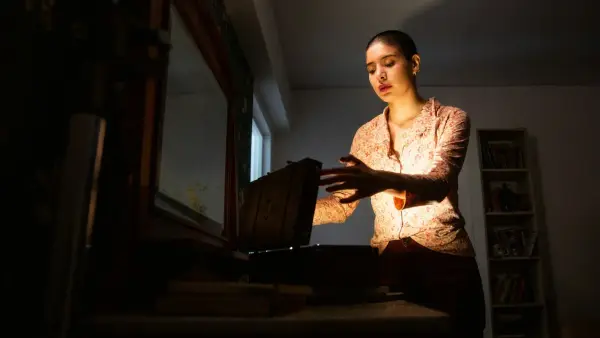
He's 55 and has quietly noticed that his voice drops to a specific register every time someone in his family starts to cry - a calm, steady, half-octave-lower version of himself that he first produced at fourteen when his mother broke down at the kitchen table and he discovered that the sound of a controlled male voice was the only thing in the room that could bring the temperature down, and thirty years later he is still performing composure in a key he never chose

The Voice That Wasn’t His
I was sitting across from my daughter last Tuesday when it happened again. She’d just gotten off the phone with her landlord - some dispute about a deposit - and her eyes started filling. Before her first tear hit the table, I heard it. My voice. Except not my voice. The other one.
The low one. The steady one. The one that sounds like a man who has everything under control.
“Hey. It’s okay. We’ll figure this out. Walk me through it.”
Measured. Warm. About half an octave below where I normally speak. I’ve been producing that voice for forty-one years, and last Tuesday was the first time I actually heard myself do it.
I’m fifty-five. And I’ve just realized that I have a second voice - one that activates the moment someone near me begins to fall apart. It doesn’t ask permission. It doesn’t announce itself. It simply arrives, like a thermostat clicking on when the room gets too cold. Steady, controlled, unhurried. The voice of a man who is fine.
The thing is, I’m not always fine when that voice shows up. Sometimes I’m terrified. Sometimes I’m furious. Sometimes I’m so tired I can barely hold my head up. But the voice doesn’t care about any of that. The voice has a job. And it has been doing that job since I was fourteen years old.
The Kitchen Table
I can tell you exactly where I learned it.
October, 1985. A Wednesday, I think, though I’m not sure why I remember that. My mother was sitting at the kitchen table with a stack of bills and a calculator that kept making a small beeping sound every time she hit the wrong key. My father had been gone about three months by then.
She wasn’t dramatic about it. That was the thing. She just put both hands flat on the table and started crying in a way I’d never seen an adult cry before - quiet, shaking, with her mouth closed, like she was trying to keep the sound inside her body.
I was fourteen. I had no money, no solutions, no authority over anything. But I had a voice. And something in me understood - not intellectually, but physically, the way you understand that a hot stove will burn you - that the pitch and speed of my voice was the only variable in that room I could control.
So I dropped it. I slowed it down. I said something like, “Mom, it’s going to be okay. We’ll be okay.” I have no idea if I believed it. What I remember is the register. Low. Even. The kind of voice you’d hear from an airline pilot explaining mild turbulence.
She looked up. She took a breath. The shaking slowed.
And something in my fourteen-year-old brain took a note: this works. This voice - this particular frequency - is a tool. It calms rooms. It stops tears. It makes you useful in a crisis.
I have been using it ever since.
The Instrument Nobody Knows Is Tuned
A 2019 study published in the Journal of Personality and Social Psychology found that men who grew up in households with high emotional volatility were significantly more likely to develop what researchers called “prosodic regulation strategies” - essentially, learned vocal patterns designed to modulate the emotional temperature of their environment. These men didn’t just stay calm. They sounded calm in very specific, measurable ways: lower pitch, slower cadence, fewer vocal fry markers, more even breath distribution.
The researchers noted something striking. These vocal patterns were almost entirely unconscious. The men who used them most consistently were the least likely to recognize they were doing it.
I read that and felt something I can only describe as being caught. Not in a shameful way. In a seen way. Like someone had put a microphone inside a room I didn’t know had walls.
Because here’s what I’ve come to understand at fifty-five: that voice I invented at the kitchen table wasn’t just a one-time survival move. It became the scaffolding of my entire emotional identity. The calm voice became the calm man. The steady register became the steady presence. Everyone around me - my wife, my kids, my colleagues, my friends - they all know a version of me that is built on a sound I first made in desperation.
They think it’s who I am. I’m starting to wonder if it’s just what I learned to produce.
Forty Years of Emergency Settings
You’d be amazed how many situations trigger it. Or maybe you wouldn’t. Maybe you have your own version.
My wife crying after her father’s diagnosis - the voice showed up before I’d even processed the news. My son calling from college at two in the morning, panicking about a grade - the voice was there before my feet hit the floor. A colleague breaking down in my office after a layoff announcement - steady, low, measured. “Let’s talk through this.”
Even small things. My daughter getting frustrated with a parking ticket. My wife sighing heavily while reading the news. A friend’s voice cracking over the phone.
The voice doesn’t wait for a genuine emergency. It responds to any signal that someone nearby might be approaching emotional overflow. It is, I’ve realized, always on standby. Always warming up in the wings.
And the thing about a voice that’s always ready to be the calm one is that it leaves no room for being the loud one. The shaking one. The one that says, “I don’t know what to do and I’m scared and I need someone to tell me it’s going to be okay.”
That version of me doesn’t have a voice. He never developed one.
The Praise That Became a Cage
People have been complimenting my calm for decades. “You’re so steady.” “Nothing rattles you.” “I always feel better when you’re in the room.”
I used to take those as the highest form of praise. What more could a man want than to be the person who makes others feel safe? What better legacy than being remembered as the one who held it together?
But here’s what I’ve started to notice, now that I’m watching myself more carefully: those compliments aren’t about me. They’re about what I provide. They’re about the service. The temperature control. The emotional thermostat function I perform.
Nobody has ever said, “I love the sound of your real voice.” Because nobody has ever heard it. Including me.
Research by psychologist Niobe Way, who spent decades studying emotional development in boys, found that adolescent males often undergo what she calls “a crisis of connection” - not because they lack emotional depth, but because they learn, usually between ages twelve and sixteen, that their emotional value to others is tied to their ability to suppress their own distress. Boys who cry are a problem. Boys who stay calm are a resource.
I became a resource at fourteen. And being a resource felt so much better than being a problem that I never questioned the exchange.
The Body Keeps the Frequency
Here’s something nobody tells you about performing composure for four decades: your body keeps score in ways your voice won’t reveal.
My jaw. I’ve cracked two molars from clenching in my sleep. My doctor asked if I was under stress, and I said no, because the voice had already answered for me. Calm men don’t have stress. Calm men have everything handled.
My chest. There’s a tightness I’ve carried so long I thought it was just how chests feel. It turns out, it’s not. It turns out that holding your breath slightly - just enough to keep your voice from wavering - creates a pattern of shallow breathing that becomes your baseline over time.
A 2021 study in Frontiers in Psychology examined the physiological cost of what the researchers termed “expressive suppression through vocal control.” They found that individuals who habitually modulated their voice to appear calm showed elevated cortisol levels, higher resting heart rates, and reduced heart rate variability - all markers of chronic stress. The voice said calm. The body said otherwise.
I think about my mother at that kitchen table. I think about the fourteen-year-old who dropped his voice and discovered he could change the weather in a room. I don’t blame him. He did what he had to do. But I wish someone had told him: you don’t have to do this forever. You don’t have to be this sound for the rest of your life.
The Question at Fifty-Five
My wife said something to me last month that I haven’t been able to shake. We were lying in bed, and she’d been talking about something that upset her - I don’t even remember what - and I’d done the thing. The voice. Low, even, reassuring.
She was quiet for a minute. Then she said, “Sometimes I wish you’d just be upset with me. Not for me. With me.”
I didn’t know what to say. Which, if you think about it, is the whole problem. I have a voice for calming. I have a voice for steadying. I have a voice for making the room feel safe. I do not have a voice for falling apart alongside someone. For saying, “This scares me too.” For letting the pitch rise and the breath catch and the words come out unsteady.
That voice was never developed. It was abandoned at the kitchen table in 1985, when a boy learned that his unsteadiness was a luxury the household couldn’t afford.
Learning a Third Voice
I’m not going to tell you I’ve figured this out. I’m fifty-five, and I’m just now hearing the mechanism. That’s not a resolution. That’s a beginning.
But I’ve started noticing. That’s the first thing. When my daughter calls and I hear the shift - the drop, the steadying, the pilot-voice clicking on - I notice it now. I don’t stop it. I’m not sure I can. But I notice it, and in the noticing, there’s a tiny space. A half-second where I could, theoretically, choose.
Daniel Goleman writes about emotional intelligence as the ability to recognize and manage your own emotional states. But I think for men like me - men who learned to manage everyone else’s emotional states before they had language for their own - the deeper intelligence is recognizing which of your emotions are actually yours and which are performances you learned so early they feel like identity.
I don’t want to lose the steady voice entirely. It’s real, in its way. It’s gotten people I love through terrible nights. It held my mother together when she needed holding. It’s not nothing.
But I want a third voice. Not the panicked boy, and not the performing man. Something in between. Something that can say, “I’m here, and I’m also struggling.” Something that lets the room hold two people’s feelings instead of just one.
I’m fifty-five. I’ve been the calm voice in the room for forty-one years. And I’m just now giving myself permission to wonder what I sound like when I’m not trying to save anyone.
I think it might be a voice worth hearing.