He's 56 and Still Leaves 25 Percent at Every Diner Counter Even When the Service Is Slow - Not Because He's Generous but Because His Mother Waitressed the Night Shift and He Learned That the Number on a Receipt Is the Difference Between Rent Paid and Rent Owed
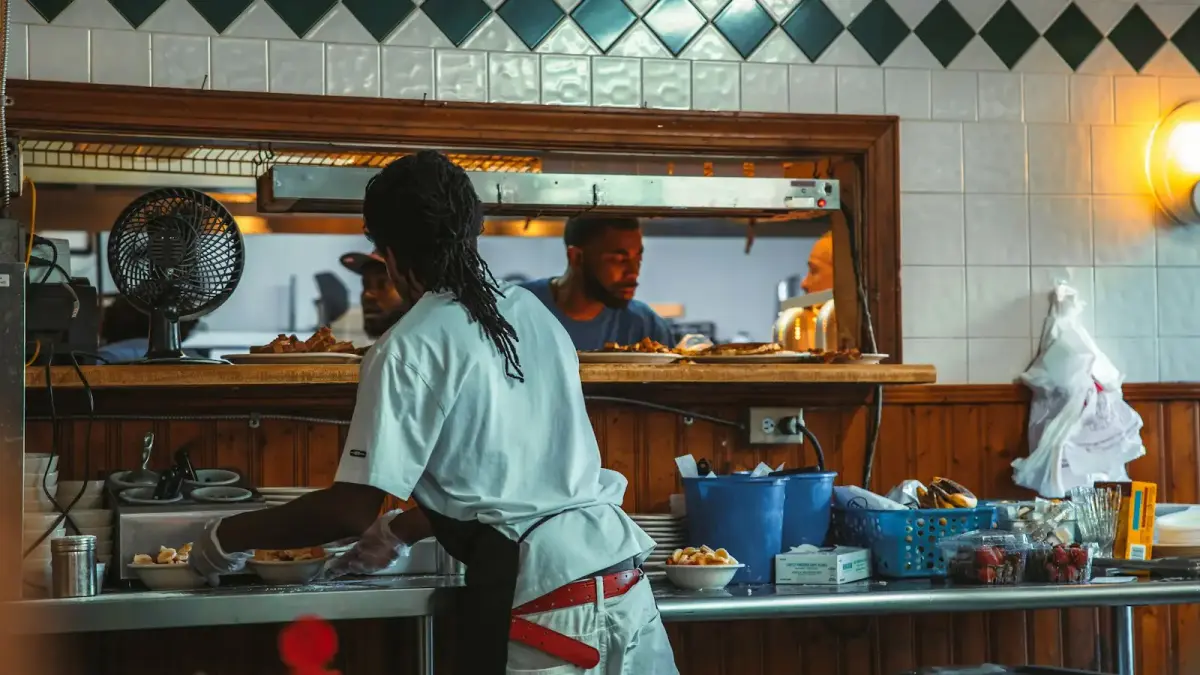
I watched my mother count tips at the kitchen table every night until I was fourteen years old. She’d come through the back door smelling like fryer grease and coffee that had been sitting on the burner too long, and before she even took off her shoes she’d pull the folded bills from her apron and smooth them flat with her palm.
I knew what a good night looked like before I knew my multiplication tables. A good night meant the bills didn’t need smoothing because there were enough of them. A bad night meant she counted the coins, too.
I’m fifty-six now and I have never once left less than twenty-five percent at a restaurant. Not at the expensive places where it probably doesn’t matter. Not at the diner counter where the coffee is burnt and the waitress hasn’t smiled at anyone since Tuesday. I don’t do it because I’m generous. I do it because every time I look at a server carrying four plates on two arms, I see a woman in white sneakers who should have been home with me.
The Math You Learn Before Math
There’s a kind of arithmetic they don’t teach in school. It’s the math of survival, and you learn it by watching someone you love do it under the kitchen light while she thinks you’re asleep.
I learned that $47 in tips meant we could eat something other than the leftover rolls she brought home in a paper bag. I learned that $23 meant she’d be quiet in the morning, moving through the house like she was trying not to take up space. I learned that certain nights - Tuesdays, rainy Wednesdays - were bad for tips the way certain seasons are bad for crops.
You don’t forget that math. It doesn’t matter how many years pass or how many degrees you earn or how far you move from the apartment with the radiator that clanked all winter. The boy who watched his mother count coins at midnight never stops counting.
A 2019 study published in the Journal of Personality and Social Psychology found that adults who grew up in lower socioeconomic environments maintained heightened sensitivity to resource scarcity throughout their lives, regardless of their current financial status. The researchers called it “residual vigilance.” I call it Tuesday night at the kitchen table.
Every Server Wears Her Face
Here’s the part that’s hard to explain to people who didn’t grow up this way. When I sit down at a restaurant, I don’t see a stranger bringing me water. I see a version of my mother. Every single time.
The woman with the tired eyes refilling ketchup bottles at closing. The older guy busing tables who moves like his back has been hurting since two o’clock. The young woman trying to smile through a twelve-top that’s been camping for three hours on a Tuesday night. They all wear her face.
I know what their feet feel like. I know that the customer who snapped his fingers didn’t just annoy them - he made them feel like furniture. I know that the couple who left exact change on a forty-dollar check just took ten minutes of someone’s rent money and walked out thinking they’d been fair.
You carry this involuntary identification your whole life. It’s not empathy in the way people usually mean it. It’s closer to recognition. You recognize the posture, the forced cheerfulness, the way someone’s shoulders drop just slightly when they pick up a credit card slip and see the tip line.
The Sound That Stays
Some people carry their childhood in photographs or songs. I carry mine in sounds.
The sound of her shoes on the linoleum when she came home - that particular tired shuffle that meant the shift had been long. The clink of quarters being stacked on the formica table. The small exhale she’d make when the count came up short, like the air leaving a tire so slowly you almost couldn’t hear it.
I’m in my fifties and I still hear those sounds. I hear them when I’m calculating a tip on my phone. I hear them when I watch someone leave cash on a table and walk away. I hear them in the pause between a server asking if I need anything else and me saying no, we’re good, thank you.
Psychologist Suniya Luthar’s research on resilience, published across several papers in Child Development, found that children of parents in high-stress service occupations develop what she termed “precocious maturity” - an early and lasting awareness of economic fragility that shapes their adult behavior around money and social obligation. These children don’t grow out of it. They grow around it, the way a tree grows around a fence post.
What Your Own Kids Don’t Understand
My daughter is twenty-four. She’s kind, she’s thoughtful, and she tips twenty percent because that’s what she was taught. But she tips twenty percent the way someone follows a rule. She doesn’t feel it in her chest.
Last year we went to breakfast at a place near her apartment. The service was slow and the eggs were cold and my daughter left exactly twenty percent and I added another ten on top when she wasn’t looking. She caught me and laughed and said, “Dad, it wasn’t even good.”
I couldn’t explain it to her. I tried, but the words came out wrong. How do you tell your child that you’re not tipping the woman who brought cold eggs - you’re paying a debt to a woman who died eleven years ago? How do you say that the extra five dollars isn’t about this meal, it’s about every meal your mother served to someone who didn’t look up from their phone?
There’s a feeling that lives in that gap - between your daughter’s reasonable twenty percent and your compulsive twenty-five or thirty. It doesn’t have a name. It’s not guilt, exactly. It’s not grief. It’s something closer to the feeling you get when you drive past the town where you grew up and realize that the diner on Route 9 is a cell phone store now.
Class Identity Never Leaves Your Bones
People talk about class like it’s a set of circumstances you can climb out of. Get the degree, get the salary, move to the neighborhood with the good school district, and eventually you become someone who belongs there.
But the boy who grew up watching his mother work the night shift knows something the spreadsheets don’t capture. Class isn’t what you earn. It’s what you saw. It’s the knowledge that sits in your body, below language, that tells you exactly how much a three-dollar tip on a fifteen-dollar check costs someone.
Sociologist Annette Lareau’s landmark research, detailed in her book Unequal Childhoods, showed that class-based patterns of behavior persist across generations not through economics alone but through what she called “concerted cultivation” versus “natural growth” parenting styles. The children of working-class families carried their class consciousness forward like a second language - fluent, permanent, spoken without thinking.
I speak that language every time I write a number on a receipt. I speak it when I stack my plates to make them easier to carry. I speak it when I make eye contact with the busboy and say thank you like I mean it, because I do mean it, because I was raised by someone who did that work and I know what it costs.
You Are Not Generous
I want to be honest about this, because people sometimes compliment me on my tipping and I accept it even though it makes me uncomfortable. They say I’m generous. They say I’m thoughtful. They say it like it’s a personality trait, like being good at tipping is the same as being good at tennis.
It’s not generosity. I want you to hear that if you’re someone like me.
What we do at restaurant tables isn’t charity. It’s loyalty. It’s a promise we made to a woman who never asked us to make it. Every receipt is a letter we’re writing to someone who can’t read it anymore, and the number at the bottom isn’t a percentage - it’s a sentence that says I remember what this cost you.
If you grew up watching someone you love carry plates until her wrists ached, you don’t need me to explain this. You already know why you do it. You’ve just never heard anyone say it out loud.
The Coins at Midnight
I’m fifty-six years old and sometimes, late at night, I still hear the coins. Not as a memory exactly - more like a frequency my body is tuned to, the way some people can hear a dog whistle and others can’t.
I hear them when I can’t sleep. I hear them when I’m doing well, when the mortgage is paid and the retirement account looks solid and by every reasonable measure I’ve made it out. The coins don’t care about reasonable measures. They keep their own time.
My mother never asked me to carry this. She would have been embarrassed to know I still think about it. She would have told me to stop being silly, that she was fine, that the tips were fine, that everything was fine. She said fine the way people say fine when the alternative is falling apart in front of their children.
But I carry it anyway. Not as a burden. As a compass.
Every dollar I leave beyond what’s expected is a small act of remembering. It’s me telling a woman in white sneakers that her son turned out okay, that he never forgot where he came from, and that the number he writes on the receipt isn’t a tip.
It’s the sound of coins being counted at midnight, finally adding up to enough.