He is fifty-six and has just understood that the reason he always orders the second-cheapest thing on a menu - never the cheapest, because that would be conspicuous, and never what he actually wants, because that would be indulgence - is not frugality but the class arithmetic a child installed at a table where his father's eyes always went to the prices before the food, and the man scanning the right side of the menu at fifty-six is not being careful with money but is still the boy who learned that wanting the thing you actually want is a luxury people like them had not earned
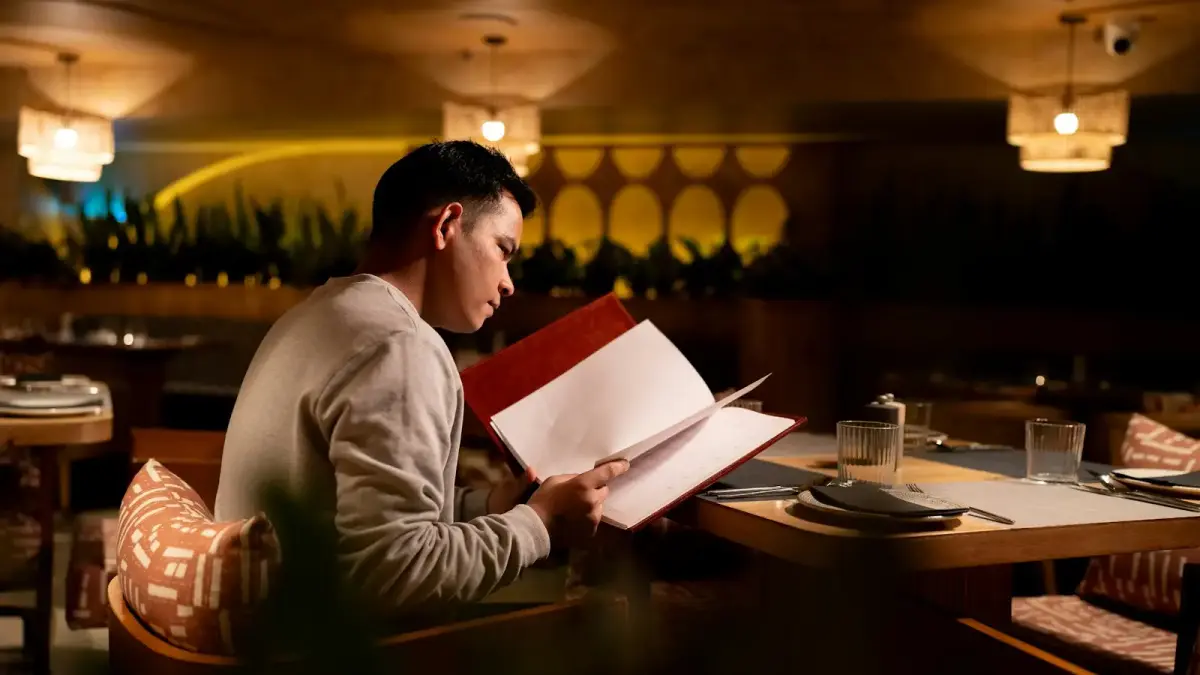
I was at a steakhouse last month with a friend I’ve known since college. Nice place. Leather booths, low lighting, the kind of menu that doesn’t have dollar signs because the assumption is you don’t need them.
I ordered the chicken.
Not because I wanted the chicken. I wanted the short rib. I’d been thinking about it since we walked in and I caught the smell from someone else’s table. But the short rib was the most expensive entree, and my hands did what they’ve always done - they found the second-cheapest option and built a story around why that was actually what I was in the mood for.
My friend ordered the short rib without hesitating. Without even scanning the prices. And something about watching him do that - the ease of it, the absence of calculation - made me feel like I was eleven years old again, sitting in a Denny’s booth, watching my father’s eyes.
The Right Side of the Menu
My father read menus from right to left.
I didn’t understand that until I was much older. As a kid, I just knew there was a particular tension that settled over our table whenever we ate out, which wasn’t often. Maybe four times a year. Birthdays and one anniversary dinner where my brother and I were brought along because babysitters cost money too.
He’d open the menu and his eyes would go to the right margin first. The prices. Then they’d track left to the food. He was building a budget before he was building an appetite.
He never said “don’t order that.” He never had to.
The atmosphere said it. The way he’d pause a half-second too long when the waitress asked if we wanted appetizers. The way he’d say “get whatever you want” with a voice that meant it and a jaw that didn’t. The way my mother would order a salad and say she wasn’t that hungry, and even at nine I knew she was that hungry, she was always that hungry, she just understood the rules of the table better than I did.
So I learned the algorithm. Not the cheapest thing - that would announce that you couldn’t afford to be here. Not the most expensive thing - that would be a burden. The second-cheapest item was the sweet spot. It said: I belong here, but I know my place.
I’ve been running that algorithm for forty-five years.
The Arithmetic of Deserving
Here’s what nobody tells you about growing up with less. The money part ends. You grow up, you get a job, you earn more than your parents did. I make three times what my father ever brought home. I have a retirement account. I own a house. By every material measure, I’ve left that Denny’s booth behind.
But the menu still reads right to left.
A 2019 study published in the Journal of Personality and Social Psychology found that socioeconomic status in childhood continues to shape consumption behavior decades later - even when adult income is high. People who grew up in lower-income households consistently chose less expensive options, not because they couldn’t afford more, but because their sense of what they “deserved” to consume had been calibrated early and never recalibrated.
That word - deserved - is the one that gets me. Because it was never about the money. It was about permission. Permission to want. Permission to want openly, without apology, without the internal arithmetic that converts every desire into a cost-benefit analysis where the benefit is always suspicious and the cost is always too high.
My father didn’t teach me to be frugal. He taught me that wanting things was dangerous. That appetite itself was a form of exposure. And that the safest place to exist was in the narrow margin between too little and too much.
The Boy Who Learned to Want Quietly
I think about this in contexts that have nothing to do with restaurants.
The way I’ll research a purchase for weeks, reading every review, comparing every price, and then buy the one that’s good enough instead of the one I actually want. The way I keep clothes until they’re threadbare, not because I value sustainability, but because replacing them feels like admitting I deserve something new. The way I’ll drive an extra twenty minutes to save four dollars on gas and feel a small, private satisfaction that has nothing to do with the four dollars.
Sendhil Mullainathan’s research on scarcity - published in his book with Eldar Shafir - describes something he calls the “scarcity mindset.” When resources are limited, the mind becomes hypervigilant about allocation. Every decision carries the weight of trade-offs. You don’t just buy a thing; you calculate what that thing costs you in terms of everything else you might need.
But here’s what the research also shows: the mindset outlasts the scarcity. Long after the bank account fills up, the brain keeps running the old software. The threat detection system that was installed when you were small doesn’t just monitor finances. It monitors desire itself. It says: be careful how much you want. Be careful how much you let yourself enjoy. Because enjoyment is a form of forgetting, and forgetting is how people like you get caught off guard.
I wasn’t taught this in words. I was taught it in glances. In the way my mother folded aluminum foil to reuse it. In the way my father nursed a single beer at a barbecue while other men had three. In the silence that followed any sentence that began with “I want.”
Class Consciousness Lives in the Body
Ruby Payne, the educator who spent decades studying how economic class shapes behavior, identified something she called the “hidden rules” of class - the unspoken norms that govern everything from how you handle conflict to how you approach a meal. In poverty and working-class culture, she argued, the orientation is toward the present and toward relationships. In middle-class culture, the orientation shifts toward the future and toward achievement.
What she didn’t say - what I wish someone had told me at twenty-five - is that when you cross from one class to another, you carry both sets of rules, and they fight each other constantly.
I have the income of a man who can order whatever he wants. I have the nervous system of a boy who knows that ordering the wrong thing will cost something he can’t name but can feel in his stomach.
This is what people mean when they talk about class consciousness, except they usually mean it politically. I mean it literally. My class lives in my body. It’s in my hands when they grip the menu. It’s in my throat when I say “I’ll just have the chicken.” It’s in the quick, involuntary scan I do of everyone else’s order to make sure I’m not the most expensive or the least.
It’s in the relief I feel when someone else orders first and picks something modest. Because now I have cover. Now the ceiling has been set, and I can safely exist beneath it.
What the Second-Cheapest Item Really Means
The second-cheapest item is a masterpiece of social engineering performed by an anxious child.
Think about it. The cheapest item says: I can’t afford to be here. That’s exposure. That’s the thing my father’s careful performance was designed to prevent - the revelation that we were stretching to do this, that this meal was a budget event disguised as a casual one.
The most expensive item says: I want. And wanting - real wanting, unapologetic wanting - was the thing I learned was most dangerous of all. Wanting meant you hadn’t done the math. Wanting meant you didn’t understand the precariousness. Wanting meant you were the kind of person who didn’t worry, and not worrying was for other families. Families with different fathers. Fathers whose eyes went to the food first.
The second-cheapest item threads the needle. It says: I’m fine. I’m comfortable. I’m choosing freely from the middle of the range, where reasonable people choose. It performs ease without performing abundance. It’s camouflage. It’s the restaurant equivalent of knowing which fork to use - a class marker disguised as a preference.
I’ve been performing that ease for decades. And the performance is so complete that I sometimes forget it is one.
The Permission No One Gave
I took my daughter to dinner last year. She’s twenty-three. She grew up in the house I bought, in the neighborhood I chose specifically because it was nothing like the one I grew up in. She went to a good school. She never saw her mother fold aluminum foil.
She ordered the most expensive thing on the menu without even a flicker of hesitation.
And two things happened inside me at exactly the same time. The first was pride. I did that. I built a life where my child doesn’t carry the weight I carry. She doesn’t hear the prices before the food. She doesn’t perform math in her head before she’s allowed to feel hunger. I broke the chain.
The second was grief. Because watching her order freely made me realize how un-free I’ve been. How every meal, every purchase, every small act of consumption has been filtered through a system I didn’t choose and can’t seem to override. Not because I lack the money. Because I lack the permission.
And nobody can give it to me. That’s the cruel part. My wife has said “just order what you want” a thousand times. My therapist has walked me through it. I understand, intellectually, that I can afford the short rib. That ordering it won’t collapse anything. That my father’s anxiety was about his life, not mine.
But the boy at the table doesn’t care about intellectual understanding. He cares about the atmosphere. And the atmosphere still says: be careful.
Learning to Read Left to Right
I don’t have a tidy ending for this. I’m not going to tell you I finally ordered the short rib and felt free. I’m not going to give you five steps to overcome scarcity thinking. That’s not how this works.
What I can tell you is that I’ve started noticing the algorithm. That’s all. Just noticing it.
Last week I was at a coffee shop and I wanted the large. I caught myself reaching for the medium - not because I wanted less coffee, but because the large felt like too much. Like it would announce something about me that I wasn’t ready to have announced.
I ordered the large. It was coffee. It cost a dollar more. Nothing collapsed.
But the noticing is the thing. Because for forty-five years I thought I was just a practical person. A sensible person. A person who didn’t need the expensive thing because he genuinely preferred the modest one.
And maybe some of that is true. Maybe I am practical. But I’d like to know what my preferences actually are, once I subtract the fear. I’d like to read a menu from left to right, just once, and see what I’m hungry for before I see what it costs.
If you recognized yourself anywhere in this - the scan, the calculation, the quiet negotiation between desire and permission - I want you to know something. Your frugality may be real. But it may also be a scar. And scars deserve to be seen for what they are - not virtues, not flaws, just evidence that you learned something young that you’re still carrying.
You’re allowed to want the short rib.
You always were.