He is 57 and still checks the prices on a menu before sitting down - not because he cannot afford anything on it but because a boy who watched his mother put things back on the grocery shelf one at a time, recalculating the total after each return, learned that the cost of comfort is the quiet guilt of having outgrown the life that taught you to count
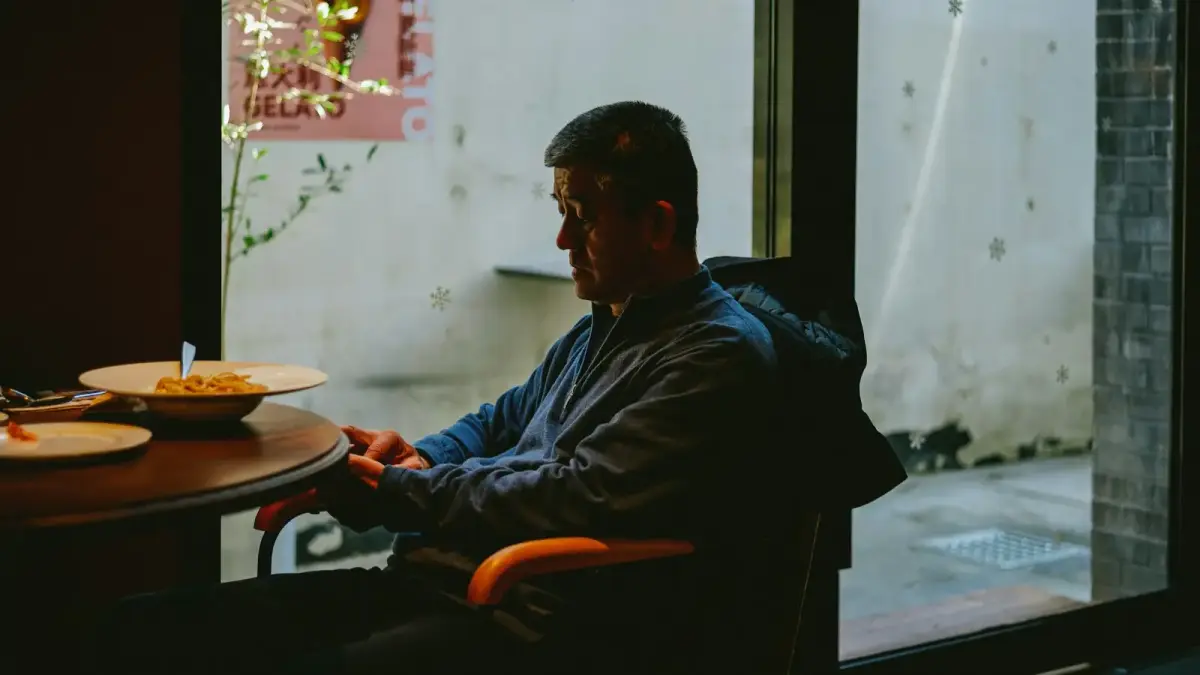
There is a thing I do that I have never told anyone about.
Before I sit down at a restaurant - any restaurant, whether it is a diner with laminated menus or a place with cloth napkins and a wine list thicker than the food menu - I check the prices first. Not discreetly. Not a casual glance. I stand near the entrance, or I pull up the menu on my phone in the parking lot, and I scan the right side of the page. The column with the numbers. I read them the way you read a weather forecast before deciding whether to leave the house.
I am fifty-seven years old. I have a retirement account. I own my home. I could order anything on any menu in any restaurant in my city and pay for it without feeling the hit.
But I check anyway. Every time. Because there is a boy inside me who is still standing in a grocery store aisle, watching his mother hold a can of tomatoes in one hand and a calculator in the other, and the boy needs to know that the numbers are safe before he can sit down and enjoy anything.
The arithmetic that never stops running
My mother could do math in her head faster than anyone I have ever met. Not school math. Survival math. The kind where you walk into a store knowing you have forty-three dollars and you need to leave with enough food for five people for six days, and every item you pick up gets added to a running total that lives somewhere behind your eyes, updating in real time, adjusting when something costs eleven cents more than it did last week.
She would stand in the canned goods aisle and do this silent calculation, her lips barely moving, her eyes tracking the price stickers like a pilot scanning instruments. And sometimes the numbers did not work. Sometimes the total in her head crept past the number in her wallet, and that is when the putting-back would begin.
One item at a time. Quietly. Without drama. She would return the name-brand green beans and pick up the store brand. She would put back the box of cereal I had been looking at and replace it with oatmeal. She would subtract and substitute, subtract and substitute, until the invisible ledger in her head balanced again.
I watched this happen hundreds of times. I never said a word about it. Neither did she. It was just the way shopping worked. It was just what a Tuesday evening looked like.
A 2013 study by Sendhil Mullainathan and Eldar Shafir, published in their research on scarcity and cognitive function, found that the experience of financial scarcity does not just limit what you can buy - it literally occupies mental bandwidth. Their work demonstrated that people operating under economic pressure showed measurably reduced cognitive capacity, not because they were less intelligent but because a portion of their mind was permanently allocated to the arithmetic of getting by. The calculations never stop. They run in the background like an operating system you cannot close.
My mother’s mental math was not a personality trait. It was a survival program. And somewhere along the way, I inherited the software.
The restaurant where you betray your mother
Here is the part no one talks about when they talk about class mobility: the guilt.
Not the guilt of poverty. The guilt of leaving it. The strange, low-grade, impossible-to-explain shame of sitting in a restaurant and ordering the thing you actually want instead of the cheapest thing on the menu, knowing that your mother - at your age - would not have been sitting in this restaurant at all.
I remember the first time I took my wife to a place with a tasting menu. Seven courses, wine pairings, the whole performance. The bill was more than my mother spent on groceries in a month. And I paid it. I smiled. I told my wife the food was incredible. And then I drove home with this hollow feeling in my chest that I could not name for years.
It was not buyer’s remorse. It was something older and stranger. It was the feeling of being a traitor to a kitchen table.
Because the kitchen table where I grew up was not just furniture. It was a courtroom. Every purchase was tried there. Every dollar was cross-examined. My father would sit at one end and my mother at the other and they would go through the week’s expenses with the seriousness of people negotiating a treaty, and I sat in the middle, absorbing the lesson that money is not a tool - it is a test. And every time you spend it, you are either passing or failing.
So when I sit in a restaurant now and order a forty-dollar steak without flinching, some part of me is failing. Some part of me is looking at the ghost of my mother, sitting across the table, doing the math in her head, and I can feel her not saying anything, which is worse than if she said something.
The code you never stop switching
Pierre Bourdieu, the French sociologist, had a word for what I am describing. He called it habitus - the idea that your social class is not just a matter of income or education or where you live. It is something you carry in your body. In your posture. In the way you hold a fork, or whether you check the prices before sitting down, or whether you instinctively reach for the store-brand ketchup even when the name brand is right there and costs forty cents more and you could buy a hundred bottles of it without thinking twice.
Class is not a tax bracket. Class is a nervous system. It is the set of reflexes you developed before you were old enough to choose them, and they persist long after the economic conditions that created them have changed.
A 2019 study published in the Journal of Personality and Social Psychology found that individuals who experienced upward socioeconomic mobility reported significantly higher levels of identity conflict than those who remained in their class of origin. The researchers described a phenomenon they called “cultural homelessness” - the sense of belonging fully to neither the world you came from nor the world you now inhabit. You speak the language of your new class fluently enough to pass, but your body still flinches at the old cues. You code-switch a hundred times a day, and the switching is so automatic you barely notice it anymore. But it is exhausting. It is the cognitive tax of living in translation.
I know this tax. I pay it every time I walk into a room full of people who grew up with more than I did. My vocabulary shifts. My stories get edited. The version of myself I present has been carefully stripped of every reference to food stamps and secondhand clothes and the summer the electricity got turned off because my father’s check was late.
I do not hide where I came from because I am ashamed of it. I hide it because I do not trust the room to hold it gently.
The store brand and the name brand living inside the same man
My wife does not check prices at restaurants. She grew up in a house where money was a thing you had, not a thing you managed. She picks up the name-brand olive oil without looking at the price tag. She orders appetizers and dessert. She does not do the phantom arithmetic.
I love this about her. I also do not understand it, in the way you do not understand a language you never learned. Her relationship with money is a foreign country I have permanent residency in but will never be a citizen of.
She caught me once, standing outside a restaurant, scrolling through the menu on my phone. She asked me what I was doing. I told her I was checking the hours. I lied so smoothly that it scared me - not because the lie was wrong, but because I did not even have to think about it. The cover story was pre-loaded. My body had been rehearsing this particular deception for decades.
Because here is the thing about growing up with scarcity: you learn to hide the checking. You learn that the checking itself is a kind of confession, a tell, a mark of the class you are supposed to have left behind. So you develop strategies. You pull up the menu on your phone before you arrive so no one sees you looking at prices in the lobby. You memorize the cost of what you are going to order so you can say it casually, without hesitation, as though you just happen to know what you want. You perform ease the way my mother performed competence at the grocery register.
The performance is seamless. The audience never suspects. And underneath it, the boy with the calculator is still running numbers.
What the prices really measure
I had a conversation with my therapist once about the restaurant thing. She asked me what I was afraid of - what I thought would happen if I sat down without checking the prices first.
I told her I was not afraid of anything. I was not worried about the bill. I was not anxious about spending too much. The checking was not about the money at all.
She waited. Therapists are good at waiting.
And then I said something I did not know was true until I heard myself say it: “I check the prices because if I do not, I am admitting that I have become someone my mother could not recognize.”
That is the knot at the center of class migration. It is not about money. It is about identity. It is about the fear that becoming comfortable means becoming a stranger to the people who made you. That ordering without looking at the prices means you have crossed a line your mother never got to cross, and crossing it without her feels like abandonment.
The man checking the menu is not performing frugality. He is performing loyalty. He is keeping the ritual alive because the ritual is the last thread connecting him to a kitchen table where every dollar had a name and every name was someone he loved.
Devotion dressed as a habit
A 2021 study published in Psychological Science examined what the researchers called “economic identity anchoring” - the tendency of upwardly mobile individuals to maintain financial behaviors associated with their class of origin, even when those behaviors no longer serve a practical purpose. The study found that these behaviors were not maladaptive. They were not signs of unresolved trauma or irrational anxiety. They were acts of identity preservation. The participants were not clinging to scarcity. They were clinging to belonging.
I think about my mother every time I pick up a menu. Not consciously. Not with words. But somewhere in the millisecond between seeing the prices and feeling my shoulders relax because the numbers are manageable - somewhere in that gap, she is there. She is standing in the canned goods aisle, doing the math. She is putting back the name brand and picking up the store brand. She is making it work with what she has, the way she always made it work, the way she taught me to make it work before I knew I was being taught anything.
And I check the prices not because I need to, but because stopping would feel like forgetting. Like closing a door on a room I am not ready to leave. Like telling that boy in the grocery store that his mother’s arithmetic does not matter anymore.
It does matter. It will always matter.
I am fifty-seven years old. I own my home. I have more money in my checking account than my mother made in a year. And I check the prices on every menu, in every restaurant, every single time.
Not because I cannot afford to eat.
Because a boy who learned to count never stops counting. And the counting is not math. The counting is love. The kind that lives in your hands and your habits and the quiet pause before you sit down, making sure the numbers are safe, the way she always made sure the numbers were safe, one can of tomatoes at a time.