He's 59 and has finally understood that the reason he cannot throw away the last bite of anything on his plate is not about waste - it is a boy who watched his mother stand at the kitchen counter eating whatever the children left behind because there was only ever enough for one real serving and she never once made herself a plate of her own
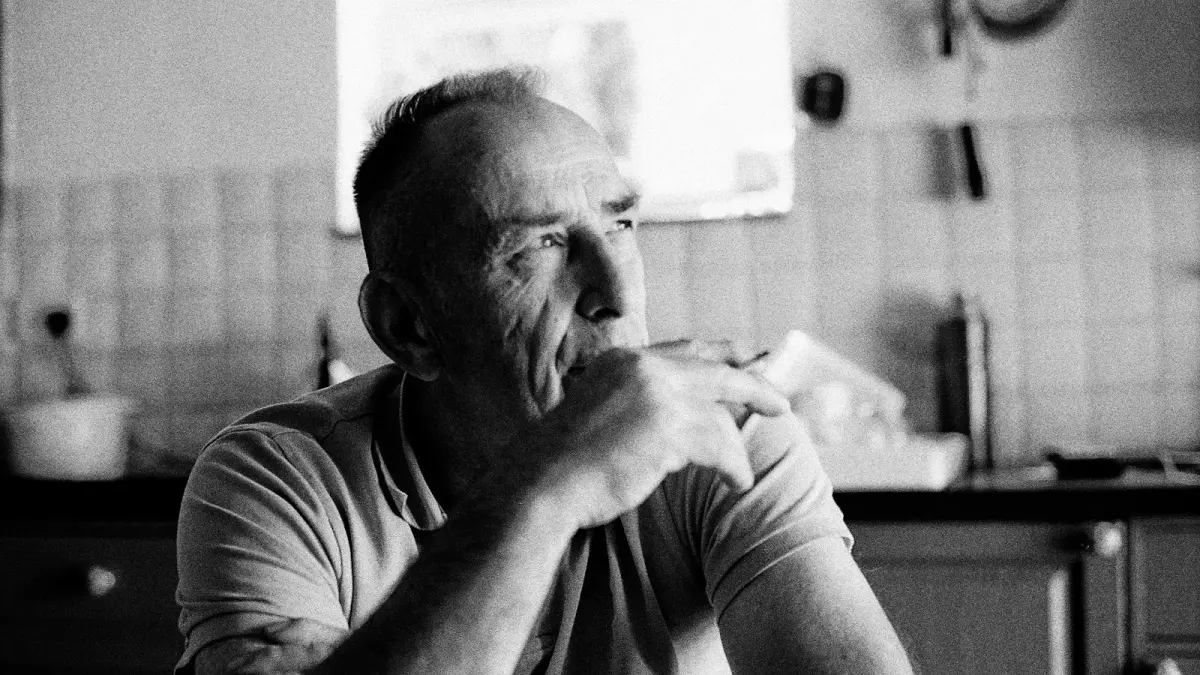
I scraped the plate clean last Thursday. Baked chicken, some rice, a few green beans that had gone cold twenty minutes ago. I wasn’t hungry anymore. I’d stopped being hungry somewhere around the halfway mark. But I sat there at the kitchen table with my fork moving on autopilot, pressing the tines into every last grain of rice until the plate looked like it had been washed.
My wife was loading the dishwasher. She glanced over and said, gently, the way she says things when she’s been holding them for a while - “You know, you don’t have to finish it. We have plenty.”
I know we have plenty. I’m 59 years old. I have a full refrigerator and a pension and a house that’s paid off. Scarcity is not my problem anymore. It hasn’t been my problem for decades.
But my hands don’t know that. My stomach doesn’t know that. Something in me still operates on a ledger that was written forty-five years ago in a kitchen with linoleum floors and a refrigerator that hummed too loud, and the math on that ledger has never been updated.
It took me until this year - this year, at 59 - to understand what that clean plate actually means. And it has nothing to do with waste.
She Never Sat Down
Here’s what I remember. Not what I’ve reconstructed or what family stories have told me. What I actually remember in my body.
My mother did not eat with us.
She cooked. She served. She made four plates - one for my father, one for me, one for my brother, one for my sister. She set them down, poured the milk, cut the bread. And then she stood at the counter with her back to the table.
She didn’t make herself a plate. Not once that I can recall. She stood there and she waited. And when we were done, she ate whatever we left behind. A few bites of meatloaf. Half a piece of bread. The potatoes nobody wanted because they’d gone dry.
I didn’t understand what I was watching. I was six, seven, eight years old. I thought that’s just what mothers did. I thought standing at the counter was where mothers ate, the same way fathers sat at the head of the table and children sat on the sides. It seemed like assigned seating.
It wasn’t assigned seating. It was arithmetic. There was only ever enough for four real servings, and there were five people in the family, and she made herself the remainder.
The Arithmetic of Working-Class Kitchens
Nobody talked about it. That’s the thing about scarcity when you grow up inside it - the logistics are invisible because they’re constant. You don’t notice the water you’re swimming in.
My father worked at a paper mill. My mother did alterations from home, taking in pants and hems for neighbors who’d drop off bags of clothes on Sunday evenings. Between the two of them, they kept us fed and clothed and never once let us feel poor. That was the project. That was the organizing principle of the household: the children must not feel the thinness.
A 2021 study published in the Journal of Research in Personality found that adults who grew up in food-insecure households develop what researchers call “scarcity encoding” - a nervous system response to food that operates independently of current economic reality. The body holds the memory even when the circumstances change. Your prefrontal cortex knows the fridge is full. Your limbic system is still counting servings.
My mother was a genius at this kind of concealment. She wore the same three dresses for years but our school clothes were always new at the start of term. She drank her coffee black not because she preferred it that way but because buying cream meant something else didn’t get bought. She created the illusion of enough by absorbing the deficit into her own body.
And we believed the illusion. That’s the cruelest part. We genuinely believed there was enough for everyone. We didn’t know that “enough for everyone” meant “enough for us because she goes without.”
What the Last Bite Carries
So here I am. Fifty-nine years old, unable to leave food on a plate.
I’ve tried. My doctor told me to eat smaller portions. My wife buys me the smaller plates thinking it might help. I serve myself less. And then I scrape every molecule off the ceramic anyway, and if there are serving dishes on the table with anything remaining, I feel a pull toward them that I can only describe as gravitational. Not hunger. Obligation.
Because the last bite on my plate is connected to the first plate she never made for herself. Every morsel I leave behind feels like something she would have eaten. And wasting it - God, even writing this, I feel the clench in my chest - wasting it feels like saying her sacrifice didn’t matter. Like the going-without was for nothing.
A 2018 study published in Psychological Science examined how food-related behaviors transmit across generations in low-income families. They found that children who witnessed parental food sacrifice - a parent consistently eating less so children could eat more - developed rigid “completion behaviors” around meals that persisted well into adulthood, even after achieving financial security. The researchers noted that these behaviors weren’t about the food itself. They were loyalty rituals. Unconscious acts of remembrance.
Loyalty rituals. That phrase hit me like a freight train when I read it. Because that’s exactly what the clean plate is. It’s not discipline. It’s not habit. It’s devotion. It’s a 59-year-old man still honoring a contract he made at seven without knowing he was making it: I will not waste what she gave up for me.
The Silent Curriculum of Scarcity
You learn things in a working-class kitchen that nobody teaches you explicitly. There is a curriculum, but it’s delivered entirely through observation. Through what isn’t said.
I learned that seconds were a question you asked with your eyes, not your mouth. I learned that you eat what’s in front of you and you don’t complain about it because someone stood in that kitchen for an hour making it and they did that instead of sitting down. I learned that the appropriate response to a full plate is gratitude, not preference.
My brother learned the same curriculum. He’s 56 now and he still can’t order the expensive thing on a menu, even when someone else is paying. He’ll scan the right side of the menu first - the prices - and work backward to find something he can justify. He doesn’t even know he’s doing it.
My sister hoards groceries. Her pantry is stacked three rows deep with canned goods that she’ll never eat before they expire. She buys in bulk not because it’s economical but because an empty shelf makes her heart race. She’s 53 and she has never once let her pantry get below what most people would consider a two-month supply.
Gabor Mate has written about how the body stores what the mind tries to move past. He describes how early experiences of deprivation don’t just shape our preferences - they shape our physiology. The stress response gets calibrated in childhood, and for children who grew up watching a parent go without, that calibration is set to a frequency that hums below every meal for the rest of their lives.
We all carry the kitchen with us. Different symptoms, same origin. The linoleum. The humming fridge. The mother at the counter.
The Moment I Understood
It happened on a Tuesday. That feels important to say because realizations like this don’t happen at dramatic moments. They happen while you’re standing at the sink.
I was rinsing a plate. My wife had made pasta - more than enough, plenty of leftovers. I’d eaten two full servings and then spent five minutes pressing my fork into the sauce residue on the plate like I was trying to absorb it through the ceramic.
And I caught myself in the window reflection. A 59-year-old man hunched over a plate, scraping. And for the first time, I didn’t see a man with a habit. I saw the boy.
I saw the boy who sat at the dinner table watching his mother not sit down. The boy who understood - not in words, because children don’t have words for economic injustice happening inside their own family - but in his body, in his nervous system, in the way his stomach tightened every time she scraped their leftovers onto her own plate. He understood that his fullness was purchased with her hunger. And he decided, without deciding, that he would never leave anything behind. Because leaving something behind meant there was excess. And if there was excess, then she went hungry for nothing.
That’s the logic. It doesn’t survive rational examination. It doesn’t need to. It was written into me before I could spell my own name.
The Plates She Deserved
I called my mother after that Tuesday. She’s 82 now. Lives alone in the same house, though we’ve updated the kitchen twice. The linoleum is gone. The fridge doesn’t hum anymore.
I asked her about the standing at the counter. About never making herself a plate. I expected her to deflect, the way she deflects everything that comes too close to what she gave up. But she was quiet for a long time.
Then she said: “I wasn’t hungry.”
And we both knew it was a lie. The same lie she’d been telling for fifty years. The beautiful, devastating lie of a woman who convinced her children that she simply preferred to eat standing up, preferred the scraps, preferred to serve and never sit.
I didn’t push it. Some lies are load-bearing. You don’t remove them without checking what they’re holding up.
But I said this: “Mom, you deserved a plate.”
A 2022 study published in Frontiers in Psychology found that acknowledging parental sacrifice - naming it specifically, rather than expressing general gratitude - produced measurable reductions in the guilt and compulsive behaviors that adult children of low-income families often carry. The researchers called it “specificity of recognition.” Not “thanks for everything you did” but “I saw what you gave up, and I know what it cost you.”
She didn’t say anything for a while. Then she told me what she was making for dinner, and we talked about the weather, and that was that. But I could hear something in her voice that had shifted. Some small, calcified thing that had loosened.
What I’m Learning at 59
I still clean my plate. I want to be honest about that. The behavior hasn’t magically dissolved because I’ve named it. I still feel the pull, still hear the quiet arithmetic running below every meal.
But now I know what the arithmetic is counting. It’s not calories or dollars. It’s counting the plates she never made. It’s counting the meals she ate standing up. It’s counting every time she said “I’m not hungry” and meant “there isn’t enough and I choose you.”
I’m learning, slowly, that finishing my plate doesn’t pay her back. That scraping every grain of rice doesn’t retroactively fill her stomach in 1974. That the debt I feel isn’t a debt at all - it’s love, fossilized into a behavior, pressed into my nervous system like a leaf in stone.
I’m learning that the best way to honor what she did is not to replicate the scarcity but to accept the abundance. To leave a bite on the plate and let it be okay. To sit with the discomfort of enough, which for a boy who grew up watching his mother eat standing at the counter, is the most foreign feeling in the world.
I’m 59. I have a full refrigerator. I have a wife who makes more pasta than we need, on purpose, because she understands what she married into. I have a mother who is 82 and still won’t sit down to eat when I visit.
And I have a plate in front of me every evening that means more than dinner. It means a kitchen with linoleum floors. A fridge that hummed too loud. Four plates on the table and a woman at the counter, eating what was left, pretending she preferred it that way.
She didn’t prefer it. She just loved us more than she loved being full.
That’s the last bite. That’s what it carries. And I’m only now, at 59, learning how to set it down.