He's 59 and still checks the price of milk every time he goes to the grocery store - not because he needs to, but because a boy who watched his father's jaw go tight at the checkout register learned that the cost of a gallon was never about money, it was about whether tonight would be safe
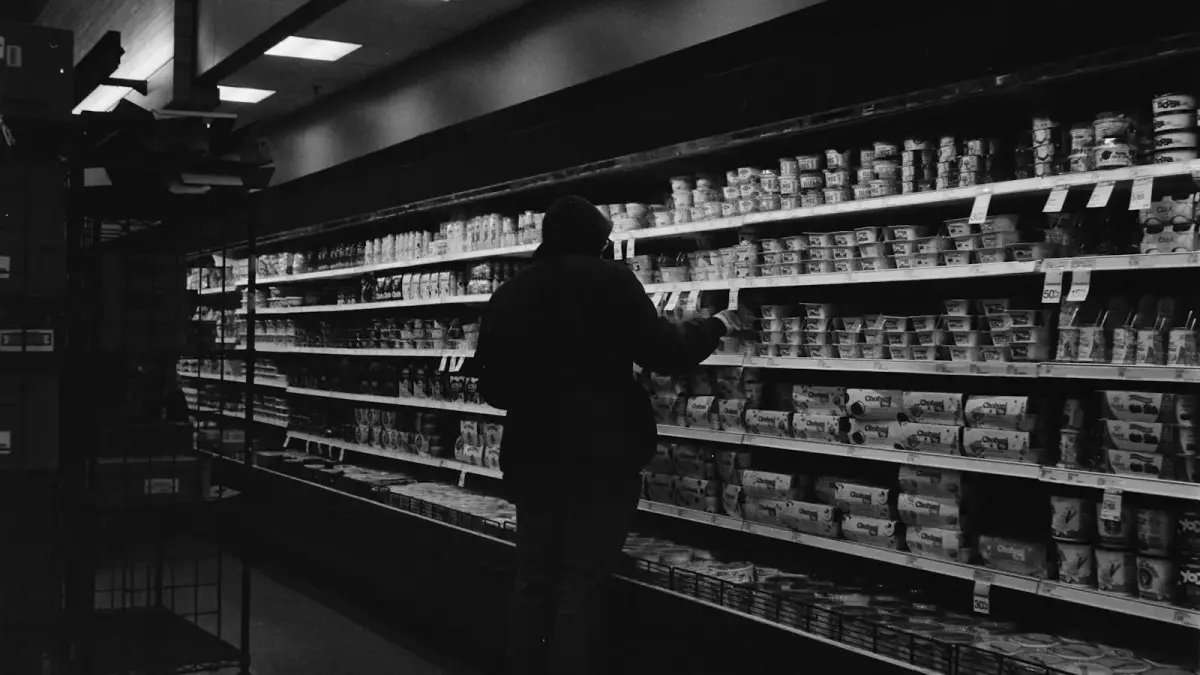
I was standing in the dairy aisle last Tuesday when I caught myself doing it again.
My hand was on a gallon of whole milk, but my eyes had already moved to the price tag on the one beside it. Eleven cents cheaper. Store brand. Same milk, different label.
I put the first one down and picked up the cheaper one.
I make good money. I have made good money for over twenty years. My house is paid off, my retirement fund could weather a rough decade, and I have not worried about making rent since I was thirty-two.
There is no rational reason for me to care about eleven cents.
But my hand made the switch before my brain could weigh in. The way it always does. The way it has done in every grocery store I have walked through since I was old enough to push a cart.
I am 59 years old, and I can tell you the price of milk at three different stores within six miles of my house. I know which one runs sales on Tuesdays. I know which one quietly raised their price by thirty cents last month.
Ask me what I want for my birthday, and I will stare at you like you have asked me to solve a math problem in a language I have never studied.
The Dairy Aisle Was a Classroom
My father was a pipefitter who worked rotating shifts at a chemical plant outside Baton Rouge. He never complained about the work. What tightened his face was not the labor but what came after - the arithmetic of keeping a family of five fed on a wage that assumed you were keeping no one but yourself.
I was maybe nine or ten when I started going to the grocery store with him on Saturday mornings. He never made it a lesson. He never said “watch how I do this” or “this is what being responsible looks like.”
He just shopped the way he always shopped - with a kind of focused quiet that I would not understand until decades later.
He would stand in the dairy aisle and hold one gallon in his left hand while his right hand reached for another. He would look at both price stickers. Sometimes the difference was eight cents, sometimes fifteen.
He always took the cheaper one.
I watched his eyes move across the shelves the way other kids watched their fathers scan a football field. He was reading the prices the way a man reads weather - not for information, but for warning.
The Checkout Register Was a Mood Barometer
The real reading happened at the register.
I learned to watch my father’s face the way a sailor learns to watch the sky. Not because anyone taught me to, but because the feel of our house on any given evening depended on a number that appeared on a small screen at the end of a conveyor belt.
When the total was low - under forty dollars, which was the invisible line I had calculated by the time I was eleven - his shoulders would drop half an inch. He might make a small joke to the cashier. Those were the drives home where the radio played and he might ask me about school, and school felt like a thing worth talking about.
When the total climbed past fifty, his jaw would set. Not dramatically. Not in a way a stranger would notice.
But I noticed. I had been calibrating my entire childhood against the angle of that jaw.
A tight jaw at the register meant a quiet drive home. A quiet drive home meant a particular kind of evening - the kind where my mother moved through the kitchen with deliberate softness, where my sisters and I found reasons to be in our rooms, where the television stayed off because no one wanted to be the person who asked for anything else.
Nothing bad happened on those nights. That is important to say. My father was not a violent man.
He was a scared one. And scared men go quiet in a way that fills a house more completely than noise ever could.
The Nervous System That Never Got the Memo
A 2019 study published in Psychological Science found that people who grew up in economically unstable households show heightened physiological stress responses to financial cues - even after achieving financial security. Their cortisol levels spike in response to price increases, billing notifications, and economic news at rates significantly higher than people who grew up in stable homes.
The researchers called it economic hypervigilance.
I call it the thing that makes me check the price of milk when I could buy the entire dairy case without blinking.
My body does not know that I am financially comfortable. My body knows that the price of everyday necessities is not information - it is surveillance. It is an early warning system that I built when I was nine years old, and it has never been decommissioned.
I check the price of gas every time I pass a station. I know what a pound of ground beef costs at the store near my office versus the one near my house. I mentally calculate the per-unit cost of paper towels while standing in the cleaning aisle, and I do it automatically, the way I breathe.
These are not choices. They are reflexes. They are the residue of a childhood spent learning that the distance between fine and not fine was measured in grocery receipts.
What Do You Want for Your Birthday?
My wife asked me this in April. She asks every year, and every year I experience the same small internal paralysis.
I genuinely do not know.
Not in the way that comfortable people say “oh, I don’t need anything” while secretly hoping for a nice watch. I mean that the question itself feels foreign - like someone asking me to describe a color I have never seen.
I can tell you the price of milk. I can tell you the price of everything in my refrigerator, rounded to the nearest quarter. I can tell you what we spent on groceries last month and how it compared to the month before.
But I cannot name a thing I want for myself. Not easily. Not without the sensation that wanting something for pleasure rather than necessity is a kind of recklessness - a door you do not open because you learned early that wanting was a luxury your family could not afford.
Gabor Mate has written extensively about how children in environments of scarcity learn to suppress their own desires as a survival adaptation. The child who does not want things does not create additional financial pressure. The child who does not ask does not risk being the reason his father’s jaw goes tight.
That boy grows into a man who is very good at monitoring prices and very poor at answering the question: what would make you happy?
The Inheritance No One Talks About
We talk about what fathers leave their sons. We talk about work ethic, values, lessons about shaking a hand or changing a tire.
We do not talk about the other inheritance - the one that lives in the nervous system rather than the memory. The way a boy absorbs his father’s relationship with money not as a philosophy but as a body language.
Financial stress is transmitted not through conversations but through jaw muscles and quiet drives and evenings where the air in the house felt like it had been pressed out of the room.
A 2021 study in the Journal of Research in Personality found that financial behaviors learned in childhood - particularly those acquired through observation rather than instruction - are among the most resistant to change in adulthood. The researchers noted that these behaviors persist even when the individual’s financial circumstances improve dramatically, because they are encoded as safety behaviors rather than financial strategies.
My father never sat me down and taught me to check the price of milk. He did not have to.
I learned it the way children learn everything that matters - by watching what the adults around me were afraid of, and building my own systems to monitor for the same threats.
I am 59 years old. My father has been gone for eleven years. And I am still running his surveillance program in every grocery store I enter.
The Boy at the Register
Here is what I want to say to the men who recognize themselves in this.
You are not cheap. You are not obsessive. You are not irrational for tracking the price of bread and gas and milk when your bank account says you do not need to.
You are the boy who learned to read his father’s face at the register. You are the boy who understood, before you had the words for it, that money was not a resource in your house - it was a weather system. And you became very good at reading the weather because the alternative was being caught in a storm you could not predict.
That skill kept you safe. It made you watchful and responsible and attuned to shifts that other people miss entirely. It is not a flaw.
It is a record of what you survived.
But it is also worth noticing - gently, without judgment - that the storm passed a long time ago. You built your own shelter. The boy at the register does not need to stand watch every Saturday morning anymore.
You might not be able to stop checking the price of milk. I am not sure I ever will. But you can start practicing the other question - the harder one, the one that has nothing to do with cost and everything to do with the life you actually get to live now.
What do you want?
Not what is cheapest. Not what is most practical. Not what creates the least pressure on anyone around you.
What do you want?
It is a difficult question for men like us. It might be the most difficult question we have ever been asked. But the fact that it feels hard does not mean something is wrong with you.
It means you are finally safe enough to ask it.