He's 60 and still cannot throw away food that has gone slightly bad in the refrigerator without a wave of something that has nothing to do with waste - it is a boy who watched his mother stretch every meal into two, rewrap every leftover like it was precious, and who learned before he could spell the word scarcity that throwing food away was the same as saying the hours she spent in that kitchen did not count
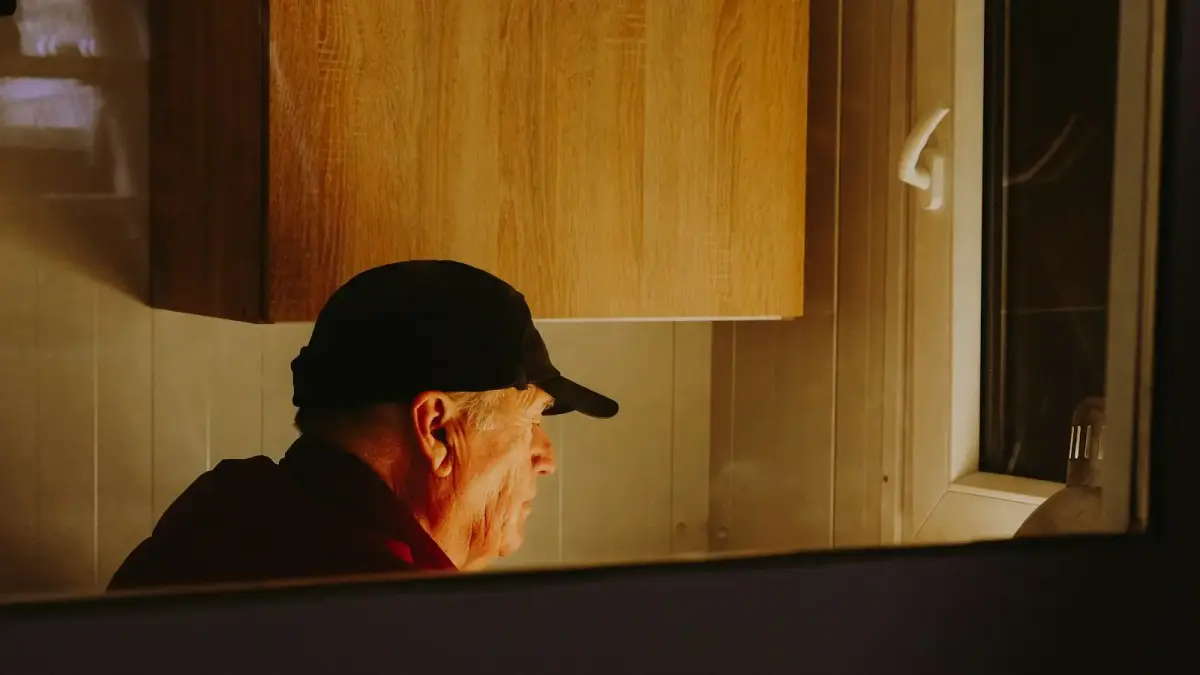
I stood in front of the refrigerator last Tuesday at eleven at night, holding a container of leftover soup that had been there six days. Maybe seven. The smell was already off. I knew it was off. My hand hovered over the trash can for a full thirty seconds before I put it back on the shelf.
My wife found it the next morning and threw it out without a second thought. She didn’t even open the lid. Just picked it up, dropped it in the bin, and moved on to making coffee.
And something in my chest tightened in a way I still don’t fully understand.
I’m sixty years old. I’ve had a good career. The refrigerator in our kitchen is a stainless steel double-door model that cost more than my parents’ first car. It is always full. There is no rational reason for what happens to me when food gets thrown away. But the feeling doesn’t care about rational reasons. The feeling is older than reason. It lives somewhere beneath language, in the body of a boy who watched his mother turn a single chicken into three different meals and still worry it wasn’t enough.
The Kitchen Was Never Just a Kitchen
My mother cooked like she was solving a math problem with no good answer. Every meal was a negotiation between what we had and what we needed, and she always made the numbers work, but you could see the cost of that arithmetic on her face.
Soup got watered down on day two. By day three she’d add bread to fill the gap - not because bread and soup was a recipe, but because bread was cheap and stomachs needed filling. Leftovers weren’t leftovers. They were tomorrow’s lunch, relabeled and reimagined.
She had a system for everything. Aluminum foil got smoothed flat after use, folded, and stored in a drawer for next time. Plastic containers were labeled with masking tape and a ballpoint pen - the date, the contents, an unspoken instruction that this food had value and was not to be forgotten. The heel of every loaf of bread became breadcrumbs. Vegetable scraps went into a freezer bag that eventually became stock.
None of this was trendy zero-waste living. None of it was environmental consciousness. It was survival dressed up as routine, and I absorbed every single lesson before I was old enough to know what I was learning.
What the Boy Internalized
Children don’t understand economics. They understand atmosphere.
I didn’t know the word “scarcity” when I was seven. But I knew the feeling of it. I knew the way the house got quieter near the end of the month. I knew that certain questions - Can we get pizza? Can I have seconds? - carried weight that other kids’ questions didn’t.
I knew, without anyone ever saying it directly, that food was not just food. Food was my mother’s time. Food was my father’s labor. Food was proof that the system was holding together, that we were going to be okay. And wasting it - leaving half a plate, letting something spoil, throwing anything away - was a kind of betrayal.
A 2018 study published in Psychological Science found that people who experienced resource scarcity in childhood continued to exhibit scarcity-related behaviors decades later, even after achieving financial stability. The researchers called it “scarcity imprinting” - the idea that early experiences of not having enough create neural pathways that persist long after the environment has changed.
I didn’t need a study to tell me this. I feel it every time I stand at that refrigerator.
The Shame That Has No Name
Here’s what’s hard to explain to someone who didn’t grow up this way: it’s not about the food.
When my wife throws out leftovers, she’s making a practical decision. The food is old. It might make someone sick. The container needs washing. She is being sensible and hygienic and entirely correct.
But what I experience in that moment is not a disagreement about food safety. It’s a flash of something closer to shame - hot, wordless, and completely disproportionate to the situation. For a split second, I am not a grown man in a comfortable kitchen. I am a boy watching someone disrespect his mother’s work.
That’s the part I’ve never been able to say out loud until now. The guilt isn’t really guilt. It’s loyalty. Loyalty to a woman who spent hours in a kitchen that was too small, with ingredients that were never quite enough, performing a daily miracle that nobody thanked her for. Throwing food away feels like saying those hours didn’t count. Like saying her effort wasn’t worth remembering.
I know this is irrational. I know it with my whole adult brain. But the boy doesn’t know it. The boy never got the memo that things are different now.
The Nervous System Never Got the Update
Gabor Mate has written extensively about how the body stores early experiences as physical responses that outlast the circumstances that created them. The body, he argues, doesn’t distinguish between a real threat and a remembered one. It simply reacts.
This is what happens to me at the refrigerator. My conscious mind knows that throwing out a container of week-old rice is not a crisis. But my nervous system - the one that was calibrated in a household where every grain of rice represented something - responds as if it is.
A 2021 study in the Journal of Personality and Social Psychology found that adults who grew up in lower socioeconomic environments showed heightened physiological stress responses to situations involving resource waste, even when they had been financially secure for twenty or more years. The researchers noted that these responses were automatic and largely unconscious - not a choice, but a reflex.
I think about that word a lot. Reflex. Because that’s exactly what it is. I don’t decide to feel guilty when food gets thrown away. I don’t choose the tightness in my chest or the impulse to rescue something from the trash. It just happens, the way flinching happens, the way your hand pulls back from a hot stove before your brain even registers the heat.
Forty years of financial comfort have never updated this programming. Not once.
The Class Wound Nobody Talks About
There’s a particular loneliness in carrying this kind of body memory into a life that looks nothing like where you came from.
I sit at dinners with friends who order too much food and leave half of it on the table without flinching. I watch my own children scrape plates into the garbage and feel something I can’t express without sounding like I’m lecturing them. I’ve learned to stay quiet about it, because the few times I’ve tried to explain, the response has been some version of “it’s just food” delivered with a kindness that somehow makes it worse.
It’s not just food. It was never just food.
This is a class wound, and it operates differently from the ones people write books about. Nobody calls it trauma. Nobody diagnoses it. It doesn’t show up on any intake form at the therapist’s office. It just sits there, quietly shaping your relationship with abundance, making you feel like a guest in your own comfortable life.
Sendhil Mullainathan and Eldar Shafir’s research on the scarcity mindset showed that poverty doesn’t just limit resources - it reshapes cognition itself. The mind that grew up counting becomes a mind that can’t stop counting, even when there’s nothing left to count. The vigilance that was once necessary becomes a permanent setting, running in the background of every decision.
I see this in myself constantly. Not just with food - though food is where it’s loudest - but with money, with heat, with leaving lights on in empty rooms. Every form of waste triggers the same ancient alarm.
What My Wife Doesn’t Know She’s Witnessing
My wife grew up differently. Not wealthy, but comfortable in the way that means you never had to think about whether there was enough. She loves me and she’s patient with what she calls my “thing about leftovers.”
But I don’t think she fully understands what she’s witnessing when I stand at that refrigerator, unable to let go of a container of food that any reasonable person would throw away.
She’s witnessing a conversation between two versions of me - the man I became and the boy I was. She’s witnessing a loyalty so deep it’s become physical, stored not in memory but in muscle and nerve and gut response. She’s witnessing the residue of a household where love was expressed through the refusal to let anything go to waste, because wasting was a luxury we couldn’t afford, and my mother’s pride wouldn’t allow it even if we could.
Sometimes I catch myself smoothing aluminum foil flat before I throw it away. I don’t reuse it. I just smooth it. Like a ritual I’m performing for no one.
The Refrigerator Is a Time Machine
I’m sixty now. I’ve spent more years in abundance than I ever spent in scarcity. By any measure, the math should have updated by now. The spreadsheet should reflect current conditions.
But the body doesn’t run on spreadsheets. The body runs on first impressions, on the earliest lessons, on whatever got written into the operating system before the conscious mind came online. And what got written into mine, in that small kitchen with the linoleum floor and the humming refrigerator that was never quite full enough, was this: food is love made visible. Wasting it is a sin against the person who made it. Throwing it away means forgetting where you came from.
I don’t want to forget where I came from. That’s the thing nobody tells you about this particular kind of guilt - it’s tangled up with love, and pulling them apart would mean losing something you’re not willing to lose.
So I stand at the refrigerator. I hold the container. I feel the wave.
And sometimes I put it back on the shelf, not because I think I’ll eat it, but because throwing it away still feels like a small act of disloyalty to a woman who deserved more recognition than she ever got for the daily miracle of feeding a family on almost nothing.
This isn’t a flaw. It’s not something that needs to be fixed or therapized away. It’s a record, written in the body, of a kind of love that most people never had to learn. The love that counts every grain, stretches every meal, and treats a container of leftover soup like it still matters - because once, not so long ago, it was the only thing between your family and hunger.
If you carry this too, you already know. You don’t need me to explain it. You just need someone to say that the weight of it is real, and the boy who learned it was paying attention to something important, and the fact that you still feel it after all these years doesn’t make you broken.
It makes you someone who remembers. And remembering is its own kind of love.