He is 60 and has just realized that he has never once thrown away a container that might be useful - that the garage holds thirty years of coffee cans with their labels scrubbed off, margarine tubs stacked six deep, and glass jars cleaned and dried and lined up on a shelf waiting for a purpose that never arrives - not because he is a hoarder or cannot let things go but because a boy who watched his mother wash out and save every container that came through the front door learned before he could name the lesson that throwing something useful away was something only families with money did, and the man at sixty keeping a cleaned-out pasta sauce jar he will never use is not sentimental but still the boy whose mother taught him that waste was the one luxury their kind of people could never afford
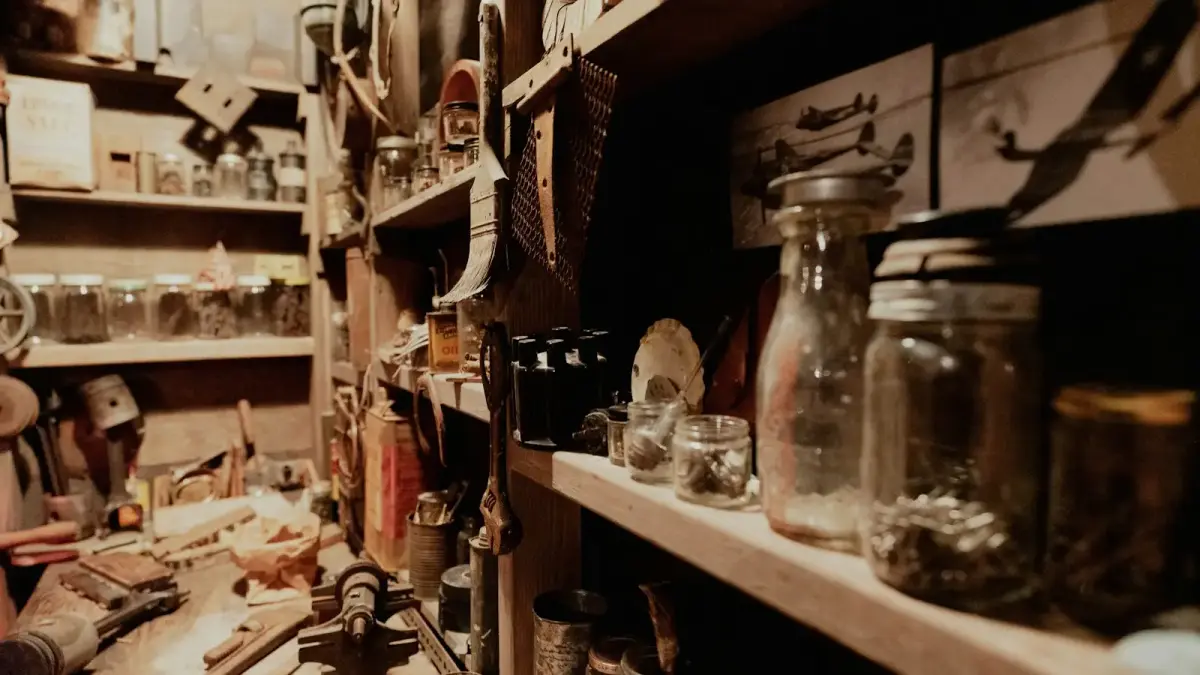
I was standing in my garage last Saturday looking for a box of screws when I noticed the shelf above the workbench. Three rows of glass jars, all clean, all empty, all facing forward with their lids screwed on tight. Behind them, a stack of margarine tubs I could not remember buying. Coffee cans with the labels peeled off, their metal still shining because someone - me, apparently - had wiped them down before putting them away.
I stood there for a long time.
Not because the shelf surprised me. I had built it myself twenty years ago specifically to hold these things. What surprised me was realizing I had never once questioned why.
My wife has asked me about the containers for years. She calls it my collection, and she says it gently, the way you talk about something you have decided to find endearing rather than strange. Our kids joke that if civilization collapses, Dad’s garage will be the community supply depot. They are not wrong. There are containers in there older than my marriage.
But standing in that garage, sixty years old and holding a pasta sauce jar I had just finished rinsing at the kitchen sink, I understood something I had never put into words. I was not saving containers. I was saving my mother.
The arithmetic she never had to explain
My mother washed every container that came through our front door. Every single one. Peanut butter jars, cottage cheese tubs, the plastic trays from deli meat. She would stand at the kitchen sink after dinner and scrub them out with the same focus she brought to the actual dishes, and then she would dry them and stack them in the cabinet above the refrigerator.
Nobody told her to do this. Nobody gave her a Pinterest board on creative reuse. She did it because in our house, a clean container was not trash. It was a resource.
A coffee can held nails on my father’s workbench. Margarine tubs stored leftovers because we did not own matching Tupperware. Glass jars became drinking glasses when a set broke and replacing it was not in the budget.
I understood the math before I understood fractions. Every container that left the house in a trash bag was a container we might need to buy later. And buying things we already had - that was what careless people did. That was what people with money did.
My mother never said the word “class.” She never talked about being poor, and I think she would have been insulted by the word. We were not poor. We were careful. We were people who noticed things, who saw the second life hiding inside something other families just threw away.
But the difference between careful and poor is mostly a matter of whether you had a choice.
What scarcity teaches a child’s hands
A 2018 study published in the Journal of Personality and Social Psychology found that people who experienced resource scarcity in childhood develop what researchers call “persistent resource management strategies” - behavioral patterns around saving, storing, and reusing that remain active decades after the scarcity itself has ended. The brain, it turns out, does not update its threat assessment just because the bank account has changed.
I find this both comforting and devastating.
Comforting because it means I am not strange. Devastating because it means the boy at the kitchen sink learning to scrub labels off tin cans was absorbing a survival lesson his nervous system would never fully release.
My mother’s hands were always rough. I remember that. Cracked at the knuckles from dish soap and hot water, and she never once complained about it. She would stand at that sink and wash a yogurt container with the same seriousness she washed the good plates, and if you had asked her why, she would have looked at you like you had asked why she locked the front door at night.
You save what might be useful. You do not throw away what still works. This was not a philosophy in our house. It was gravity.
And I absorbed it the way children absorb everything - not through the words but through the watching. Through the way her hands moved. Through the way she dried each container and placed it on the shelf with a kind of quiet satisfaction, as if she had just won something small but real.
The gap between knowing and feeling
I make good money now. I have made good money for twenty years. My retirement account has numbers in it that would have made my parents cry, and my kitchen has three sets of matching containers with color-coded lids that my wife bought from a catalog.
And I still cannot throw away a jar.
I know this does not make sense. I know the pasta sauce jar I rinsed last Saturday will sit on that shelf for years, waiting for a purpose I will never assign it. I know that the coffee cans are not holding anything. I know that the margarine tubs stacked in the corner have been there so long they have started to yellow.
But knowing and feeling are different countries, and I have never found a bridge between them.
Psychologist Sendhil Mullainathan, whose research on scarcity has reshaped how we understand poverty’s lasting effects, describes how scarcity creates a kind of cognitive tunnel - a way of seeing the world that persists long after the scarcity is gone. You do not simply grow out of it when your circumstances improve. The tunnel stays. You just walk through it carrying nicer things.
That is what my garage is. A tunnel with good lighting and a workbench I built myself.
What people with money will never understand
There is a particular kind of confidence that comes from never having worried about a container. From never having stood in a kitchen wondering if the jar you just emptied should be washed or thrown away, because in your house, the answer was always obvious. You threw it away. You bought new ones when you needed them.
I did not grow up with that confidence. I grew up with the other kind - the kind that looks like carefulness but feels like vigilance. The kind where you learn to scan every object for its hidden usefulness, because in a house where money was geometry - you could see its shape, you could feel its edges, but there was never quite enough of it to fill the space - the ability to see a second life in a thing was not charming. It was necessary.
My mother could look at a coffee can and see six things it could become. A pencil holder for the counter. A planter for the windowsill. A container for bacon grease. A bank for loose change. A vessel for nails and screws. A gift container for cookies at Christmas, lined with wax paper and topped with a rubber band.
She was brilliant at this. And her brilliance was born entirely from the fact that she could not afford not to be.
The containers are not the point
A 2021 study in Frontiers in Psychology examined how socioeconomic status in childhood shapes adult attitudes toward waste and disposal. Researchers found that adults who grew up in lower-income households were significantly more likely to experience what they called “disposal anxiety” - a measurable discomfort at throwing away objects perceived as potentially useful, even when replacement cost was negligible.
Disposal anxiety. I read those words and felt the back of my throat tighten.
Because that is exactly what it is. Not hoarding. Not sentimentality. Not some inability to let go of physical objects. It is anxiety - a low, steady hum that says if you throw this away, you are being the kind of person your family could not afford to be.
And the thing nobody tells you about class - the thing that books about upward mobility always seem to skip - is that you can change your tax bracket without changing your nervous system. You can earn six figures and still feel a small pulse of guilt when you throw away a container that still has a good lid.
The containers in my garage are not about containers. They are about the distance between where I started and where I am. They are about a woman who stood at a kitchen sink and made something out of nothing every single day, and a boy who watched her and learned that the world divides people into two groups - those who can afford to throw things away and those who cannot.
The jar on the shelf
My mother passed away eleven years ago. Her kitchen was immaculate when we cleaned it out. Under the sink, she had a stack of folded grocery bags. In the cabinet above the refrigerator, there were thirty or forty containers - washed, dried, stacked, waiting.
My sister wanted to throw them all away. I took six of them home.
They are on the shelf in my garage right now. Not because they are useful. Not because I think I will need them. But because throwing them away would mean agreeing that they were never worth saving, and I am not willing to do that. Not to her. Not to the version of me who stood next to her at that sink and learned without words that the things other people discard still hold something worth keeping.
I am sixty years old. I have a garage full of containers I will never use. And I have finally stopped asking myself why.
The answer was always the same. It was always her hands at the sink, the way she turned a jar under the faucet and held it up to the light to check for residue, the small nod she gave when it was clean enough. The way she placed it on the shelf like she was putting something precious away.
She was. She just did not know anyone would remember.
I rinse the pasta sauce jar. I dry it with a dish towel. I carry it to the garage and set it on the shelf next to the others.
And I do not feel foolish. I feel like her son.