He's 61 and just realized he always places his hand on the small of his wife's back when they walk through a crowd - not possessiveness or any kind of display, but the exact gesture his father performed with his mother at every church door and grocery store for forty years, and a boy who watched a man guide a woman through the world with nothing but the quiet flat of his palm learned that love in public is not something you announce but something you navigate with the architecture of where you place your hand
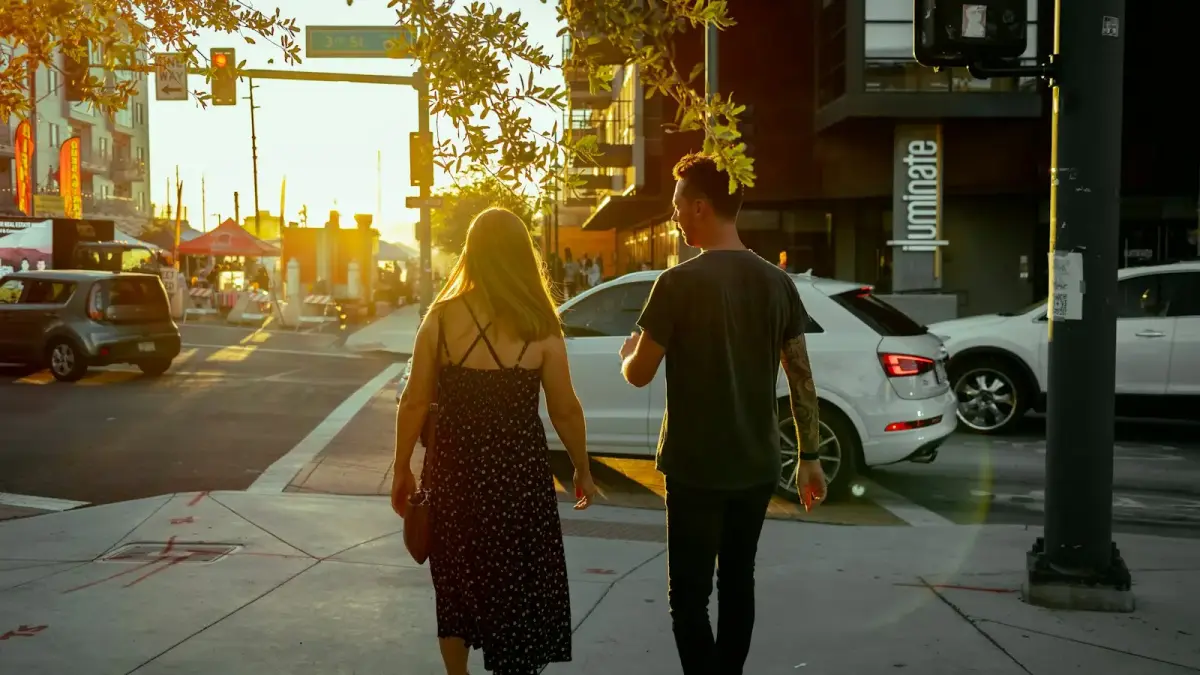
It happened at a restaurant two weeks ago. Saturday night, busy hostess stand, a dozen people shifting around the entrance waiting for tables. My wife stepped forward and my hand went to the small of her back - not a push, not a steer, just a landing. The flat of my palm resting between her shoulder blades and her waist like it had done this ten thousand times before.
Because it had.
I am sixty-one years old, and I have been placing my hand on the small of my wife’s back in crowded spaces for the entirety of our thirty-four-year marriage. I never decided to do it. I never thought about it. I never once stood at the edge of a parking lot and told myself, “Okay, Marcus, hand on her back now.” It just happened - the way breathing happens, the way blinking happens. The crowd appeared and my hand found its coordinates.
What stopped me that night was the flash of recognition. Not of my own hand, but of my father’s. The exact same gesture, performed at every church entrance, every grocery store, every family gathering where the room got loud and the bodies got close. His right hand, open and steady, pressed gently against my mother’s lower back as they moved through the world together.
I learned love from the architecture of where a man places his hand. And I did not know I had learned it until I was sixty-one.
The Gesture Nobody Teaches You
There is no class for this. No father sits his son down and says, “When you walk through a crowd with the woman you love, you place your hand here.” No manual exists. No diagram. No instructional video.
And yet men do it. Millions of them. The hand on the small of the back - not the shoulder, not the arm, not the wrist. The small of the back. That specific, deliberate location that says something no other touch quite says.
It is not a grab. It is not a claim. If you have ever watched it done right, you know the difference immediately. The hand does not grip. The fingers do not curl. The palm simply arrives, open and flat, and it stays there like a quiet sentence that does not need punctuation.
I spent decades performing this gesture without understanding its grammar. But grammar it has. A 2016 study published in the Journal of Nonverbal Behavior found that touch location carries distinct relational meaning - touches to the lower back between romantic partners consistently signaled protective connection rather than dominance or control. The researchers noted that this particular placement communicated what they called “affiliative guardianship” - a way of saying I am with you, not I own you.
My father never read that study. He just knew where his hand belonged.
Watching a Man Love a Woman in Public
My father was not a demonstrative man. He did not say “I love you” in front of other people. He did not hold my mother’s hand at the dinner table or kiss her in the kitchen when company was over. He was born in 1934. His emotional vocabulary was built with different materials.
But I watched him. Boys watch their fathers the way linguists watch native speakers - not for what they say, but for how they move through the language of being alive.
Every Sunday morning, the church parking lot. My mother in her good dress, my father in his sport coat. The walk from the car to the front doors. And there it was - his hand, rising without thought, settling against the fabric of her back as they crossed the threshold into the crowded foyer.
Every Friday evening, the grocery store. My mother pushing the cart, my father beside her. When the aisle got narrow and someone needed to pass, his hand went to her back. Not to move her. To be with her.
I did not catalog these moments as a child. I did not think, “That is how a man loves a woman.” I just absorbed it the way you absorb the accent of the place where you grew up. It entered my body before it entered my mind.
What Gets Passed Through the Body
We talk a lot about inherited trauma these days. We talk about the wounds our parents gave us, the anxieties they transmitted, the attachment styles they installed like operating systems we spend decades trying to update.
We talk far less about inherited tenderness.
But it is real. It is as real as the inherited flinch, the inherited silence, the inherited fear of raised voices. Our bodies learn love the same way they learn everything else - through repetition, observation, and the slow accumulation of what the people around us did without thinking.
A 2019 study in Developmental Psychology examined how children internalize parental touch patterns and found that physical affection styles are among the most reliably transmitted behaviors across generations. Children who observed consistent, gentle touch between their parents were significantly more likely to reproduce those exact touch patterns in their own adult relationships - often without any conscious awareness of doing so.
I am living proof. Thirty-four years of placing my hand on my wife’s back in crowded rooms, and I never once connected it to the man who showed me how.
The Small of the Back Is Not a Random Location
There is something about that specific spot. Below the shoulder blades, above the waist. It is the center of a person’s body - not their emotional center, but their structural one. The place where balance lives.
When you place your hand there, you are not steering. You are stabilizing. You are saying, with the flat of your palm, “I know where you are. I am not going to lose you in this crowd. You can move however you want to move, and I will be right here, matching your direction.”
It is such a small gesture. Five inches of contact. No force behind it. And yet my wife told me, after I mentioned this realization at dinner, that she has always felt it. Every single time.
“I never think about it either,” she said. “But when your hand is there, I know you’re there. And when it’s not, I notice.”
Thirty-four years. She noticed every time.
The psychologist Daniel Goleman has written extensively about what he calls the “neural duet” between people in close relationship - the way two nervous systems learn to co-regulate through physical proximity and touch. What my wife described is exactly that. Not a conscious thought, but a felt sense. A body recognizing the presence of its person through five inches of palm.
The Things Men Do Not Know They Are Saying
I think about all the men my age who perform this gesture without knowing its origin. Men who watched their fathers, their grandfathers, their uncles guide women through crowded spaces with nothing but an open hand and a steady presence. Men who absorbed this vocabulary of care so early and so completely that they mistake it for instinct.
It is not instinct. It is inheritance.
And it is worth sitting with that for a moment. Because if we inherited this - this quiet, beautiful, wordless act of public love - then our fathers gave us more than we usually credit them for. Even the ones who could not say it. Even the ones whose mouths never formed the words “I love you” in front of another living person.
They said it with the flat of their palm on a Sunday morning. They said it in a grocery store aisle. They said it at every threshold where the world got crowded and they wanted the woman beside them to know she was not navigating it alone.
My father has been gone for eleven years. He never told me how to love my wife. He never sat me down and explained what a marriage requires or what a woman needs or what a man is supposed to do when the room fills up and the noise gets loud.
He just put his hand on my mother’s back.
And I became the kind of man who puts his hand on his wife’s back. Not because someone told me to. Because a boy stood in a church parking lot forty-five years ago and watched the only lesson he would ever need.
Love as Navigation
Here is what I understand now that I did not understand two weeks ago. Love in public is not a performance. It is not the couples who kiss at restaurants or hold hands for the camera or announce their devotion in ways designed to be witnessed.
Love in public is navigation. It is the way two people move through a space together. It is the geometry of how close you stand, which side you walk on, and yes - where you place your hand when the crowd thickens and the room gets small.
My hand on my wife’s back is not a display. It is a compass. It says, “This is where I am.” It says, “This is who I am with.” It says, “We have been walking through crowded rooms together for three decades and I have not once forgotten that you are beside me.”
I am sixty-one years old. I have no idea how many times I have placed my hand on the small of my wife’s back. Thousands, probably. Maybe tens of thousands.
Every single one of them was my father’s hand first.
And every single one of them was my way of saying what he said, in the only language he trusted, with the only vocabulary that ever made it from his generation to mine fully intact.
You do not announce love.
You navigate it. With the quiet, open, unhesitating flat of your palm.