He's 61 and still keeps his father's tools in the garage even though most of them are rusted and none of them are the right size anymore - not because they're useful but because a wrench placed in a boy's hand without a word was the closest his father ever came to saying I am proud of you and the weight of the thing is the only part of that sentence he can still hold
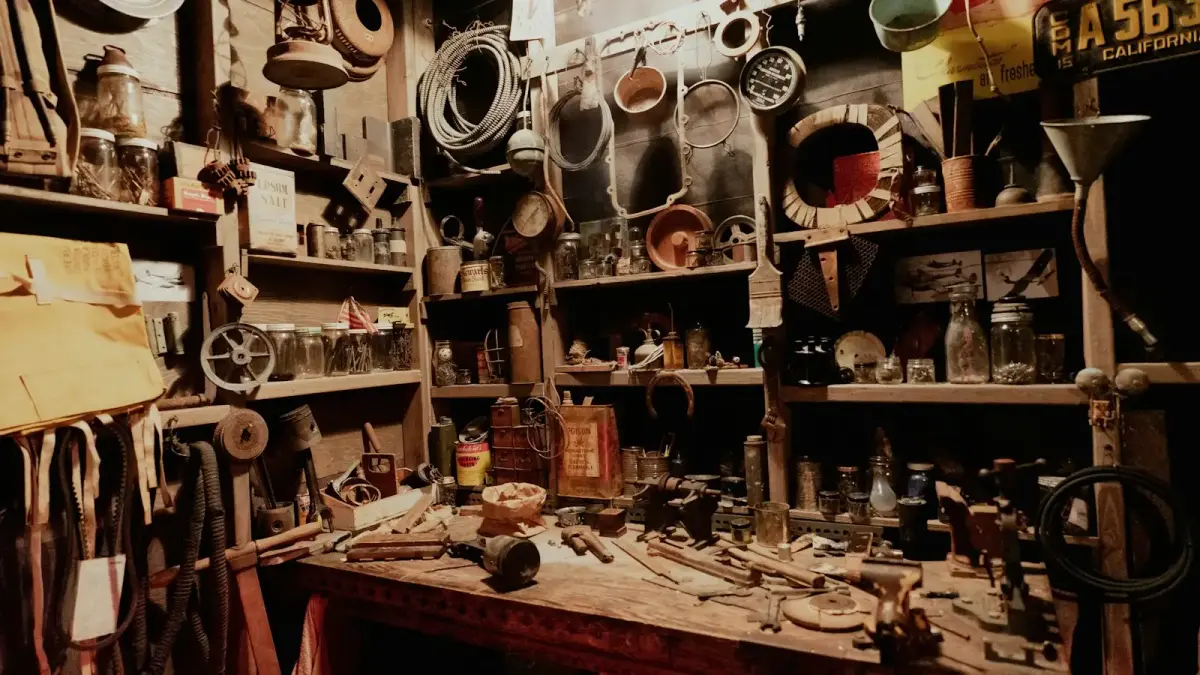
My neighbor Gary let me into his garage last fall to borrow a socket set, and I ended up standing in there for almost an hour.
Not because I couldn’t find it. Because I couldn’t stop looking at everything else.
On the back wall, hung on nails that were themselves rusting into the drywall, was a collection of tools that hadn’t been functional in years. A ball-peen hammer with a cracked handle wrapped in electrical tape. A set of box wrenches so corroded the sizes had worn off. A hand drill with a chuck that no longer tightened. A level with a bubble that had long since gone still.
I asked Gary if he wanted help clearing them out. He looked at me like I’d suggested we burn down his house.
“Those were my dad’s,” he said. And then he didn’t say anything else for a while. He just stood there, sixty-one years old, looking at a pegboard full of tools that couldn’t fix anything anymore, and something in his face made it very clear that fixing things was never what they were for.
The first time a hand reached down and meant something
Gary’s father was a pipe fitter in southern Ohio. Came home most nights with grease in the creases of his knuckles that never fully washed out. He didn’t talk much. Not because he was angry or cold - Gary is very clear about this - but because talking wasn’t the currency he’d been raised on.
What his father did was fix things. Everything. The screen door, the lawnmower, the neighbor’s fence, the church basement sink. On Saturday mornings, he’d open the garage and start working on whatever needed working on, and at some point - Gary says he was probably five or six - his father reached down and handed him a wrench.
No instruction. No preamble. Just a wrench, placed in a boy’s hand, and a nod toward a bolt.
“I didn’t know which way to turn it,” Gary told me. “I just started trying. And he didn’t correct me right away. He let me struggle with it. And when I finally got it to move, he didn’t say anything. He just handed me the next one.”
That was the lesson. That was the entire curriculum.
A 2018 study published in the Journal of Family Psychology found that in working-class families, instrumental communication - teaching through shared tasks rather than verbal expression - often serves as the primary vehicle for emotional bonding between fathers and sons. The researchers noted that these fathers weren’t withholding affection. They were expressing it through the only channel that felt safe and legitimate within their cultural framework.
Gary’s father wasn’t being silent. He was being fluent in the only language he’d ever been taught.
The vocabulary of competence
Here’s what a wrench in a boy’s hand actually says, when you translate it out of the silence it arrives in.
It says: I trust you with this. It says: I believe your hands can do what my hands do. It says: you are not too small for the real work. It says: I am letting you into the part of my life where I feel most like myself, which is here, in this garage, with grease on my knuckles and a problem to solve.
Gary told me his father never once said he was proud of him. Not at his high school graduation, not when he got into trade school, not when he bought his first house. The man came to every one of those events, sat in the back, and drove home. But in the garage, something different happened. In the garage, when Gary got the bolt to turn or held the flashlight at exactly the right angle or figured out which socket fit without being told, his father’s silence changed texture.
“You know how a room can feel different even though nothing’s moved?” Gary said. “That’s what it was like. The quiet got warmer.”
That warm quiet was the closest his father ever came to a standing ovation.
Donald Winnicott, the British psychoanalyst who spent decades studying how children form attachments to objects, described what he called transitional objects - the blankets and stuffed animals that children imbue with emotional significance because they represent the felt presence of a caregiver. What Winnicott didn’t fully explore, and what researchers have only recently begun examining, is how this dynamic extends well into adulthood. A 2021 paper in Frontiers in Psychology found that adults maintain deep emotional bonds with physical objects connected to deceased loved ones, and that these bonds serve a continued regulatory function - the objects don’t just represent the person, they provide ongoing emotional stability.
Gary’s wrenches aren’t souvenirs. They’re still doing the job they always did. They’re still saying the thing his father couldn’t.
The bolt you couldn’t turn
Not every Saturday in the garage was warm.
Gary told me about a time - he was maybe twelve - when he stripped a bolt on the lawnmower deck. Cross-threaded it, then forced it, and by the time his father saw it the whole assembly was damaged. His father didn’t yell. He took the wrench out of Gary’s hand, looked at the bolt, and walked inside the house without a word.
He came back twenty minutes later with a cup of coffee and a new bolt from the hardware store. They fixed it together. His father never mentioned it again.
“But I still think about it,” Gary said. “That twenty minutes he was inside. I stood in the garage and I felt like I’d failed him in a way I couldn’t fix. Not because of the bolt. Because I’d been given this one thing - this one place where we were something together - and I’d broken it.”
This is what people miss about the emotional lives of boys who grew up in these households. The stakes of the garage weren’t mechanical. They were relational. Every task was a test of belonging, and the boy knew it even if the father didn’t.
A 2020 study published in the Journal of Research in Personality examined how men from working-class backgrounds process paternal approval and found something remarkable: the participants consistently described moments of competence - fixing something, building something, solving a mechanical problem - as the primary evidence that they were valued by their fathers. Not words. Not physical affection. Proof that their hands could do what their father’s hands could do. That was the love language, and it was the only one on offer.
When Gary stripped that bolt, he didn’t break a lawnmower. He broke the sentence his father was trying to say. And thirty minutes of silence felt like a paragraph being crossed out.
The inheritance nobody puts in a will
Gary’s father died in 2009. Heart attack, the kind that arrives on a Tuesday afternoon with no warning. Gary drove down from Columbus and got there too late by about forty minutes.
He handled the funeral arrangements. He sold the house. He sorted through closets and dresser drawers and the accumulated debris of a man’s life.
But when he got to the garage, he stopped.
“I couldn’t do it,” he told me. “My wife said, ‘Just take what’s useful and donate the rest.’ And I stood there looking at that pegboard and I thought - none of it’s useful. All of it is necessary.”
He loaded every tool into the back of his truck. Drove them four hours north. Hung them on his own garage wall in approximately the same arrangement his father had kept them in.
His wife thought he was being sentimental. He wasn’t. Sentiment implies a kind of soft fondness - a warm feeling you can smile about. What Gary was doing was more urgent than that. He was preserving evidence.
Evidence that he was chosen. Evidence that he was taught. Evidence that a man who couldn’t say “I’m proud of you” found a way to put the weight of that sentence into a half-inch socket wrench and hand it to a boy who has been carrying it ever since.
Psychologist Gabor Mate has written extensively about how unexpressed emotion doesn’t vanish - it migrates into the body, into objects, into rituals. The tools on Gary’s wall are holding the emotional content that his father’s words never carried. They’re not memorabilia. They’re vessels. Throwing them away would be like burning the only letter someone ever wrote you - especially if the letter was written in a language only the two of you spoke.
What the rust is actually saying
Here’s something Gary told me that I keep coming back to.
“The rust doesn’t bother me,” he said. “If anything, it makes them more real. My dad’s hands were never clean. His tools were never pristine. Everything he owned showed wear because he actually used it. The rust is just the tools doing what he did - getting older, getting worn, still showing up.”
There’s a kind of honesty in a tool that has outlived its function. It can’t pretend to be useful anymore. It can only be what it is: an object that was once held by someone who mattered, used for work that mattered, passed to a hand that was being told - without a single word - that it belonged in the conversation.
The men who keep these tools aren’t hoarders. They aren’t stuck in the past. They’re loyal to a vocabulary that nobody else can read. When Gary looks at that pegboard, he doesn’t see rust and cracked handles. He sees Saturday mornings. He sees the angle of light through a garage window at eight a.m. He sees a hand reaching down. He sees the nod.
A 2022 study in Psychological Science found that physical objects associated with deceased attachment figures activate the same neural regions as direct social connection - the brain processes the object not as a thing but as a relationship. The wrench isn’t a proxy for Gary’s father. As far as Gary’s nervous system is concerned, the wrench is a conversation still in progress.
The weight you can still hold
I think about Gary sometimes when I hear people talk about how men need to learn to express their emotions, as if expression only counts when it arrives in words. As if the man who hands his son a wrench and lets the boy figure out which way to turn it isn’t saying something enormous. As if the silence in a garage on a Saturday morning isn’t its own kind of eloquence.
Gary’s father said what he needed to say. He said it with a three-eighths drive ratchet and a nod and the particular quality of quiet that settles between two people when one of them has just proven - to himself and to the man watching - that his hands work.
Those tools are rusted now. The sizes are wrong for anything Gary actually needs to fix. The handles are cracked and the edges are dull and no reasonable person would use them for their intended purpose.
But their intended purpose was never to fix things.
Their intended purpose was to carry a sentence that a man spent his whole life trying to say and a boy spent his whole life trying to hear, and the weight of a half-inch wrench is the only part of that sentence either of them could hold in their hands at the same time.
Gary keeps them because they still work.