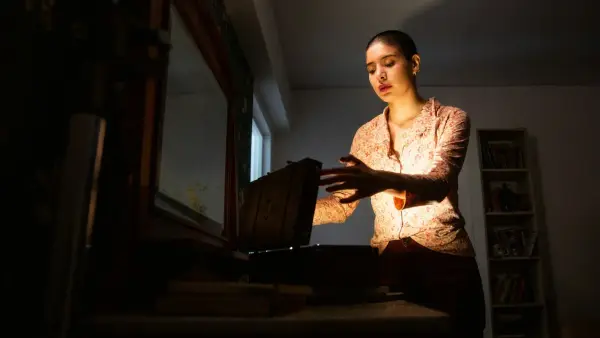
There is a kind of love that expresses itself entirely through remembering - the appointment your sister mentioned once, the coffee brand your neighbor prefers, the name of your son's third grade teacher - and the women who carry this invisible catalogue of everyone else's details reach fifty and realize the most exhausting part was never the remembering but the slow understanding that nobody was keeping a file on them

I know your husband’s blood type. I know your daughter is allergic to amoxicillin. I know your mother prefers the blue mug, the one with the chipped handle, because she bought it on a trip to Nova Scotia the year your father was still well enough to travel.
I know these things because I am the kind of person who collects them. Not deliberately. Not with any strategy. I simply cannot hear a detail about someone I love and let it fall to the floor.
So I carry it. All of it. A vast, invisible catalogue that lives somewhere between my ribs and my throat. And for most of my life, I believed that this was just what love looked like - that if you loved someone, you remembered them. You remembered what they needed before they had to ask.
It took me until my late forties to notice that nobody was doing this for me.
The file you keep on everyone
You know the details I mean. You know exactly what I am talking about because you have your own version of this catalogue, and it is enormous.
You know that your sister-in-law wears a size eight shoe but prefers an eight and a half because of the bunion she doesn’t like to mention. You know your coworker’s daughter is studying marine biology at a school in Oregon, and that she almost transferred last semester.
You know that your friend from college takes her coffee with oat milk now because dairy started bothering her after her second pregnancy. You know your neighbor’s husband just switched blood pressure medications and is feeling dizzy in the mornings.
You did not study for this. Nobody handed you flashcards. You simply listened, and because you listened, you remembered. And because you remembered, people started to rely on the fact that you would.
This is how it builds. Not through any single dramatic moment but through thousands of tiny acts of attention that nobody asked you to perform and nobody thanked you for performing.
A 2019 study by sociologist Allison Daminger at Harvard examined what she called “cognitive labor” - the mental work of anticipating needs, identifying options, monitoring outcomes. She found that in heterosexual relationships, women performed the vast majority of this invisible work, particularly the anticipating and monitoring stages. The decisions might be shared. The noticing almost never was.
You already knew that. You have been living inside that research your entire adult life.
The morning you noticed
There is usually a moment. It does not arrive with any fanfare. It is not an argument or a betrayal. It is smaller than that, and somehow worse for being small.
Maybe it was a Tuesday. Maybe you were sick - not dramatically sick, just a low fever and a sore throat - and you realized that nobody in your house knew where you kept the ibuprofen. That they would stand in the bathroom and open cabinets at random, calling your name, rather than simply knowing.
Or maybe it was your birthday, and someone asked what kind of cake you wanted, and you realized that after twenty-three years, the question itself was the answer. Nobody had memorized it. Nobody had filed it away the way you filed away everyone else’s preferences without being asked.
Or maybe you were filling out emergency contact forms for your aging mother and you knew every medication, every doctor, every dosage. And then you thought - does anyone know mine? Does anyone in my life know the name of my doctor? My blood type? What I am allergic to?
The answer floated up quietly, the way grief does when it has been waiting a long time to be acknowledged.
No. Nobody knows.
This is not about resentment
I want to be careful here, because I know how easily this gets misread.
This is not a complaint. This is not a scorecard. The women I am describing - the women like me, and maybe like you - are not angry. Or if they are angry, that came later, and underneath the anger there is something much older and much more tender.
It is grief. Specifically, it is the grief of realizing that the way you loved people was never the way they loved you back. Not because they loved you less. But because they loved you differently, in a language that did not include the particular dialect of remembering.
Research on “kin-keeping” - the work of maintaining family connections, tracking relationships, managing the social and emotional calendar of a household - has consistently shown that women carry this role disproportionately. A 2020 study in the Journal of Marriage and Family found that women spent significantly more time on this invisible relational maintenance, and that the work was so normalized it was rarely even recognized as labor.
It was simply expected. Like breathing. Like something your body just does.
And so you did it. And you kept doing it. And eventually, you forgot that it was something you were doing at all.
Where you learned this
If I asked you when this started, you might say you don’t remember. But I think you do.
I think it started young. I think it started in a household where the safest thing a girl could be was useful. Where love was not given freely but earned through acts of service so quiet they barely registered as acts at all.
You learned that if you noticed your mother’s mood before she spoke, you could adjust. If you remembered your father’s preferences, there would be less friction. If you anticipated what everyone needed, you could move through the house without disturbing anything, like a person walking through a room full of sleeping animals.
This was intelligence. I need you to understand that. This was not weakness, and it was not submission. It was a child’s brilliant, desperate strategy for staying safe in an environment that required her to be three steps ahead at all times.
Psychologist Harriet Lerner has written extensively about how women are socialized to be the emotional managers of their families, the ones who track the undercurrents, the ones who translate between people who cannot speak directly to each other. This is not a flaw in your wiring. This is an adaptation. A profoundly effective one.
The problem is not that you learned it. The problem is that nobody told you it was supposed to be temporary.
The difference between being loved and being known
People love you. I believe that. Your husband loves you. Your children love you. Your friends would say, without hesitation, that you are one of the most important people in their lives.
But there is a difference between being loved and being known. Being loved means someone feels warmth toward you, wants you around, values your presence. Being known means someone has memorized the landscape of you - your textures, your preferences, your quiet fears, the things you reach for when you are tired.
You can be deeply loved and almost entirely unknown. And this is the particular loneliness of the woman who remembers everything. Because she knows what being known would feel like. She provides it to everyone around her. She has been providing it for decades.
She knows that her husband drinks his coffee black but prefers it with cream when he is stressed. She knows that her daughter hates phone calls but will always answer on the second ring if you text first. She knows that her best friend is terrified of the new mole on her shoulder but won’t bring it up unless someone else mentions it casually.
She knows all of this. And she holds all of this. And the holding is an act of love so consistent and so invisible that it has become indistinguishable from air.
A 2022 study in Psychological Science explored the concept of “felt understanding” - the subjective experience of being truly comprehended by another person. Researchers found that felt understanding was one of the strongest predictors of relationship satisfaction, stronger even than general feelings of support. It is not enough to be cared about. We need to be accurately perceived.
And that is what you have been giving everyone. Accurate perception. The luxury of being seen in high resolution.
The ache comes when you realize your own portrait is still a sketch.
What you deserve to say out loud
You are allowed to want this. You are allowed to want someone to remember that you hate the taste of melon. That you prefer the window seat. That you always get anxious on Sunday nights and it helps when someone asks about your week before Monday arrives.
You are allowed to want someone to keep a file on you.
This does not make you needy. This does not make you high-maintenance. This makes you a person who has spent a lifetime being fluent in a language that nobody speaks back to you, and who is finally naming the silence for what it is.
It is not selfishness. It is hunger. The completely ordinary hunger of a person who has been feeding everyone else from a kitchen she was never invited to sit down in.
This capacity is yours
I want to end here, not with instructions or fixes, but with a recognition.
The thing you do - this compulsive, exhausting, beautiful act of remembering people in their full detail - it is a form of intelligence. Not the kind that gets measured on tests. The kind that makes people feel held in a world that mostly glances past them.
You are the reason your family functions. You are the reason birthdays get remembered and allergies get flagged and the right brand of cereal shows up in the pantry without anyone asking. You are the reason people in your orbit feel like someone is paying attention.
That is not a small thing. That is an extraordinary thing.
And if you are reading this at fifty, or fifty-five, or sixty-two, and you are only now realizing that you have been carrying a catalogue of everyone else’s details without anyone carrying yours - I want you to know that seeing this does not mean you failed.
It means you finally looked up.
It means you are ready to ask for what you have been giving all along. Not louder. Not with fury. Just clearly, and without apology, in the voice of a woman who knows exactly what it means to be remembered - because she has been doing it for everyone else her entire life.
You were never invisible. You were just so good at seeing others that no one thought to look back.