There are men who always walk on the street side of the sidewalk when they are beside someone they love, who switch positions at every crosswalk without being asked, who have been doing this since they were nineteen and have never once mentioned it because the men who taught them never mentioned it either, and the tenderness passes from body to body like a language that would die the moment someone tried to speak it out loud
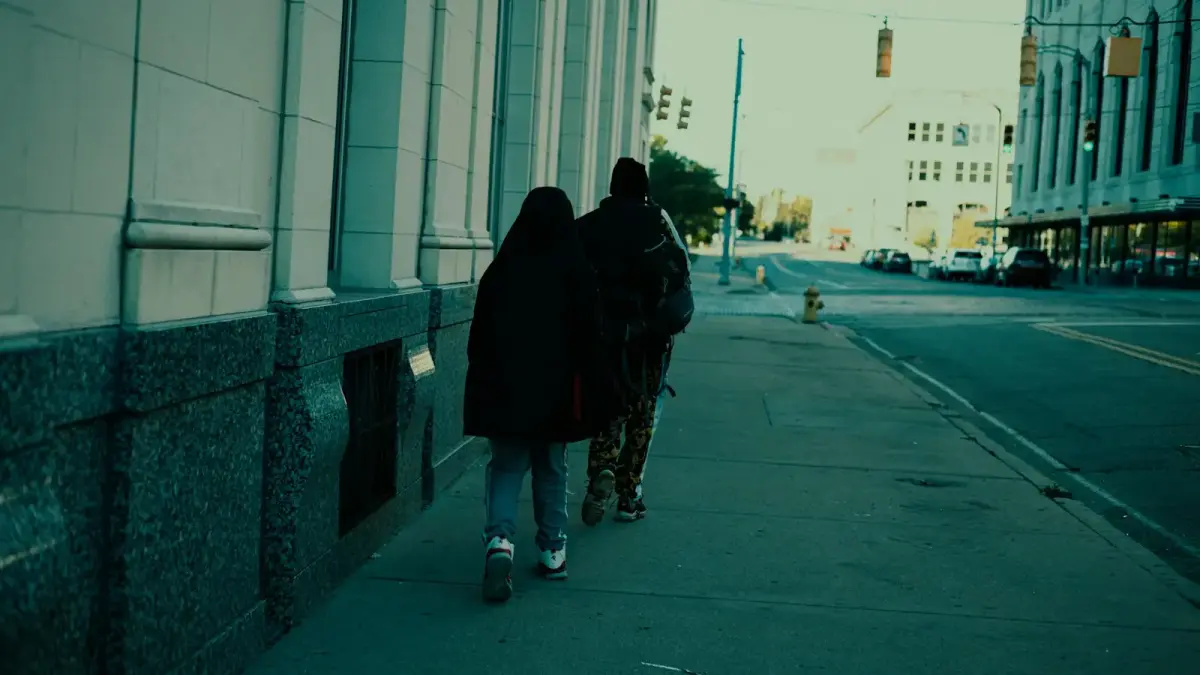
I caught myself doing it again last Tuesday. My partner and I were walking to dinner, and as we crossed the intersection at Fifth and Olive, I drifted to her left side without breaking stride. I didn’t decide to do it. My legs just knew. She was talking about something that happened at work, and I was listening, and my body quietly rearranged itself so that I was between her and the cars.
She has never once commented on it. I have never once explained it.
I am thirty-eight years old, and I have been doing this since I was maybe nineteen - since the first time I walked down a busy street with a girl I liked and felt my father’s voice move through my skeleton like a current. He never sat me down and taught me. He just always did it. And I watched, the way sons watch, which is to say I absorbed it into my muscles before I had any idea what I was absorbing.
This is about that. The quiet choreography of men who love through positioning. The inherited tenderness that lives in the body and would probably vanish the moment anyone tried to turn it into a speech.
The choreography nobody rehearses
Watch a man who does this and you will see something almost mechanical in its precision. He approaches a crosswalk. The person he loves is on his left. They cross. Now traffic flows from the right. And somewhere between the second and third step onto the new sidewalk, he has already switched sides.
No announcement. No pause. No self-congratulation.
It looks like nothing. It looks like a man just walking. But the geometry is exact, every single time, and it has been exact for years - sometimes decades - without a single conscious repetition.
A 2019 study published in the Journal of Nonverbal Behavior found that romantic partners unconsciously coordinate their walking patterns within seconds of beginning to move together. Stride length, pace, even breathing rhythms synchronize. But what the researchers also noted, almost as an aside, was that male partners in heterosexual couples disproportionately positioned themselves closer to perceived environmental threats - traffic, construction, crowded curbs - without being asked and, in post-walk interviews, without being able to articulate why.
They just did it. The way their fathers just did it.
A love language with no dictionary
We talk a lot now about love languages. Words of affirmation. Acts of service. Quality time. Gary Chapman gave us a framework, and it is genuinely useful. But there is an entire dialect of love that the framework misses - the kind that is never spoken, never named, never even acknowledged, because the moment you name it, something about it changes.
The street-side walk belongs to this dialect.
So does the hand on the small of the back when navigating a crowd. The arm that extends across the passenger seat during a sudden stop. The way some men will always enter a dark room first, not out of dominance, but out of a need so deep it feels biological - the need to be the first body that meets whatever is waiting.
These are not performances of masculinity. They are not peacocking. They are the residue of a very old agreement between a man and the people he loves - I will put myself between you and the thing that might hurt you, and I will do this so quietly that you may never notice, and that is fine, because it was never about being noticed.
Psychologist Deborah Tannen has written extensively about how men and women differ in their communication orientations - men toward action, women toward rapport. But what she also acknowledges is that this action orientation is not a deficit. It is its own grammar. It is its own literature, even, if you know how to read it.
The transmission
Here is what fascinates me. Nobody teaches this explicitly.
I did not learn the street-side walk from a conversation. I learned it from watching my father’s body move around my mother’s body for eighteen years. The way he always took the outside of the sidewalk. The way his hand would find her elbow in a parking lot, just barely, just enough pressure to steer without controlling. The way he positioned his chair in restaurants so he could see the door.
He learned it from his father. Who learned it from his.
It passes from body to body like muscle memory for an instrument nobody manufactures anymore. No one writes it down. No instruction manual exists. A boy watches a man he loves navigate space around a woman he loves, and the geometry installs itself somewhere below language, below conscious thought, in the part of the brain that also remembers how to ride a bicycle or catch a ball that is already behind you.
A 2021 study in Frontiers in Psychology examined what researchers called “embodied social learning” - the way children absorb behavioral patterns not through explicit instruction but through physical proximity and observation. Children who spent more time in close physical space with caregivers developed more nuanced nonverbal communication skills, and boys specifically showed higher rates of what the researchers termed “protective spatial orientation” - the unconscious positioning of the body to shield familiar others from environmental stressors.
The researchers had a clinical name for it. But the fathers who taught it had no name at all. They just walked on the street side. And their sons watched. And now their sons do it too.
The men who never say it
I think about my father sometimes when I do the crosswalk shuffle. I think about how he carried so much love in his body and so little of it in his mouth. How he could spend an entire dinner not saying a single tender thing and then, walking to the car, place himself between my mother and a puddle with such automatic grace that it looked like choreography.
He was not a cold man. He was a man who had been taught that love is a verb and that verbs do not require narration.
There are millions of men like him. Men who check the tire pressure before their wives drive to work. Men who always sleep on the side of the bed closest to the door. Men who will carry every grocery bag in a single trip not because they are stubborn but because they cannot bear to watch someone they love make two.
Adam Grant has written about how prosocial behavior - giving, protecting, sacrificing - activates some of the deepest reward pathways in the human brain. But what strikes me is that the men I am describing do not experience this as prosocial behavior. They do not experience it as behavior at all. It is just how they move. It is the shape their love takes when it has no words to wear.
And here is the part that gets me every time. They do not want credit. Most of them would be mildly embarrassed if you pointed it out. The street-side walk is not a gesture that asks to be seen. It is a gesture that asks only to continue. Quietly. For as long as there are sidewalks and crosswalks and someone worth standing between.
The language that survives by staying silent
There is something almost paradoxical about this kind of tenderness. It is powerful precisely because it is unspoken. The moment you turn it into a lesson - “always walk on the street side” - it becomes a rule. And rules can be followed grudgingly, or forgotten, or rebelled against.
But when it passes from body to body, from father to son, through nothing more than proximity and time, it becomes something closer to instinct. It becomes part of how a man inhabits space. Not a choice he makes but a way he is.
I worry sometimes that we are losing this transmission. Not because men are becoming less caring - I do not believe that for a second - but because the conditions for this kind of embodied learning are harder to come by. Fathers work longer hours. Families walk less. The physical closeness that allows a boy to absorb his father’s spatial grammar is rarer than it used to be.
But then I watch my friend’s nineteen-year-old son walk his girlfriend to her car, and I see him drift - just barely, just enough - to put himself between her and the street. And I know he did not learn this from a TikTok. He learned it from standing next to his father in parking lots for nineteen years. The current is still live.
What the body remembers
I walked home alone last night after dropping my partner at her apartment. And I noticed something strange. Even without her beside me, I walked on the outside of the sidewalk. Closer to the street. As if my body was saving the safer space for someone who was not there.
It made me laugh. And then it made me feel something I could not quite name.
Maybe that is the whole point. Some kinds of love are not meant to be named. They are meant to be enacted - in parking lots and crosswalks and on rainy sidewalks where a man you will never notice shifts his position so quietly that the woman beside him feels safe without knowing exactly why.
Your father probably did this. Or your grandfather. Or some man who loved someone in your family so much that he rearranged his entire body around their safety, every single day, and never once expected a thank you.
That tenderness is still in you. It is still moving through you, even now, passed from body to body like a prayer that no one taught you the words to because the words were never the point.
The body remembers what the mouth never learned to say. And sometimes that is the most fluent language of all.