There are men who have never once hired someone to do something they could figure out themselves - who taught themselves plumbing from a library book, who replaced the garbage disposal with a wrench and three hours of trial and error, who retiled the bathroom floor on a Saturday because the quote from the contractor felt not like a price but like an accusation that they had become the kind of person who pays strangers to do what their father would have done with his own two hands and a trip to the hardware store, and the man at fifty-nine with scraped knuckles and a crooked tile he will never fix is not handy but fluent in the only language of self-respect a boy whose family could not afford to call anyone ever learned to speak
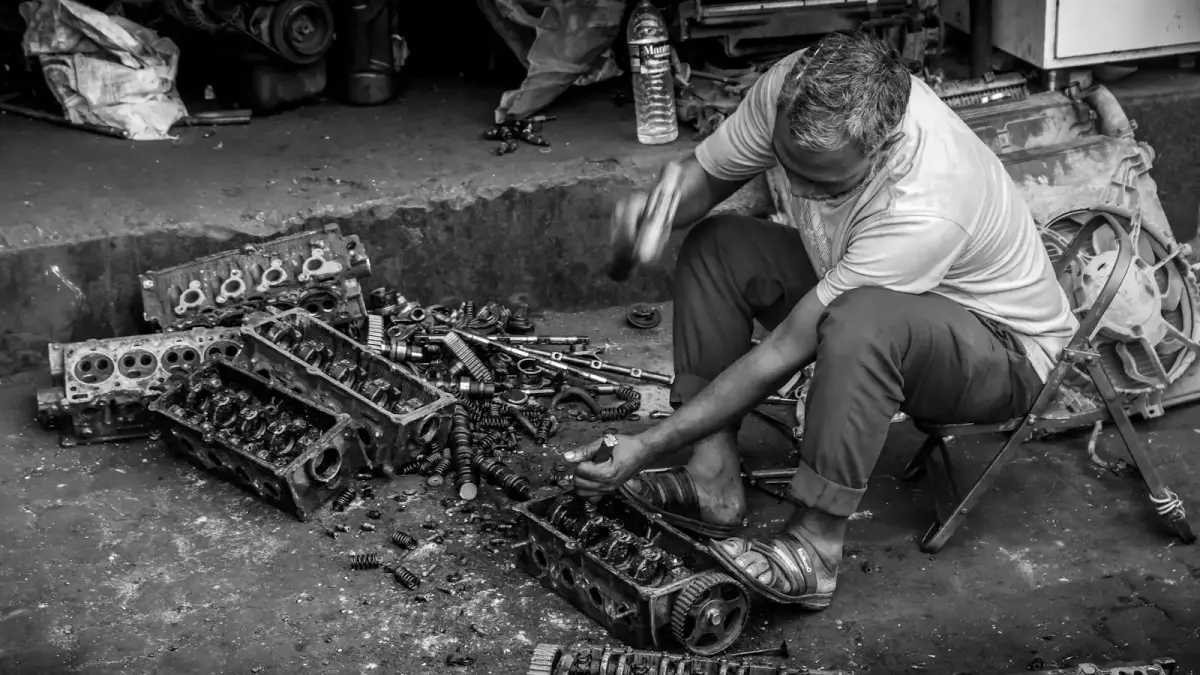
The Man Under the Sink
He is on his back on the kitchen floor, a phone propped against the drainpipe, a YouTube video paused on a frame that shows a hand gripping a fitting he has been staring at for twenty minutes. His wife found a plumber. She has the number on her phone. She offered it the way you offer an umbrella to someone standing in rain they refuse to acknowledge.
He said no. Not with irritation, not with pride. With something quieter. Something that sounded almost like fear.
Because calling the plumber is not calling the plumber. It is admitting something. And whatever that something is, it lives deeper than the leak, deeper than the corroded fitting, deeper than any pipe in this house.
I grew up around men like this. Men whose weekends were not leisure but labor. Men who built decks and replaced alternators and patched drywall and rewired outlets. Not because they loved the work. Because the alternative felt like a kind of betrayal they could not name.
It took me a long time to understand what they were being loyal to.
What the Hardware Store Meant
There is a particular walk a man does through a hardware store when he is looking for a part he cannot quite describe. He holds the broken piece in his hand. He compares it against packages. He asks no one for help, not because he is arrogant, but because asking for help was never modeled for him as a thing a man could do without cost.
His father walked these same aisles. His father knew the difference between a compression fitting and a flare fitting, between galvanized and black iron, not because he was an engineer but because he could not afford to be ignorant. Knowledge was free. Plumbers were not.
A 2019 study published in the Journal of Consumer Research found that working-class individuals were significantly more likely to associate self-sufficiency with moral virtue than their middle-class counterparts. For people who grew up without financial cushion, doing things yourself was not a preference. It was an ethic. It was the line between dignity and dependence.
The hardware store was the library of this ethic. Every aisle held a lesson his father had already memorized through necessity, and the son learned the aisles not by studying but by following. By watching. By carrying the bag to the truck and handing tools up through the crawl space and holding the flashlight steady when his father’s voice got tight because the fitting would not seat.
The boy did not know he was learning a language. He thought he was just helping his dad.
The Distance of a Phone Call
There is a class line in America that nobody talks about, and it runs directly through the act of hiring someone.
On one side of that line, you call a professional. You call the plumber, the electrician, the landscaper, the handyman. You pay them. You do not think about it. It is simply what people do when something breaks - you find someone whose job it is to fix it, and you write a check.
On the other side of that line, you fix it yourself. You always fix it yourself. You fix it yourself even when it takes all weekend. Even when you cut your hand. Even when the repair is worse than the original problem. Because on this side of the line, calling someone is not convenience. It is confession.
It is confessing that you have become the kind of person who cannot do for himself. The kind of person your father would have looked at with something you refuse to call contempt but that lived in the neighborhood of disappointment.
I knew a man - a friend’s father - who spent an entire July replacing his own roof. Not a shed roof. The house roof. He borrowed a nail gun, watched videos, nearly fell twice. His wife begged him to hire a crew. The quote was reasonable. He could afford it.
He could not afford what it would mean.
Because the men his father drank coffee with, the men who gathered in garages on Sunday mornings with grease under their nails and knowledge in their hands - those men did their own roofs. And to hire a crew was to leave their circle, to cross into a world where your hands were clean and your money spoke for you and your father’s way of living became something you had outgrown rather than something you carried.
Teaching Sons the Same Promise
These men teach their children to fix things. This is important to understand.
They do not think of it as teaching a skill. They think of it as passing on something essential, the way you pass on a last name or a faith. The twelve-year-old holding the other end of the board while his father runs the saw is not learning carpentry. He is learning who he is.
Psychologist Jacqueline Mattis, whose research at the University of Michigan explored how working-class families transmit values across generations, noted that practical self-reliance often functions as a moral inheritance. The child learns not just how to use a wrench but what kind of person uses a wrench instead of a phone.
And the lesson sticks. It sticks in ways that outlast the house, the marriage, the father himself.
The boy grows up. He buys his own house. The garbage disposal seizes. His wife says call someone. And he hears his father’s voice - not the words, because his father never said it outright, but the posture. The way his father walked to the garage like a man walking to church. The way his father’s hands moved over a broken thing with a patience he rarely showed people.
The boy, now forty-seven, gets under the sink. He watches a video. He buys a wrench. He spends three hours lying on linoleum, and when the disposal finally hums to life, the feeling that floods him is not satisfaction.
It is belonging.
The Crooked Tile and What It Holds
There is a bathroom floor somewhere in every city in this country that is not quite right. The grout lines are uneven. One tile sits a millimeter higher than its neighbor. If you walk across it barefoot, you can feel the ridge.
A professional would have laid it flat. A professional would have used spacers and a level and would have finished in a day. This floor took a weekend and a half, two trips to the hardware store, one moment of quiet rage at a tile that cracked during cutting, and a beer at the end that tasted better than any beer has a right to taste.
The man who laid that floor will never fix the crooked tile. He sees it every morning. He knows it is there the way you know a scar is on your own body - intimately, without needing to look.
He will not fix it because fixing it would mean admitting it was wrong. And admitting it was wrong would mean admitting that maybe his father’s way - the self-taught, library-book, trial-and-error way - produces imperfect results. And admitting that feels less like an observation about tile and more like a judgment about an entire life.
A 2022 study in Frontiers in Psychology examined what researchers called “effort-based valuation” - the phenomenon in which people assign greater meaning to objects and outcomes they struggled to create. The crooked tile is worth more than the straight one precisely because it cost something beyond money. It cost a Saturday. It cost scraped knees. It cost the quiet argument with his wife about whether this was really necessary.
It cost a boy’s promise to his father, kept.
What His Hands Are Really Saying
Here is what I want you to understand about this man. The one with the calloused palms and the drill bits organized in a coffee can and the shelf in the garage that leans slightly to the left.
He is not stubborn. He is not cheap. He is not performing masculinity for an audience that does not exist.
He is speaking.
Every repair is a sentence in a language he learned before he learned to read. Every trip to the hardware store is a pilgrimage to a place where his father made sense, where the world was a series of problems that yielded to patience and the right tool. Every hour under the sink, behind the dryer, beneath the car, is an hour spent in conversation with a man who may no longer be alive but whose hands are still moving through his son’s hands.
This is devotion expressed through scraped knuckles. This is grief expressed through grout. This is a man saying, in the only language he was ever given, I remember you. I remember what you taught me. I am still the boy who held the flashlight.
The Inheritance No One Appraises
He is fifty-nine now. His knees ache when he kneels. His back protests the crawl space. His wife has stopped suggesting he call someone because she understands something she did not understand at thirty - that this is not about the repair.
It was never about the repair.
It is about a boy who watched his father refuse to ask for help, not out of pride but out of a quiet, unshakable belief that a man who can fix his own house is a man who cannot be taken from his family by poverty, by bad luck, by the particular humiliation of needing someone and not being able to pay.
The inheritance is not plumbing. It is not carpentry. It is not the ability to patch a hole or hang a door.
The inheritance is the belief that your hands are enough. That you are enough. That whatever breaks, you can meet it. That you do not need to call anyone because you are the one who was called - called by a father’s example into a life of showing up, kneeling down, and fixing what is broken with whatever you have.
The tile is crooked. The shelf leans. The faucet still drips, just barely, if you listen for it late at night.
And the man who did all of it himself sleeps soundly. Not because the work is perfect. But because the work is his. Because every imperfect repair in this house is a letter in a long, ongoing message to a father who built everything he could with what little he had.
And the son - the son built everything he could, too.
With the same hands. The same wrench. The same quiet refusal to let anyone do for him what love taught him to do for himself.