There are men who have never once said the words 'I'm proud of you' to another man's face - not because they don't feel it but because somewhere between boyhood and the first real job the part of them that could say something earnest to another man without wrapping it in a joke or a backslap was quietly sealed shut, and the handshake that lasts one beat too long at a retirement dinner is forty years of unspoken admiration compressed into three seconds of grip
The grip that said everything
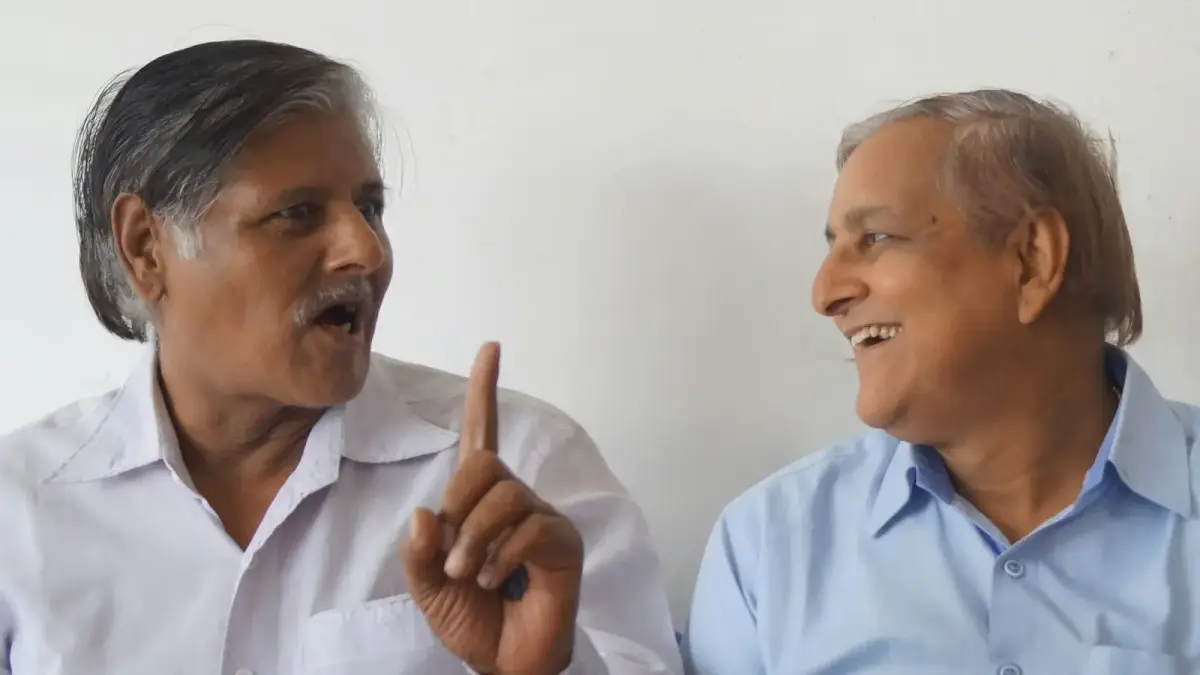
I watched my father say goodbye to his best friend of thirty-one years at a retirement party in a VFW hall. The two of them stood by the door while everyone else was eating cake. My father reached out his hand. His friend took it. And for maybe four seconds, neither of them let go.
That was it. No speech. No hug. No “you meant the world to me” or “I don’t know how I would have gotten through those years without you.” Just a handshake that lingered past the point of formality and into something that made me look away, like I had accidentally walked in on something private.
My father drove home in silence that night. I was sixteen and didn’t understand what I had seen. Now I’m forty-three, and I realize I watched two men say “I love you” in the only language they were ever given permission to speak.
The vocabulary nobody taught them
There is a fluency that boys have at eight or nine that vanishes by fourteen. A boy can throw his arm around his friend’s shoulder walking home from school. He can say “you’re my best friend” without flinching. He can cry when his friend moves away.
Then something shifts. It’s not one moment - it’s a slow tightening, like a faucet being closed a quarter-turn at a time until the drip stops entirely. By high school, admiration between boys has to be laundered through competition. You don’t tell your friend he’s talented. You say “you’re a beast.” You don’t tell him you missed him. You punch his shoulder.
A 2020 study published in the Journal of Social and Personal Relationships found that men reported levels of emotional intimacy in their closest male friendships that were statistically comparable to women’s - but used fundamentally different channels to express it. Where women relied on verbal disclosure, men used shared activity and physical co-presence. The feeling was identical. The delivery system was unrecognizable.
And so an entire generation of men learned to speak fluent admiration in a language that has no words. Only gestures. Only timing. Only the weight of a hand on the back of a neck for two seconds longer than necessary.
The compression of forty years into three seconds
Think about what a handshake between two men who have known each other for decades actually contains.
It contains the morning one of them got the phone call about his father and the other one drove forty-five minutes in the rain without being asked. It contains every lunch where they sat across from each other and talked about nothing because the company was the point. It contains the argument they had in 1997 that they never resolved and never needed to, because they just kept showing up.
All of that gets compressed into grip pressure and eye contact and a nod that means, roughly translated, “I see you and I see what you’ve carried and I hope you know that you didn’t carry it alone.”
But they will not say those words. Not because they can’t. Because somewhere deep in the architecture of how they were taught to be men, saying those words to another man feels like standing naked in a room full of people. The vulnerability isn’t emotional - it’s social. It’s the fear that earnestness between men will be misread, mocked, or simply met with awkward silence.
And so the handshake does the talking. The shoulder grip. The two-pat hug that lasts exactly one second. The nod across a crowded room that carries more weight than most wedding toasts.
The geometry of male affection
I’ve started noticing it everywhere once I learned to look for it.
The way a man will insult his friend in front of others and then, when no one else is watching, ask quietly, “You doing okay?” The way two men who haven’t seen each other in years will stand three feet apart and talk about the weather and the game and absolutely nothing personal for twenty minutes - and both walk away feeling refilled in some way they couldn’t explain.
The way a father will shake his adult son’s hand at the airport instead of hugging him, and both of them will feel that handshake in their chest for the entire flight home.
Researcher Niobe Way spent years studying adolescent boys and documented in her book Deep Secrets how boys in their early teens describe their male friendships with the same emotional intensity and language that girls use - words like “love” and “need” and “can’t live without.” By age sixteen, those same boys describe the same friendships in clipped, guarded terms. The feelings didn’t change. The vocabulary was revoked.
What remains after the vocabulary is gone is geometry. Distance and proximity. The lean-in. The arm’s length. The angle at which two men stand next to each other at a bar, shoulders almost touching, looking straight ahead instead of at each other, because that’s how you have an intimate conversation when the rules say you can’t have intimate conversations.
What the jokes are actually saying
The insult is the dialect. I need you to understand that.
When a man says “you old bastard” to his friend of twenty years, he is not being crude. He is saying “you are permanent in my life and I am comfortable enough to be careless with you, which is the highest honor I know how to give.”
When he says “don’t get sentimental on me” right as a moment starts to deepen, he’s not shutting it down. He’s acknowledging that the moment exists. The deflection is the confession. If he felt nothing, there would be nothing to deflect.
A 2018 study in the journal Adaptive Human Behavior and Physiology found that men’s use of humor in close friendships was directly correlated with the depth of their emotional bond - the more relentless the ribbing, the deeper the trust. The researchers described it as a testing mechanism for intimacy. If you can absorb my worst joke and still show up tomorrow, we’re real.
This is not a failure of emotional intelligence. This is emotional intelligence expressed through a different operating system - one that was installed without their consent and reinforced every single day of their adult lives.
The retirement dinner and the funeral
There are two places where the seal cracks, if only briefly.
Retirement dinners and funerals.
At a retirement dinner, a man can stand up in front of a room full of colleagues and say “this man made me better” and it’s acceptable because the frame is professional. He’s not expressing love. He’s expressing professional respect. The fact that his voice cracks in the middle of the sentence - that’s just the microphone. That’s just allergies. That’s just the room being warm.
At a funeral, a man can grip the edge of a casket and weep and no one will question it because grief is the one emotion men have been granted unconditional permission to show. But grief is the wrong time for admiration. It arrives too late. What the man crying at the casket wants to say is not “I miss you.” It’s “I should have told you.”
This is the quiet tragedy of the sealed vocabulary. Not that these men feel nothing. But that the people they feel it for will often never hear it in words. The pride was always there. The admiration was always there. It lived in the nod, the grip, the showing up, the twenty-year streak of Thursday night poker games that was never about poker.
And Brene Brown’s research on vulnerability speaks directly to this double bind - men are told to open up, but the social architecture surrounding male friendships still punishes direct emotional expression between men far more than it rewards it. The men I’m describing aren’t emotionally illiterate. They’re navigating a corridor so narrow that the only form of emotional delivery that survives intact is the one that can be plausibly denied.
The younger men are watching
Something is changing, slowly, in the generation below.
I see it in my nephew, who tells his friends he loves them over the phone and doesn’t lower his voice when he says it. I see it in the young men on my son’s soccer team who hug after games - real hugs, not the one-armed half-contact that my generation perfected. I see it in the way younger men have started saying “I’m proud of you” to each other in public, plainly, without wrapping it in irony.
And I see the older men watching this happen with a look I can only describe as confused longing. Not disapproval. Longing. As if they’re watching someone speak a language they once knew as children but forgot under pressure.
Daniel Goleman’s work on emotional intelligence confirms that the capacity for emotional expression doesn’t atrophy - it goes underground. The neural pathways for tenderness, admiration, and verbal affection don’t disappear in men. They get rerouted through gesture, action, and presence. The feeling finds a way out. It just has to use the back door.
The hand that stays
If you are a man who has never said “I’m proud of you” to another man’s face, I want you to know something.
You were not born this way. There was a version of you at nine years old who could say anything to anyone without performing a risk assessment first. That version didn’t leave. He was just taught to be quiet.
And if you have a friend - a real one, the kind who showed up at the hospital or helped you move in the rain or simply sat next to you during the worst year and didn’t try to fix it - you don’t have to find the perfect words. You don’t have to make a speech or write a letter or do anything that feels like standing on a stage.
But if you ever find yourself shaking that man’s hand and you feel the impulse to hold on for one extra second - hold on. He’ll feel it. He already knows what it means.
The handshake that lasts one beat too long has always been a complete sentence. You were never silent. You were speaking in a language that just happened to have no words.
And the men who knew you best heard every syllable.