Psychology says men who can diagnose what is wrong with an engine by the sound it makes but cannot tell you what they are feeling right now are not emotionally unavailable, they are men who grew up in homes where being useful was the only reliable way to be loved, and the competence everyone admires at fifty-seven is the same wall that keeps everyone at arm's length
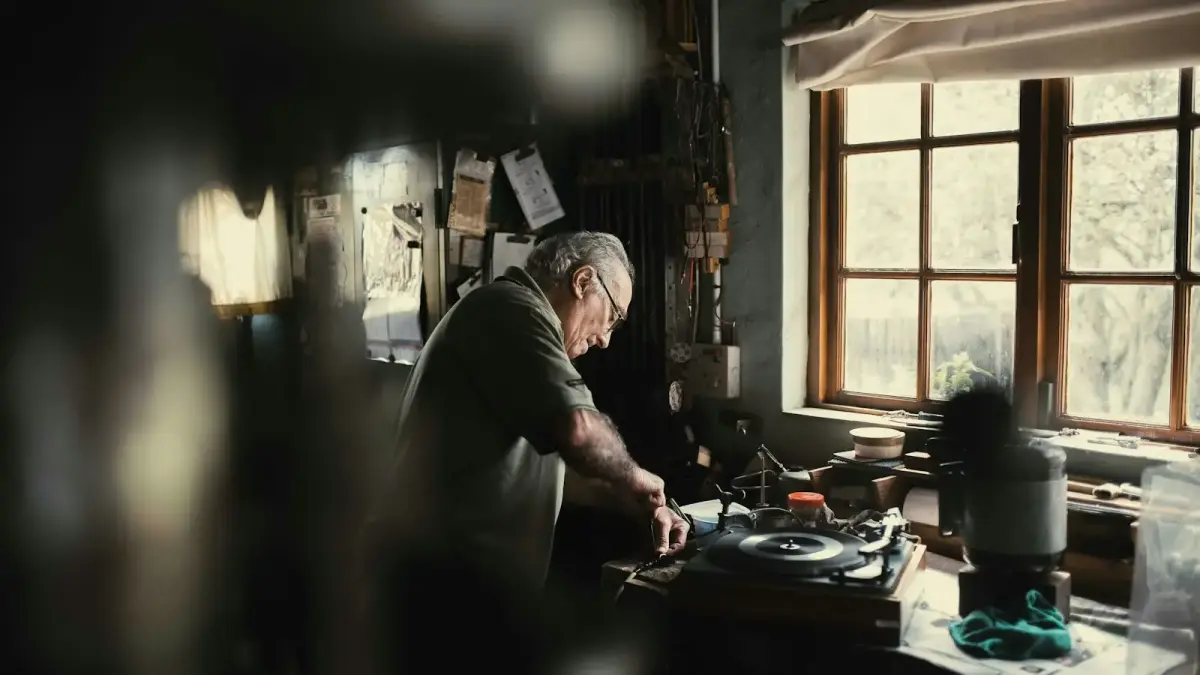
My father could rebuild a carburetor blindfolded. I watched him do it once on a Saturday morning in the garage, grease up to his elbows, humming along to the radio, completely at ease. He could hear a timing belt slipping from across a parking lot. He knew when a furnace was about to quit three weeks before it did.
But when my mother asked him how he felt about his own father dying, he stood up from the kitchen table and went outside to check the oil in her car.
I didn’t understand that moment until I was fifty-three years old and my wife looked at me across our living room and said, “I know you love me. I just wish you could say it without handing me a fixed garbage disposal.”
That landed somewhere I didn’t have a name for. Which, as it turns out, was exactly the problem.
The Boy Who Learned That Usefulness Was Safety
There is a particular kind of household - and if you grew up in one, you already know what I mean before I describe it. It wasn’t necessarily abusive. It wasn’t necessarily cold. But love in that house had conditions, even if nobody ever said them out loud.
The condition was contribution.
You were noticed when you were helpful. You were praised when you solved a problem. You were safe when you made yourself indispensable. And somewhere in the back of your developing brain, a formula took root that would run your entire life: if I am useful, I am loved.
A 2019 study published in the Journal of Personality and Social Psychology found that children who received conditional regard - love that was clearly linked to performance or behavior - developed what researchers call “introjected motivation.” They didn’t just want to be competent. They needed to be. Their sense of self literally depended on it.
That boy doesn’t grow up emotionally unavailable. He grows up emotionally redirected.
Every feeling he has gets routed through the same question: what can I do about this? Sadness becomes a project. Anxiety becomes preparation. Love becomes service. And eventually, the feelings themselves stop registering as feelings at all. They just become fuel for the next task.
The Language Nobody Taught Him
Here is something most people don’t think about: emotional vocabulary is learned. You aren’t born knowing the difference between disappointment and grief, between frustration and heartbreak, between loneliness and boredom. Someone has to teach you those words. Someone has to sit with you when you’re seven years old and falling apart and say, “That feeling you have right now - that’s called being hurt.”
In a lot of homes - especially homes raising boys in the 1960s and 70s - nobody did that.
What they taught instead was the vocabulary of solutions. That’s a loose fitting. That’s a dead battery. That’s a leak in the flashing. Those words had precision. Those words had power. When you said them, adults respected you.
Psychologist Daniel Goleman has written extensively about what he calls “emotional literacy” - the basic ability to identify and name what you’re feeling in real time. And his research makes something painfully clear: this literacy isn’t optional. Without it, emotions don’t disappear. They just go underground, showing up as back pain, insomnia, road rage, or a third beer on a Tuesday night that you can’t quite explain.
The man who can’t tell you what he’s feeling isn’t withholding. He genuinely does not have the words. He is standing in front of a dashboard with no labels, watching lights flash, unable to read a single one.
What Competence Actually Is When You Look Underneath It
I want you to try something. Think about the most competent man you know. The one everyone calls when something breaks. The one who shows up with the right tool and the quiet confidence and fixes it without fanfare.
Now ask yourself: when was the last time that man asked for help?
Not practical help. Not “hand me that wrench.” I mean the kind of help that requires admitting you don’t know what to do. The kind where you sit down and say, “I’m struggling and I don’t know why.”
A 2021 study in Frontiers in Psychology examined men over fifty who scored high on measures of practical competence but low on emotional expressivity. The researchers found something striking: these men didn’t lack emotional depth. Brain imaging showed robust emotional activation - sometimes even stronger than average. What they lacked was the bridge between feeling and expression. The wiring was all there. The road just didn’t connect to the mouth.
Competence, for these men, isn’t a personality trait. It’s an emotional survival strategy. It’s the thing that kept them connected to the people they loved when they had no other way to say it.
Your father didn’t fix your bike because he didn’t know how to hug you. He fixed your bike because fixing your bike was the hug. It was the only dialect of love he was ever taught to speak, and he spoke it fluently, and nobody ever told him there were other languages.
The Wall That Looks Like a Gift
Here is where it gets complicated, and where I have to be honest about my own life.
The competence that made me reliable also made me unreachable. My wife could depend on me for anything practical. If something broke, I fixed it. If something needed building, I built it. If a crisis hit, I was calm, steady, and effective.
But she couldn’t depend on me to sit with her sadness without trying to solve it. She couldn’t depend on me to say “I’m scared” when I was scared. She couldn’t depend on me to be a person instead of a service.
And that’s the cruel trick of this particular pattern. The very quality that everyone admires - his reliability, his steadiness, his unshakable competence - is the same quality that keeps people from ever truly knowing him. He becomes a function instead of a person. The guy you call, not the guy you confide in.
Gabor Mate has talked about how the adaptations we develop in childhood to survive our emotional environment become the exact limitations that constrain our adult relationships. The kid who learned to be useful instead of vulnerable becomes the man who is surrounded by people who need him but nobody who knows him.
At fifty-seven, he has a garage full of tools and a heart full of things he has never said out loud.
The Moment the Dashboard Lights Up
I don’t want to pretend there’s a simple fix for this, because there isn’t. You don’t spend five decades routing every emotion through a workbench and then suddenly start journaling your feelings because someone told you to.
But I will tell you what happened to me.
I was replacing a faucet in the bathroom - a job I’d done a dozen times - and halfway through, I stopped. My hands were shaking. Not from strain. Not from the position. Just shaking. And for the first time in my life, instead of pushing through it, I sat back on the tile floor and asked myself the question I’d been avoiding for forty years.
What am I feeling right now?
I didn’t have an answer. Not at first. It took what felt like ten minutes of sitting there, wrench in hand, staring at the cabinet, before a word surfaced.
Lonely.
Not alone. I had a wife downstairs and two grown kids who called every Sunday. Lonely. The kind of lonely that comes from being thoroughly surrounded by people who love the version of you that shows up with solutions, and wondering if any of them would stay for the version that doesn’t know what to do.
That was the beginning of something I’m still in the middle of. I won’t call it a breakthrough because it didn’t break anything. It just opened a door that had been painted shut since I was nine years old.
What It Looks Like to Start Translating
If you recognize yourself in any of this - or if you recognize your father, your husband, your brother - I want to be careful here. I’m not going to tell you that competence is bad. It isn’t. Being someone people can count on is a beautiful thing.
But there’s a difference between choosing to be useful and being unable to be anything else.
A 2020 study in the Journal of Research in Personality found that men who began developing emotional vocabulary later in life - even in their fifties and sixties - showed measurable improvements in relationship satisfaction and personal wellbeing within eighteen months. The brain doesn’t stop being capable of this. It just needs practice, the same way your hands needed practice the first time you picked up a wrench.
It starts small. Not with grand confessions or tearful revelations. It starts with noticing. Noticing that the tightness in your chest when your daughter doesn’t call isn’t indigestion. It’s missing her. Noticing that the restlessness on Sunday evenings isn’t boredom. It’s dread. Noticing that the impulse to get up and fix something when someone is crying near you is not helpfulness. It’s escape.
You don’t have to stop fixing things. You just have to learn that you are not only what you fix.
The man who can hear an engine struggling from across the street has extraordinary perception. He just needs to turn that same careful listening inward - toward the engine he’s been ignoring his whole life.
The one that’s been running rough for years, and that nobody else can hear, because he never makes a sound.