There is a particular kind of person who keeps her shoes on inside the house even when it is her own house - not because she is worried about the floors or forgot to take them off but because a girl who grew up in a house where the carpet was stained, the linoleum was cracked, and the basement apartment never quite got warm enough learned that the floor beneath her was never something her body trusted, and a woman who now owns a house with hardwood she chose herself still cannot convince her feet that they are somewhere they are allowed to settle
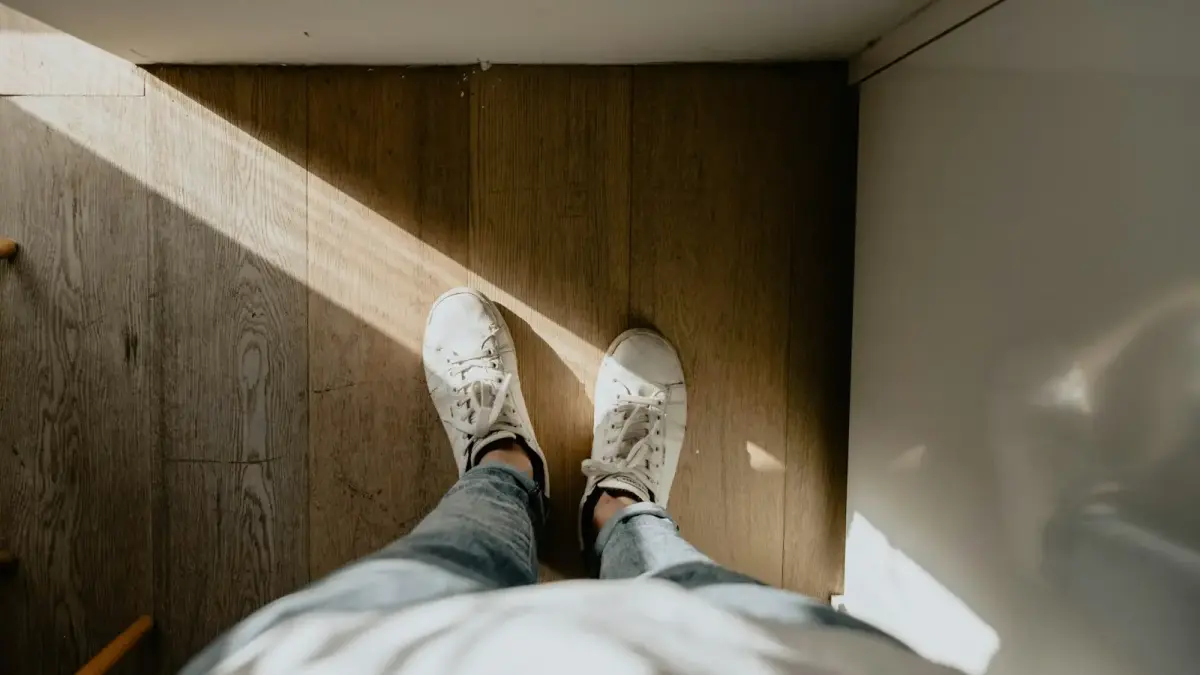
I noticed it on a Tuesday evening, standing in my own kitchen, pouring wine into a glass I had picked out myself at a store where nothing was on clearance. I was wearing sneakers. Not because I had just come in. Not because I was about to leave. I had been home for three hours, had changed into sweatpants and a soft shirt, had settled into the evening in every way except one.
My feet were still dressed for somewhere else.
My partner had mentioned it gently, the way you mention something you have noticed for years but never found the right moment to say. “You know you can take your shoes off, right?” And I laughed, because of course I knew that. This was my house. These were my floors. I had chosen the warm oak hardwood myself, had run my hand across samples at the showroom, had paid for the installation. These floors were mine in every legal and financial sense of the word.
But my feet did not believe that. My feet remembered something older than my mortgage.
The floor beneath the floor
There is a geography of childhood that lives in the body long after the address changes. Not the street name or the city, but the texture of the ground - what it felt like under bare skin when you were small enough that the floor was your whole world.
I grew up in a basement apartment where the carpet had a smell I could never name and a color that had once been something else. The linoleum in the kitchen curled at the edges. In winter, the concrete underneath seeped cold through every layer, and my mother would tell me to put socks on, then slippers, then just keep my shoes on because the floor was not a place for bare feet.
She was not being neglectful. She was being practical. The floor was cold. The floor was not clean in the way that floors in other people’s houses seemed to be. The floor was something you crossed to get somewhere better - a couch, a bed, a chair with a blanket on it.
I did not know this was a class experience until I went to a friend’s house in middle school and watched her mother pad across white tile in bare feet, relaxed, unhurried, as if the ground beneath her was an extension of her own body. I remember staring at her feet. I remember thinking she looked like someone who had never worried about what was underneath her.
What poverty teaches your body
A 2019 study published in Psychological Science found that socioeconomic status in childhood shapes bodily stress responses well into adulthood - even when income and stability improve dramatically. The researchers called it “biological embedding,” the way early environments write themselves into muscle, posture, and reflexes that outlast the conditions that created them.
Your bank account can change. Your nervous system takes longer.
Gabor Mate has written extensively about how the body stores what the mind tries to move past. He describes it not as pathology but as intelligence - the body remembering what kept you safe when you were too young to think your way through it. Keeping your shoes on inside was not a quirk. It was a survival posture, a readiness that said: the ground here might shift, so stay prepared to move.
And the thing about survival postures is that they do not retire when the danger does. They just keep showing up, loyal and outdated, like a security guard still patrolling a building that was sold years ago.
The homes that taught us to hover
If you grew up in a home where things broke and stayed broken, where the landlord did not come when you called, where the heat was unreliable and the surfaces were not quite yours to maintain, you learned a particular relationship with space. You learned to hover above it rather than sink into it.
You sat on the edge of furniture rather than leaning back. You kept your coat on a little too long when you came inside. You did not sprawl. You did not feel entitled to take up the full square footage of a room, because some part of you understood - not intellectually but physically - that this space was borrowed, temporary, conditional.
A 2017 study in the Journal of Personality and Social Psychology found that people who grew up in lower socioeconomic environments were more likely to exhibit what researchers called “vigilant body postures” - physical stances associated with monitoring the environment for threat or change. These postures persisted regardless of current income level.
Your body learned to stay ready. And readiness, when you are small, looks like shoes that stay on.
The guilt of good floors
Here is what nobody prepares you for when you move up in class: the strange guilt of comfort.
I remember the first time I lay on my living room floor - my living room, my floor - and felt the warmth of the heating underneath the wood, and something in my chest tightened instead of released. It felt wrong. Not morally wrong, exactly, but physically dissonant, like hearing a familiar song in the wrong key.
My mother never had warm floors. My grandmother never had warm floors. The women who raised me navigated cold surfaces their entire lives, and here I was with radiant heating, feeling the oak against my bare calves and wanting to cry for reasons I could not articulate.
This is the texture of class mobility guilt that rarely gets discussed. It is not just about money or opportunities or feeling like you do not deserve success. It is about the body. It is about what happens when your skin touches comfort that your lineage never had access to, and something in you says: this is not for people like us.
So you keep your shoes on. Not as a decision, but as a genuflection. A small, unconscious act of loyalty to the women who never got to feel safe on their own floors.
Inherited postures
Brene Brown talks about how vulnerability requires a sense of safety - you cannot open up in a space where your body reads danger. But what she describes as emotional vulnerability has a physical dimension that maps directly onto class.
Being barefoot is vulnerable. It is exposed. It says: I trust this surface. I trust this space. I am not going anywhere quickly. I am here.
For people who grew up in homes that felt precarious, that level of physical openness was never safe. You kept your shoes on the way you kept your guard up - not because anyone told you to, but because the environment taught your body a lesson it never unlearned.
I have friends who grew up in stable, middle-class homes who cannot understand why I do not simply take my shoes off. They see it as a preference, maybe a mild eccentricity. What they do not see is the basement apartment beneath it, the cracked linoleum, the carpet that smelled like someone else’s history. They do not see the girl who learned that the ground was unreliable and the woman who still carries that girl’s feet.
A 2021 study in Frontiers in Psychology examined how “place attachment” - the emotional bond between a person and a physical space - is shaped by early housing stability. Children who experienced frequent moves, substandard housing, or a lack of control over their living environment showed weaker place attachment in adulthood. They were less likely to describe their homes as extensions of themselves and more likely to treat domestic space as functional rather than personal.
They lived in their houses. But they did not quite inhabit them.
Learning to land
I am not going to tell you there is a simple fix for this, because there is not. You cannot think your way out of a body memory. You cannot read an article and suddenly feel safe on your own floors. The nervous system does not respond to arguments.
But I will tell you what has helped me, slowly, imperfectly.
I started noticing. Not judging, not forcing, just noticing. Oh, I am still wearing my shoes. I have been home for four hours. That is interesting. I wonder what my feet are still bracing for.
Sometimes noticing was enough to create a tiny opening. A moment where I could slip one shoe off, then the other, and feel the floor - really feel it - for thirty seconds before the old discomfort crept in and I put them back on. Thirty seconds of trusting the ground. That was enough for one day.
I also started thinking about my mother differently. Not as someone who failed to give me safe floors, but as someone who gave me the best protection she had available. She told me to keep my shoes on because the floor was cold, and she was right, and she was loving me the only way the apartment allowed.
My shoes were never a flaw. They were her care, translated into a posture I carried forward.
The floor remembers
If you are someone who keeps her shoes on in her own home, I want you to know something. You are not strange. You are not broken. You are not failing at relaxation or domesticity or the simple act of being at ease in a space you pay for.
You are carrying a body that learned, very early, that the ground beneath you required preparation. That floors were something to manage, not to melt into. That comfort was conditional and could be pulled out from under you - literally - without warning.
And now you are somewhere safer, somewhere warmer, somewhere with floors you chose. Your feet just have not caught up to your life yet.
That is not a failing. That is a kind of faithfulness - to the girl you were, to the home that shaped you, to the women whose feet never got to rest.
One day, maybe, you will come home and kick your shoes off without thinking about it. And you will stand on your own floor in your own socks and feel the warmth come up through the wood and it will not feel like guilt. It will just feel like ground.
But if today is not that day, that is fine too. Your shoes are not your shame. They are your history, still fitting themselves around a life that has finally, quietly, outgrown them.