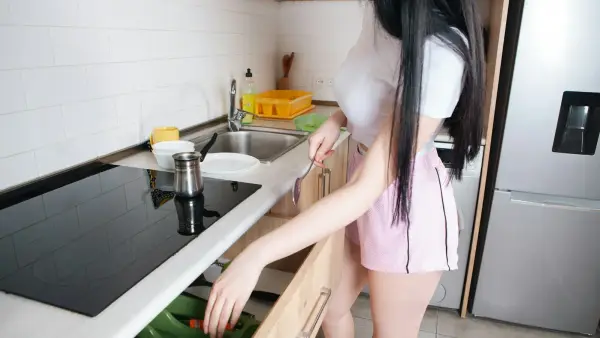
There is a particular kind of person who still washes every dish by hand before putting it in the dishwasher - not because she does not trust the machine but because a girl who grew up in a house without one watched her mother stand at the kitchen sink every night for twenty years, and a woman who finally owns the appliance her mother never had still cannot convince her hands that the job is finished until she has touched every plate herself
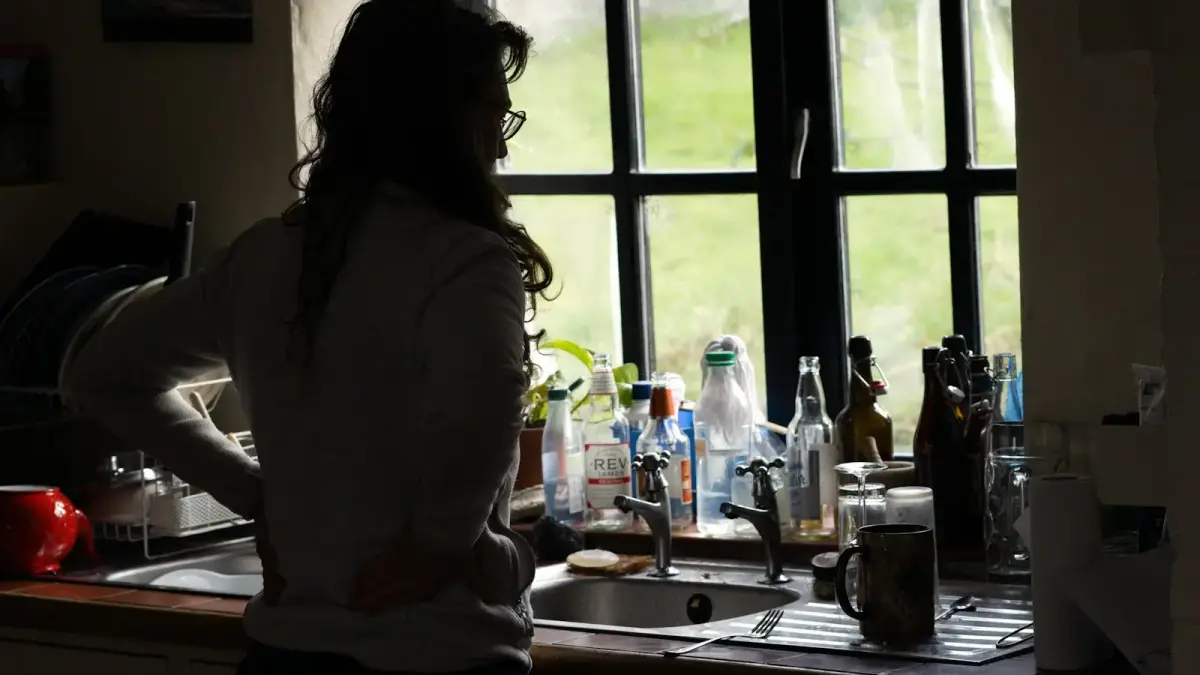
I pre-wash every dish before it goes in the dishwasher. Every fork. Every coffee mug. Every plate with nothing on it but a crumb I could blow away with a breath.
My husband has pointed this out gently, the way you point out something you know touches a nerve. “The dishwasher does that part,” he said once, leaning against the counter with a towel over his shoulder. I nodded. I agreed with him completely. And the next night I stood at the sink again, running warm water over a bowl that was already clean, scrubbing it with a sponge until it squeaked, and then placing it carefully in the machine that existed specifically to do the thing I had just done.
I am not confused about how dishwashers work. I am confused about something much older than that.
The sink my mother never left
My mother did not have a dishwasher. She had a single-basin sink, a bottle of off-brand dish soap, and two kids who ate dinner every night on plates she washed by hand, dried with a cotton towel, and stacked in a cabinet that didn’t close all the way.
She stood at that sink after every meal. Sometimes she was already there when I came downstairs in the morning, finishing what she hadn’t gotten to the night before.
I don’t remember her complaining about it. I remember the sound of it - water running, ceramic clinking, the occasional sharp exhale that meant a pot needed extra work. It was the background music of our evenings. Homework on the kitchen table, my mother’s back to me, her hands moving in that steady rhythm that meant the day was almost over.
She wasn’t just washing dishes. She was closing the day down. She was completing the cycle of feeding us, cleaning up after feeding us, and preparing the surfaces for feeding us again. It was a loop she lived inside, and it never occurred to me to notice it because it never occurred to her to stop.
What the machine cannot replace
I bought my first dishwasher at thirty-four. A stainless steel Bosch that hummed so quietly you could forget it was running. I loaded it the first night and pressed start and stood in my kitchen feeling like I had stolen something.
That sounds dramatic. But the feeling was real - a hollowness in my hands, a sense that the evening had ended too quickly, that I had skipped a step in a sequence I didn’t know I had memorized.
So I started pre-washing. Not because I read somewhere that you should. Not because I doubted the machine. But because my body needed to stand at the sink for a while. My hands needed to feel the warm water. Something in me needed to perform the labor before I could allow the convenience.
A 2019 study in the Journal of Consumer Research found that people who grew up in lower-income households often experience what the researchers called “comfort guilt” - a persistent discomfort with ease, leisure, or convenience that feels unearned. The study found this pattern even in participants who had been financially stable for over a decade. The guilt didn’t track to their current circumstances. It tracked to their earliest ones.
I didn’t need a study to tell me that. I could feel it in my pruned fingertips every night.
Inherited choreography
Here is the thing nobody explains about class mobility. You can change your income. You can change your zip code. You can change the thread count of your sheets and the brand of olive oil in your pantry. But you cannot easily change the choreography your body learned in childhood.
Your muscles remember. Your nervous system remembers. The order in which you move through a kitchen, the way you wipe a counter, the instinct to check the price tag before you check the fit - these are not preferences. They are recordings. Your mother’s hands taught your hands, not through instruction but through repetition, and your hands play back the lesson whether you ask them to or not.
Dr. Gabor Mate has written extensively about how the body stores emotional history - how physical habits carry psychological meaning long after the original context has disappeared. We think of habits as personal quirks. But many of them are inherited liturgies, passed from one generation’s hands to the next.
My mother scrubbed because she had no choice. I scrub because I cannot locate the feeling of “done” without the scrubbing. The behavior is identical. The meaning underneath has shifted entirely. I am not cleaning dishes. I am recreating the conditions under which I knew my mother was present, capable, holding everything together.
The guilt of the woman with the machine
There is a quiet betrayal in letting a machine do your mother’s work.
I know that sounds irrational. My mother would be thrilled to know I have a dishwasher. She would laugh at me for pre-washing. She would say the whole point of working as hard as she did was so I wouldn’t have to.
And she would be right. But guilt doesn’t negotiate with logic.
A 2021 study published in Psychological Science examined the emotional responses of first-generation college graduates who had surpassed their parents’ socioeconomic status. Researchers found that many participants described a persistent sense of inauthenticity - not imposter syndrome in the professional sense, but a feeling that their comfort was a costume they were wearing over someone else’s life. One participant said she couldn’t buy a couch without thinking about the folding chair her father sat in every evening. Another said he still packed lunches even though his company provided catered meals, because eating a meal he didn’t earn felt wrong.
The dishwasher is my couch. My catered meal. The thing I technically deserve and emotionally cannot absorb.
Every time I load it without pre-washing, I feel a flicker of something that lives in the neighborhood of disloyalty. As if resting means forgetting. As if efficiency is a form of ingratitude.
The prayer of the sponge
I think what I am really doing at the sink each night is praying.
Not in any religious sense. But in the sense that ritual is prayer - the repetition of a gesture that connects you to something larger than the moment. My hands on the sponge connect me to my mother’s hands on her sponge. Her hands connect to her mother’s. Somewhere back through the generations, a woman is standing at a basin, cleaning the vessels that fed her family, and the line between her body and mine has not been broken.
Brene Brown has spoken about how belonging is not just about being accepted by others - it is about feeling tethered to your own history. The people who struggle most with class transition, she suggests, are the ones who feel they have to choose between who they were and who they’ve become. The pre-washing is my refusal to choose.
I am the girl at the kitchen table. I am the woman with the Bosch. I am both of them at the same time, and the only place where they coexist peacefully is at the sink, with warm water running over a plate that does not need to be washed.
What your hands are trying to tell you
If you do this too - if you pre-wash, or hand-fold laundry that came out of the dryer perfectly fine, or make your bed with hospital corners even though nobody will see it, or scrub the bathroom on your hands and knees when you own a perfectly good mop - I want you to know something.
You are not being irrational. You are not wasting time. You are not failing to evolve.
You are honoring a woman who worked so hard that her labor became your language. The way you move through your house is the way she moved through hers, and your body refuses to let that lineage go, because letting it go feels like letting her go.
A 2022 study in Frontiers in Psychology found that physical rituals - even ones that serve no practical purpose - reduce anxiety and increase feelings of connectedness, particularly in individuals navigating identity transitions. The researchers noted that the rituals didn’t need to be meaningful in the traditional sense. They just needed to be repeated. The repetition itself was the meaning.
Your pre-washing is a repetition. A devotion. A nightly act of remembrance performed with dish soap and warm water.
You don’t need to stop doing it. You don’t need to be more efficient. You don’t need to fully inhabit the comfort you’ve earned if inhabiting it means releasing the muscle memory of the woman who made it possible.
Some nights, the most loving thing you can do is stand at the sink a little longer than necessary, feeling the weight of a clean plate in your hands, and letting your body complete a sentence your mother started years ago.
She would understand. She was always the last one to sit down, too.