There are people who buy the generic brand of everything for themselves but the name brand for their children, who eat the bruised apple so the kids get the perfect one, who wear the same coat for a decade but make sure their daughter has a new jacket every winter - and that split in every grocery cart is not thrift but the quiet math of a body that learned early its own comfort was always the first line item to be cut
I watched my mother do it my entire childhood and never had a name for it.
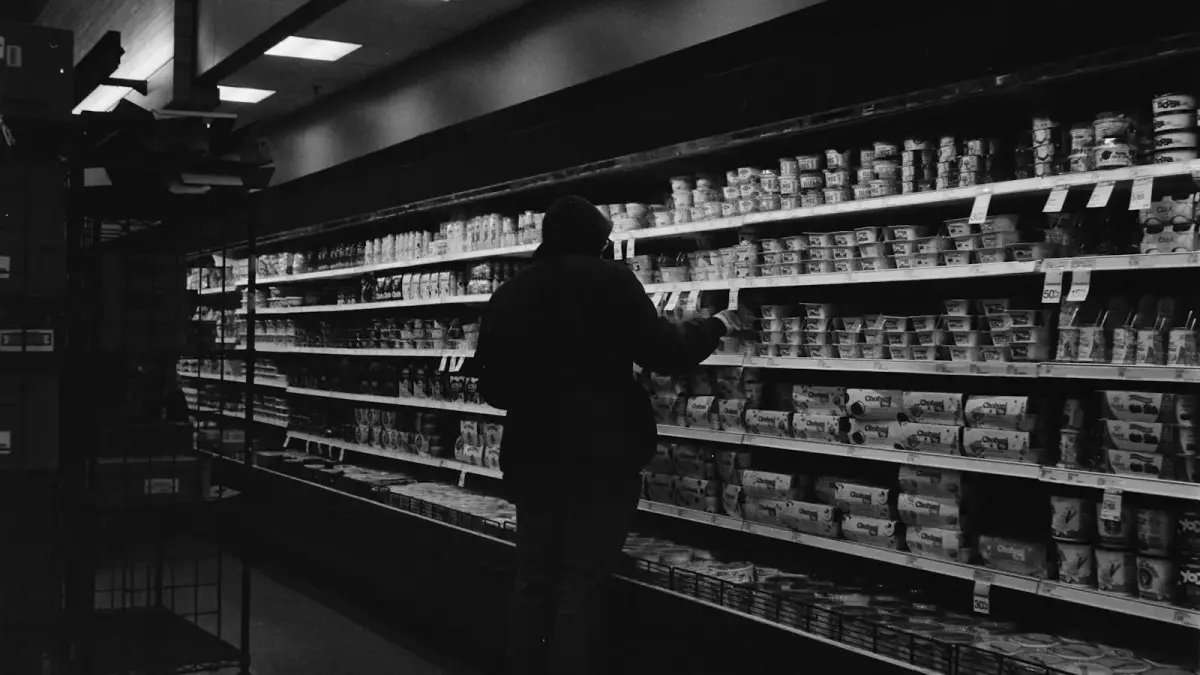
She would stand in the cereal aisle at ShopRite, holding two boxes - one in each hand, like she was weighing something far heavier than breakfast. The store brand went into the cart for her. The name brand went in for us. She did this with shampoo, with bread, with the orange juice she poured into a glass every morning but never seemed to drink herself.
I thought it was just how shopping worked. I thought every parent ate the bruised banana and gave the good one to their kid. I thought every mother’s winter coat was supposed to look like that - faded at the elbows, zipper catching every time, still somehow “perfectly fine” for another year.
It wasn’t until I caught myself doing the exact same thing at thirty-six - standing in a Target aisle, putting the store-brand body wash in my basket while reaching for the better one for my son - that I realized this wasn’t a shopping habit. It was an inheritance. A sorting system so deep in my body that I didn’t even feel it happening.
And I want to talk about what that sorting system actually is. Because it looks like good parenting. But underneath it is something much older and much sadder.
The grocery cart that tells the whole story
If you grew up in a home where money was a conversation that happened in whispers after the kids went to bed, you know this landscape.
You know the parent who drove the car with the check engine light on for two years but made sure you had new sneakers for the school year. You know the father who ate leftovers for lunch every day - the same reheated pasta, the same sandwich on day-old bread - while packing something fresh for your lunchbox.
You know the mother who said “I already ate” when there wasn’t quite enough dinner to go around. You know she hadn’t.
These aren’t dramatic sacrifices. Nobody writes a memoir about buying store-brand coffee for yourself. There’s no Oscar-worthy scene in which a parent puts back the good shampoo and grabs the cheaper bottle. It’s too small for anyone to notice.
But that’s exactly what makes it so powerful. It happens in the most ordinary places - the grocery store, the shoe rack by the front door, the bathroom cabinet where one person’s toiletries are always a little less than everyone else’s. And the person making that split doesn’t think of it as sacrifice. They think of it as obvious. As automatic. As just what you do.
A 2018 study published in the Journal of Consumer Psychology found that adults who grew up in financially precarious households developed what the researchers called “self-directed austerity” - a pattern in which the individual reflexively restricts their own consumption even when resources are sufficient. The scarcity is gone. The sorting system remains.
Where the sorting system gets installed
Here is what I’ve come to understand about this pattern: it doesn’t start in adulthood. It doesn’t even start with your own children. It starts in the house you grew up in, in the thousands of tiny moments where you watched your parents subtract themselves from the equation.
You watched your dad wear the same three shirts on rotation while making sure you had what you needed for picture day. You watched your mom skip the doctor when her knee was bothering her because the copay was twenty dollars and that twenty dollars was earmarked for your field trip. You watched them choose, over and over, in ways so quiet you could have missed them entirely.
And what your nervous system learned from that - before you had any words for it, before you could have possibly understood household budgets or insurance premiums or the weight of a mortgage - was a rule. A foundational rule about how resources get distributed in a family.
The rule was: someone has to go without, and that someone is the parent.
Not because the parent doesn’t matter. But because in the algebra of a tight household, the children’s needs are the constant and the parent’s comfort is the variable. And the variable is the thing you solve for. Which means it’s the thing you cut.
Psychologist Gabor Mate has written extensively about how children absorb the emotional logic of their household long before they can articulate it. They don’t learn from what parents say. They learn from what parents do with their bodies, their plates, their winter coats. And a child who watches a parent consistently put themselves last absorbs that sequence as natural law.
Not as sacrifice. As physics.
The adult version looks like generosity
Here’s the part that makes this pattern so hard to see: it presents beautifully.
The adult who buys the name brand for their kids and the generic for themselves looks like a devoted parent. Looks like someone who has their priorities straight. Nobody pulls you aside at the checkout and says, “Hey, you’re allowed to buy the good soap for yourself too.”
And you wouldn’t hear them if they did. Because the sorting isn’t happening in the conscious, decision-making part of your brain. It’s happening downstream, in the part of you that was shaped by watching your parents navigate scarcity with their own bodies as the first sacrifice.
A 2021 study in Psychological Science examined adults who grew up in lower-income households and found that even after achieving financial stability, many continued to exhibit what the researchers described as “residual resource allocation bias” - a tendency to direct quality and comfort toward others while defaulting to the minimum for themselves. The participants didn’t describe this as deprivation. They described it as preference. They said they liked the cheaper version. They said it didn’t matter.
But when the researchers dug deeper, they found that the pattern was remarkably specific. These adults weren’t frugal across the board. They spent freely on their children, their partners, their friends. The austerity was aimed inward, like a spotlight that only illuminated one person’s needs as optional.
That’s not preference. That’s a blueprint. And the blueprint was drawn in a kitchen where someone always ate last.
The coat you’ve been wearing for ten years
I want to stay with the specifics for a moment, because this pattern lives in specifics.
It’s the coat you’ve had since your twenties that you keep saying is fine. It’s fine. The zipper works if you pull it at the right angle. The lining is only torn in one spot. You don’t need a new one. You’ll get a new one next year.
Next year never comes. But your daughter’s jacket is brand new every September.
It’s the car you drive - the one with the small dent, the one that makes a sound you’ve been ignoring, the one you keep saying you’ll deal with eventually. Meanwhile your kid’s car seat is top-of-the-line, because of course it is, because you researched every option and read every safety rating and didn’t hesitate for a second.
It’s the way you order at a restaurant with your family. You scan the menu and your eyes go automatically to the middle of the price range. Not the cheapest thing - that would be too obvious. But not what you actually want, either. You find the thing that’s reasonable. You tell everyone else to get whatever they’d like.
These moments don’t feel like self-denial. They feel like the only sensible thing to do. And that’s exactly how you know the sorting system is running. When deprivation feels like common sense, it means someone taught you very early that your comfort was a luxury the household couldn’t afford.
The lie underneath the math
The deepest part of this pattern isn’t the shopping or the coat or the order at the restaurant. The deepest part is the belief that makes all of it feel rational.
And the belief is this: I am not the kind of person who gets the good version of things.
Not “I can’t afford it.” Not “I’m saving money.” Not even “my kids come first.” Those are the stories on top. Underneath all of them is something quieter and more painful - the conviction that your comfort is fundamentally less important than other people’s. That you were built to go without. That wanting the better version of something for yourself is a kind of greediness you were never allowed to have.
Researcher Brene Brown has described this as a form of what she calls “scarcity thinking that gets dressed up as virtue.” The person who always takes less isn’t necessarily humble. They may be someone whose early environment taught them that their needs were the problem - that when resources ran short, the solution was always to need less, not to find more.
And when you carry that into parenthood, it doesn’t look like damage. It looks like devotion. It looks like the thing every parenting article tells you to do - put your children first. But there’s a difference between choosing to prioritize your kids and being unable to imagine that you deserve the same quality of care you give them.
One is a choice. The other is a wound wearing the clothes of a choice.
What happens when your kids notice
Here is the part that caught me off guard.
My son was nine when he looked at my plate and then at his and said, “Dad, how come you always give yourself the small piece?”
I laughed. I said something about not being that hungry. But he just looked at me with that quiet clarity kids sometimes have and said, “You always say that.”
And I felt something crack open. Because he was right. I always said that. And I always meant it to be invisible - the way my mother’s choices in the cereal aisle had been invisible to me for decades.
But kids see it. They see the coat. They see the plate. They see the parent who never orders what they actually want. And they start learning the same algebra. They start absorbing the same rule: when things get distributed, someone goes without, and that someone is you if you love people enough.
A 2020 study published in the Journal of Family Psychology found that children who observed parental self-sacrifice as a consistent pattern were more likely to develop difficulty accepting care and generosity in their own adult relationships. They didn’t learn that sacrifice was noble. They learned that receiving was selfish. And that distinction shaped how they moved through every relationship for the rest of their lives.
That was the moment I realized this pattern isn’t just about me. It’s a thing that travels. It moves through grocery carts and winter coats and dinner plates, generation to generation, each one believing they’re just being practical.
The permission no one gave you
I’m not going to tell you to go buy yourself expensive things. That’s not what this is about. This isn’t a lecture on self-care or a prompt to treat yourself.
What I want to say is simpler and harder than that.
You are allowed to have the good version.
You are allowed to buy the soap that smells the way you like, the bread that isn’t the cheapest on the shelf, the coat that actually keeps you warm. You are allowed to eat the unblemished apple. Not because you earned it. Not because you finished everything else first. But because your comfort was never supposed to be the thing that gets cut.
Somewhere in a grocery store aisle a long time ago, you watched someone you loved choose the lesser version for themselves and hand the better one to you. And you learned from that. You learned love looks like subtraction. You learned that the people who matter most are the ones who need least.
But that math was written in a kitchen that didn’t have enough to go around. And you’re not in that kitchen anymore.
The light in the cereal aisle is fluorescent and unflattering and it hums a little. But you’re standing there with enough. Enough for your kids and enough for yourself. And the only thing keeping you from reaching for the better box is a voice that was installed so long ago you think it’s yours.
It’s not yours. It was given to you by someone who loved you the only way they knew how - by going without.
You can love your kids without continuing that tradition. You can hand them the good version and also keep one for yourself. The cart is big enough. It always was.