There are people who still calculate the per-unit price of everything they put in their cart, not because they need to anymore but because a childhood spent watching a parent stand at the register quietly putting items back installed a kind of arithmetic that runs underneath every purchase they will ever make, and the comfort they built for themselves has never fully reached the part of them that knows exactly how many hours of labor a gallon of milk used to cost
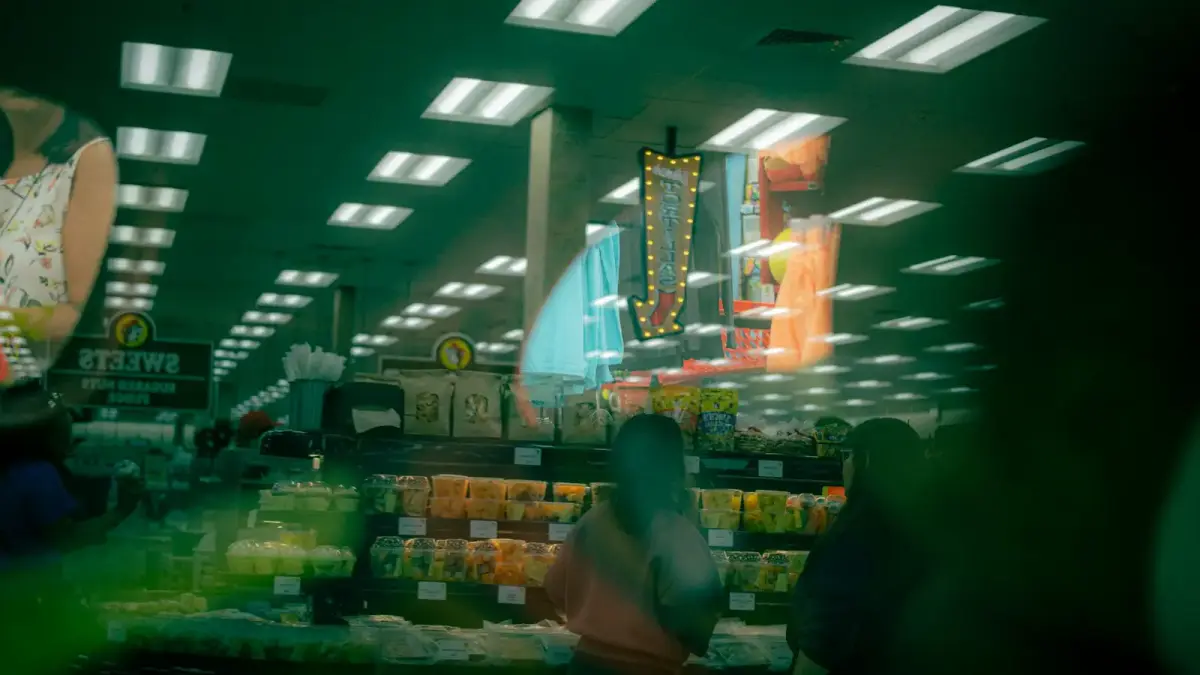
I was standing in the cereal aisle last Tuesday when I caught myself doing it again.
My hand had already bypassed the brand I actually wanted. It was reaching - automatically, without any instruction from the part of me that has a retirement account and a paid-off car - for the store brand. Not because I preferred it.
Not because I was budgeting. Because my fingers know a route through a grocery store that my salary has never been able to reroute, and that route always bends toward the lower shelf, the bigger bag, the version of the thing that costs less per ounce.
I stood there holding both boxes. The one I wanted cost a dollar sixty more. A dollar sixty.
I make a comfortable living. I have made a comfortable living for over a decade. And I was doing math.
I put the name brand in the cart. It felt like defiance. It felt like something I should not be doing.
And I knew, standing under those fluorescent lights with my reasonable cart and my unreasonable guilt, that the arithmetic running underneath that moment had nothing to do with the person I am now and everything to do with the kitchen I grew up in.
The calculator that never powers down
There is a specific kind of math that gets installed in childhood, and it does not come with an off switch.
It is not something you learn the way you learn long division or percentages. It is something you absorb through years of proximity to a parent who could do the cost-per-ounce calculation faster than most people can read a price tag. You absorb it by standing next to them in the store, watching their eyes move from product to shelf label to product again, watching the quiet decision happen before they reach for anything.
You absorb it by noticing the things that went back on the shelf.
A 2019 study published in the Journal of Personality and Social Psychology found that adults who experienced economic scarcity in childhood exhibit what researchers call “residual vigilance” - a heightened, automatic monitoring of resources that persists long after the scarcity has resolved. The study found that this vigilance operates below conscious awareness, activating in contexts related to spending, food, and material acquisition even when participants reported feeling financially secure.
This is the calculator. It is not a habit. It is not a preference.
It is a piece of software that scarcity wrote into you before you were old enough to understand what it was doing, and it runs every time you stand in a store, sit in a restaurant, or click “add to cart” on something that costs more than the version you know you’re supposed to choose.
It runs, and it does not ask permission.
The running total
You know who you are because you do the thing most people never think to do: you keep a number in your head while you shop.
Not a budget. Not a list with prices written next to items. A running total - alive, updating, adjusting in real time as things go into the cart.
Bread, two forty-nine. Milk, three eighty. The chicken thighs on sale, six twelve.
You round up. You always round up. Because your parent rounded up, and rounding up meant you were never surprised at the register, and not being surprised at the register was the whole point.
The register was where it happened. The register was where the number that had been building quietly through the whole trip finally became real, became a thing someone had to respond to out loud, in front of other people, with children watching.
I remember my mother’s face at checkout. Not distressed. Not embarrassed. Just focused.
Running her own total against the number on the screen, and when the screen won - when the number was higher than the number she had been carrying - the quiet recalculation began.
This can go back. We don’t really need that. Actually, I changed my mind about the other one.
She said it like it was a preference. Like she had simply reconsidered. I was eight years old and I already understood that reconsidering was not what was happening.
The running total exists because of that moment. Because if you always know the number before you reach the register, you never have to stand there and choose what to put back while someone waits behind you.
You never have to perform that arithmetic publicly. The running total is a form of protection, and the fact that you no longer need protection does not seem to matter to the part of you that learned this skill under duress.
What a gallon of milk used to cost
Not in dollars. In hours.
This is the conversion that lives underneath the other conversions, the one that poverty teaches and comfort never fully unlearns. Before you knew what per-unit pricing was, before you understood sales tax or coupon math, you understood that money came from somewhere, and that somewhere was your parent’s body, their time, their hours standing or lifting or driving or waiting.
You knew what a gallon of milk cost in the currency that mattered, which was the currency of someone you loved being away from home, being tired, having sore feet, coming back with less energy than they left with.
A gallon of milk was forty minutes. A box of cereal - the good cereal, the kind with the cartoon on the box - was nearly an hour. You learned to see through the price tags to the labor underneath, and that kind of seeing does not reverse itself when the labor is no longer visible.
A 2021 study in Psychological Science examined how childhood socioeconomic status shapes what researchers called “effort-cost mapping” - the tendency to mentally translate monetary costs into physical labor equivalents. Participants who grew up in lower-income households were significantly more likely to evaluate purchases by estimating the work required to earn the money, even when their current income made such calculations unnecessary. The researchers noted that this mapping was automatic and resistant to change, suggesting it functions less as a cognitive strategy and more as a deeply embedded perceptual framework.
This is why a forty-dollar dinner feels different to you than it does to the person sitting across the table. Not worse. Not painful, exactly. But weighted.
You are not just spending forty dollars. You are spending the thing that forty dollars used to mean, and that thing had a face and a body and came home tired.
The flinch and the guilt
There is a physical sensation that arrives when you spend money on something that is not strictly necessary, and it is not anxiety and it is not fear. It is closer to flinching. A small contraction somewhere behind the ribs, a pulling-back, as if your body is trying to intercept the purchase before it becomes permanent.
You feel it when you buy the good olive oil instead of the one in the plastic bottle. You feel it when you choose the restaurant with the cloth napkins. You feel it at the holidays, standing in a store with a gift in your hands that costs more than what your family used to spend on an entire Christmas, and your chest tightens not because you cannot afford it but because some part of you still believes that wanting the nicer thing is a kind of betrayal.
The guilt is specific. It is not generalized financial anxiety. It is the guilt of someone who got out - who built something more comfortable than what they came from - and who carries the quiet, irrational sense that comfort is borrowed, that it can be recalled, that it was never really meant for someone who knows what it’s like to put items back at the register.
Dr. Sendhil Mullainathan and Eldar Shafir, in their research on scarcity and cognition, described how financial scarcity creates a “tunneling” effect - a narrowing of attention that prioritizes immediate economic threat above all else. But what they also found, and what fewer people discuss, is that the tunnel does not always widen when the scarcity ends.
For some people, the attentional pattern persists. The tunnel becomes a lens.
You see the world through the economics of everything, not because you are cheap or rigid or unable to enjoy abundance, but because the part of you that was shaped by scarcity is still scanning, still calculating, still checking whether the math works out.
The flinch is that scan made physical. And the guilt that follows is the sound of two versions of yourself disagreeing about whether you are allowed to have what you have.
The dignity of the quiet math
Here is what I want to say carefully, because it matters.
The arithmetic is not a wound. Or rather, it is not only a wound.
It is also a record of someone’s love. The parent who stood at the register doing math in their head was not failing. They were solving a problem that should not have been theirs to solve - the problem of making not-enough into enough, of making sure their children ate, had shoes, had the things that other children had without anyone in their household doing long division in a checkout line.
The quiet math was dignity. It was resourcefulness. It was a parent refusing to let their children see panic, converting their fear into calculation because calculation was something they could control.
And when you stand in the cereal aisle doing the same math twenty or thirty years later, you are not broken. You are carrying a skill that someone you love built under pressure, and your body learned it the way bodies learn everything - by watching, absorbing, and repeating without being asked.
The calculator does not make you cheap. It does not make you damaged.
It makes you someone who knows what things cost in the way that only people who have been close to the edge of not-having can know, and that knowing is not a flaw. It is a form of fluency.
You speak a language that comfortable people never had to learn, and the fact that you are now comfortable yourself does not erase the fluency. It just means you are bilingual.
Buying the name brand
I still do the math. I do not think I will ever stop doing the math.
But something has shifted in the years since I started paying attention to it. I notice the calculation now. I notice the flinch.
I notice my hand reaching for the bottom shelf and I let it, sometimes, because the store brand is fine and there is no shame in choosing it. And other times I reach past it.
I pick up the thing that costs more. I put it in the cart without converting the price into hours of someone’s labor.
It does not feel like freedom, exactly. It feels like a conversation.
The part of me that learned the math is still there, still running the numbers, still making sure we are okay. And the part of me that built a different life is there too, gently saying: we are okay. We have been okay for a while.
Both of them are telling the truth. The math is real. The comfort is also real.
And the place where they meet - the cereal aisle, the checkout line, the moment of reaching for something and feeling the old arithmetic stir - is not a place of failure.
It is the place where you carry everything you came from into everything you have become.
If you grew up watching someone do the quiet math, if you still carry a running total in your head, if the calculator poverty installed is still humming underneath every purchase you make - you are not stuck in the past. You are someone who remembers where they came from with their whole body, and that memory, even when it aches, is a kind of honoring.
The comfort you built is real. The arithmetic is also real. You are allowed to hold both.