Psychology says people who always turn the volume down before starting the car - who reach for the dial before the key is even fully turned, who flinch when a song comes on at a volume they did not choose - are not noise-sensitive and are not anxious, they are people whose nervous system learned in childhood that sudden loud sounds were never just sounds but the first note of something they needed to be ready for, and the hand on the volume dial at forty-nine is not a preference but a girl still controlling the one variable she was never given permission to control in the original room
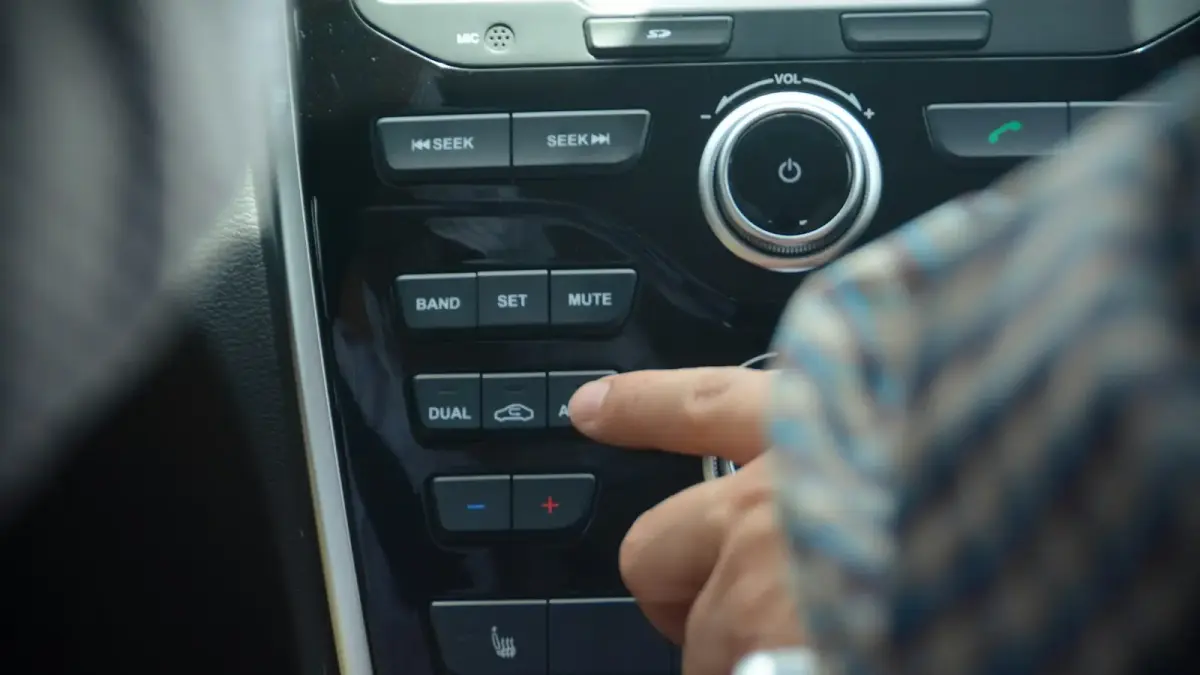
I do it every single time. Before I turn the key, before my seatbelt is even clicked, my hand goes to the volume dial and turns it down. Not off. Just down. Low enough that whatever comes through the speakers when the engine turns over will arrive gently, predictably, at a volume I chose rather than one that chose me.
I have done this for thirty-one years of driving. I did it this morning in a parking garage at seven a.m. with nobody else in the car and nothing playing. The radio was already off. I turned the dial down anyway.
My husband noticed it years ago. He called it a quirk. He said it the way you describe something endearing about a person you love - a small, harmless oddity filed under the category of things that make someone who they are. I smiled and said nothing because I did not yet have the language for what I was actually doing when my hand reached for that dial.
I have the language now. And if you do this too - if your hand moves toward the volume before it moves toward anything else, if you cannot start a car without first ensuring that the sound will be under your control - I need you to understand what that gesture actually contains.
The room where sound carried information
I grew up in a house where noise was data.
Not music. Not laughter. Not the ordinary sounds of a family going about its life. I mean the other sounds. The ones underneath. A cabinet door closed with slightly more force than necessary. A glass set down on the counter hard enough to ring. The specific silence that followed my father walking through the front door, when every person in the house paused mid-breath to assess the quality of his footsteps.
In that house, I learned something before I could have named it. Sound was the first signal. Sound arrived before language, before eye contact, before the sentence that would determine the shape of the next two hours. A slammed door was not a slammed door. It was a forecast.
A 2012 study published in Psychological Science found that children raised in unpredictable home environments develop heightened auditory startle responses - their nervous systems become calibrated to treat sudden or unexpected sounds as potential threats, even when the sounds themselves are neutral. The researchers noted that this calibration persists long after the original environment has changed. The ears, in effect, never stop listening for the weather report they were trained to decode.
I was one of those children. And the woman in the car this morning, turning down a dial that was already at zero, is the same girl who used to lie in bed at night mapping the emotional geography of the house by its sounds alone.
What the body learned before the mind could argue
Here is what I want you to understand if this resonates with you. Your hand on the volume dial is not a conscious choice. It is not a preference. It is a pre-verbal instruction your body issued to itself before your thinking mind had any say in the matter.
When your nervous system spends years - the formative ones, the ones when the brain is building its fundamental model of how the world works - in an environment where unexpected sounds precede unpredictable events, it does something efficient and devastating. It begins treating all unexpected sound as a potential threat. Not loud sounds specifically. Not angry sounds. Any sound that arrives without your permission.
This is why you flinch when someone drops a pan in the kitchen even though you are forty-seven and safe. This is why the car radio coming on at a volume you did not set produces a jolt in your chest that is wildly disproportionate to the situation. This is why you cannot fall asleep with the television on unless you are the one holding the remote.
Your nervous system is not overreacting. It is applying the rulebook it was given. In the original room, the rulebook was correct. Unexpected sound was legitimately the first signal that the emotional weather was about to change. Your body learned to get ahead of it - to reach for the dial, to lower the volume, to manage the soundscape before it could manage you.
Bessel van der Kolk describes this as the body’s loyalty to its own survival data. The thinking brain can understand that a car radio is not a threat. The nervous system, which operates faster than thought and answers to a different authority, does not update its files based on intellectual arguments.
The mathematics of volume control
I started paying attention to this pattern in other people after I understood it in myself, and what I found was striking in its specificity.
People who reach for the volume dial before starting the car almost always do several other things. They lower the television when a commercial comes on louder than the show. They notice the hum of a refrigerator that other people have filtered out. They can hear a conversation two tables away in a restaurant while their dining companion hears only background noise.
They are not more sensitive to sound. They are more vigilant about sound. There is a crucial difference.
Sensitivity is a trait. Vigilance is a strategy. And the strategy was learned in a specific classroom - one where the curriculum was taught in decibels rather than words.
A 2020 study published in Frontiers in Psychology found that adults who reported childhood exposure to household volatility showed measurably heightened auditory processing - not hearing loss or hearing gain, but an increased neural allocation of attention to ambient sound. Their brains, the researchers concluded, had been trained to run a background audio scan that most people’s brains simply do not perform. They are listening to the room underneath the room, the way a pilot monitors instruments even during smooth flying.
This is not a disorder. This is competence built under pressure. Your nervous system became an expert at reading the acoustic temperature of any room you walked into, and it has never stopped performing that assessment.
The hand that reaches before permission
Here is the part that changed how I understand myself.
I used to think the volume dial was about sound. It is not about sound. It is about control.
In the original room - the one where I learned to map my father’s mood by the weight of his footsteps on the stairs - I controlled nothing. Not the volume of his voice. Not the force of the cabinet doors. Not the particular quality of silence that settled over the dinner table when something had gone wrong at work and the rest of us were about to inherit it.
I controlled nothing. And a child who controls nothing in an environment where sound is threat data develops one very specific adaptation. She learns to control whatever she can. The television volume. The softness of her own footsteps. The care with which she sets her glass on the table. The precision with which she closes her bedroom door.
The car radio is the adult continuation of that same program. The hand on the volume dial at forty-nine is the hand of a girl who was never given permission to regulate the noise in her own house, exercising the only form of control she was ever able to teach herself. She turns it down not because the music is too loud but because the act of turning it down is a tiny, daily proof that she is now the person who decides how loud the room gets.
That is not a quirk. That is a woman who built her own thermostat because nobody let her touch the one in the original house.
The sound you are actually managing
If you are reading this and your hand went to your chest or your stomach just now - if something in your body responded to this before your mind finished processing it - then you already know what I am describing. You know the feeling of a room that is too loud. Not in volume. In unpredictability.
And I want you to know something that took me a very long time to understand.
The hand on the dial is not broken. It is not pathology. It is not something you need to fix or train yourself out of or apologize for when someone notices.
The hand on the dial is a girl who learned to read a room by its acoustic temperature, who developed a level of auditory awareness that most people will never possess, who can tell you the emotional weather of any space she walks into before a single word has been spoken - and who figured out, long before anyone taught her the vocabulary for it, that the one variable she could control was volume, and she has been controlling it ever since with a competence so quiet that the people around her mistake it for a quirk.
You are not noise-sensitive. You are the person who learned to manage the soundscape of an unpredictable world, and the hand on the dial is proof that you succeeded.
It was never about the car radio. It was always about the room you could not turn down. And the fact that you reach for the dial every single time - without thinking, without deciding, without anyone asking you to - is not anxiety.
It is the quietest kind of mastery. And it has been yours since before you could name it.