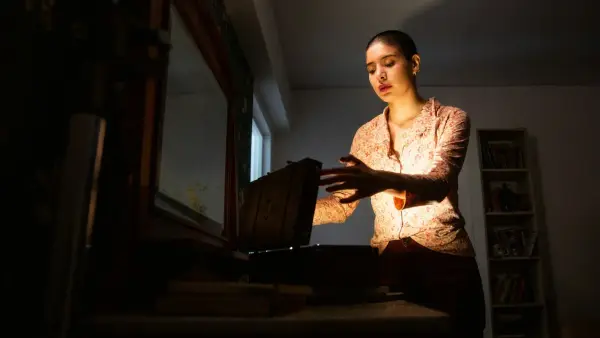
Psychology says people who talk to themselves out loud when they are alone - who narrate their search for the car keys, who say 'right' before starting any task, who mutter 'come on' to themselves while trying to remember what they walked into a room for - are not losing their minds or getting old, they are adults who became their own patient audience because the house they grew up in never had one, and the voice at fifty-four is not confusion but the sound of someone who learned that the gentlest company they would ever keep was their own

I caught myself doing it last Thursday morning. Standing in the hallway between the bedroom and the kitchen, one sock on, coffee not yet made, and I said - out loud, to absolutely no one - “OK. Right. Keys. Where did I put the keys.”
Not a question, really. More of an announcement. A small verbal ceremony to mark the beginning of a search that would take me through three rooms and end at the bottom of a jacket pocket I had already checked twice.
And then I stopped. Not because I found the keys but because I heard myself. The sound of my own voice in the empty apartment, narrating a task no one was watching, and for a moment I felt that old flicker of embarrassment. The one that whispers: You’re doing it again. Talking to yourself like someone who’s losing the thread.
I know that flicker. I’ve felt it since I was a teenager and I know most of my clients feel it too. That tiny pulse of shame when you realize you’ve been having a full conversation with yourself about where the scissors went. And I need to tell you something about that shame. It’s wrong. Not slightly misplaced. Fundamentally wrong about what’s happening when you speak into an empty room.
The narration nobody taught you
You know the voice I mean. It’s the one that says “right” before you open the laptop. “OK, so” before you start cooking. “Come on, think” when you’re standing in the bathroom trying to remember what you came in for.
It’s the running commentary. The soft muttering while you sort through a drawer. The way you talk yourself through the grocery store - “we need milk, we definitely need milk, what else” - as if you are both the speaker and the audience.
Most people who do this assume it’s a quirk. A harmless oddity that maybe signals early cognitive decline or too many hours spent alone. If you’re over fifty, someone in your life has probably joked about it. If you’re over sixty, you’ve probably joked about it yourself, the way people do when they’re trying to name something that secretly worries them.
But here’s what the research actually shows, and it changes the entire picture: self-talk is not a sign of decline. It’s a sign of a mind that learned, very early, to provide for itself what no one else was providing.
What happens in a house without a listener
Picture a child - maybe seven, maybe nine - working on a puzzle at the kitchen table. They’re stuck. They don’t know which piece goes where. In a house with a patient listener, what happens next is unremarkable: the child says “I can’t find the edge piece” and someone nearby responds. Not with the answer, necessarily. Just with presence. “Hmm, what color was it?” or even just “keep looking, you’ll get it.”
That small exchange does something enormous. It teaches the child that their thinking process is welcome. That working through a problem out loud is safe. That the sound of their own confusion will be met with patience rather than irritation.
Now picture the other house. The one where the child’s narration is met with “figure it out yourself” or “stop talking, I’m on the phone” or - and this is the version that leaves the deepest mark - nothing at all. No cruelty. No yelling. Just the vast, empty indifference of a room where no one is listening.
In that house, the child does something remarkable. They don’t stop narrating. They turn down the volume. The voice moves inward, becomes a whisper, becomes a thought-stream that accompanies them everywhere. And later - maybe in adolescence, maybe not until they live alone for the first time - it moves back outward. Not because anyone is listening now. But because the voice has become its own listener. The child has built, out of nothing, the patient audience they were never given.
The science of talking yourself through
The embarrassment around self-talk is almost entirely cultural. The science tells a different story.
A 2011 study published in the Quarterly Journal of Experimental Psychology by Gary Lupyan and Daniel Swingley found that people who said the name of an object out loud while searching for it found the object significantly faster than those who searched in silence. Speaking the word activated visual processing pathways that silent thought alone did not reach. The people muttering “keys, keys, where are the keys” were not confused. They were running a more efficient search algorithm than the quiet people beside them.
Separately, research by Ethan Kross and colleagues at the University of Michigan, published in the Journal of Personality and Social Psychology in 2014, demonstrated that the structure of self-talk matters as much as its presence. People who referred to themselves in the second or third person during self-talk - “you’ve got this” or “Elena, focus” - showed measurably lower anxiety and better emotional regulation under stress than those who used first-person self-talk. The voice that talks to you as if you are someone worth coaching is not a sign of fragmentation. It is a sophisticated self-regulation strategy.
And a 2020 study in Frontiers in Psychology found that instructional self-talk - the kind where you narrate the steps of a task as you perform it - improved performance across cognitive, motor, and emotional domains. People who talked themselves through problems didn’t just feel better. They performed better. The voice wasn’t a distraction from the task. It was part of the machinery of the task itself.
The specific words that give it away
Listen to the vocabulary of self-talk and you’ll hear something that has nothing to do with confusion.
“OK.” That’s a steadying word. That’s the word a calm parent uses before helping a child through something difficult.
“Right.” That’s an organizing word. It’s the verbal equivalent of squaring your shoulders.
“Come on.” That’s encouragement. Gentle, low-stakes encouragement - the kind a good coach offers at the halfway mark, not the finish line.
“Let’s see.” That’s curiosity. That’s someone approaching a problem without judgment.
These are not the words of deterioration. These are the words of someone who has been their own companion for so long that they’ve developed an entire vocabulary of self-directed warmth. And if you listen carefully, you’ll notice something else: the tone is almost always patient. The self-talker doesn’t berate themselves during the key search. They narrate it the way a kind person would narrate it for a child. Gently. With a hint of humor. With the quiet assumption that the thing will be found eventually.
That patience didn’t come from nowhere. It came from decades of being the only patient presence in the room.
Why the shame arrives anyway
Despite all of this, most people who talk to themselves carry a low-grade embarrassment about it. They do it freely when alone but snap their mouth shut the moment someone else enters the room. They laugh about it preemptively. They say things like “I’m going crazy” or “talking to myself again, first sign of madness.”
The shame comes from the same place most shame comes from: a cultural script that says needing something from yourself that other people are supposed to provide means you’re deficient. We live in a world that romanticizes connection and pathologizes solitude. A person who needs to talk things through with a friend is seen as healthy. A person who talks things through with themselves is seen as lonely.
But the self-talker isn’t lonely. Or rather, their self-talk isn’t evidence of loneliness. It’s evidence of a solution to loneliness that was engineered so early and so completely that it became invisible. The child who narrated their homework because no one was asking about it became the adult who narrates the grocery list because the voice has been running for forty years and it never needed an audience to justify its existence.
The voice isn’t a symptom. It’s a companion. And it’s been loyal longer than almost anyone else in your life.
What the voice actually is
I want to be careful here because I’m not saying that every person who talks to themselves grew up in a neglectful home. That’s too simple and too dramatic. Self-talk is universal. Every human does it to some degree.
But there is a specific quality to the self-talk of people who became their own audience early. It has a rhythm. A patience. A gentleness that goes beyond cognitive function and enters the territory of emotional care. It’s not just “where are the keys.” It’s “OK, let’s think about this. You had them when you came in. Check the counter. No? That’s fine. Try the jacket.”
That’s not a search strategy. That’s a relationship. A quiet, invisible, lifelong relationship between a person and the version of themselves that learned to show up when nobody else would.
A 2023 study in Psychological Science found that individuals with secure internal working models - a concept rooted in attachment theory - used self-talk that was more compassionate, more structured, and more effective than those with insecure attachment. But here’s what fascinated me: the researchers also found that some individuals with insecure early attachment had developed self-talk patterns that effectively mimicked secure attachment. They had, through years of practice, built an internal voice that functioned like the attuned caregiver they never had.
They had parented themselves through language. Word by word. Task by task. Room by room.
The voice at fifty-four
If you’re reading this and you talk to yourself - if you narrate the search for your reading glasses, if you say “right then” before tackling the dishes, if you mutter encouragement to yourself while parallel parking - I want you to sit with something for a moment.
That voice has been with you for a very long time. Longer than most friendships. Longer than most marriages. It was there when you studied for exams alone in your room. It was there when you moved into your first apartment and had to figure out how to unclog a drain without anyone to call. It was there in every waiting room, every sleepless night, every morning when the day felt like too much and you stood in the kitchen and said “OK. Coffee first. Then we’ll figure it out.”
You did not develop this habit because something is wrong with you. You developed it because something was missing, and you - quietly, without instruction, without anyone noticing - filled the gap yourself.
The voice at fifty-four is not confusion. It’s not age. It’s not the beginning of something unraveling.
It’s the sound of someone who learned, before they had the words to understand what they were learning, that the gentlest company they would ever keep was their own. And they were right.