She is 61 and still counts the items in her grocery cart twice before she reaches the register - not because she cannot afford whatever is in it but because she was twelve when her mother put something back at the checkout counter while people waited behind them, and a girl who watched her mother's face change in front of a stranger's impatience learned that the distance between plenty and not enough is a single miscalculation, and the woman who has not needed to count in thirty years cannot stop
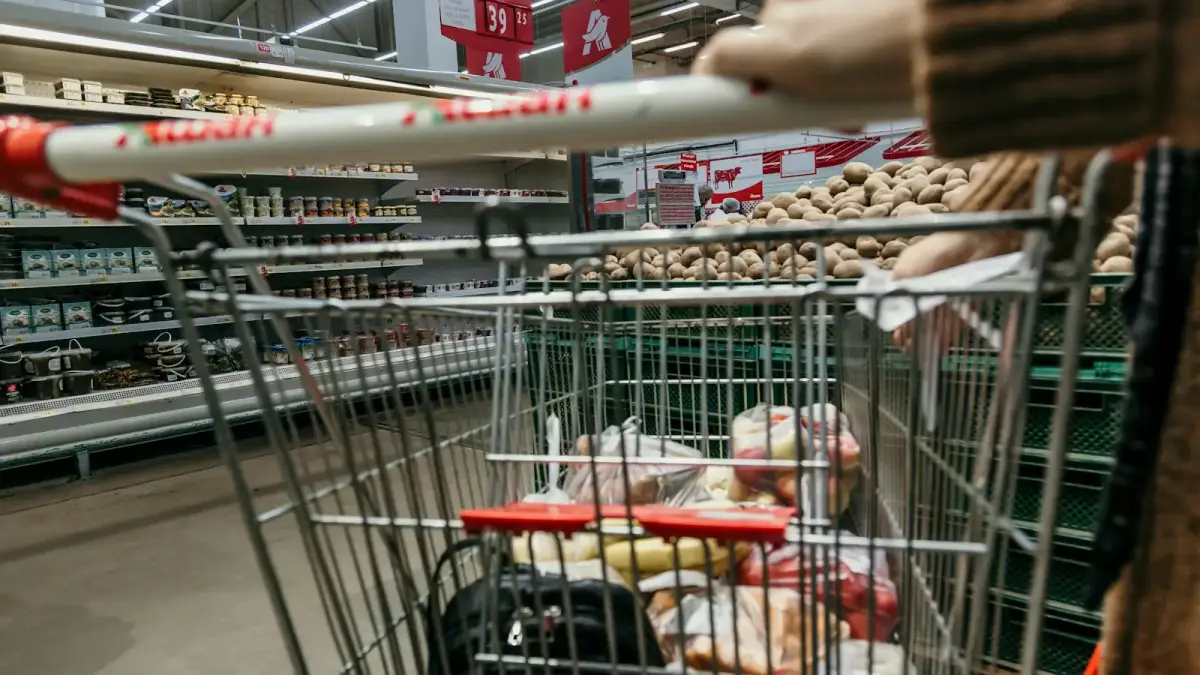
I was standing in the cereal aisle last Tuesday, holding a box of granola that cost nine dollars, and I was doing the math. Not because I needed to. Not because anything depended on it. But because something in me - something old, something lodged below my ribs - had already started tallying the cart before my thinking mind caught up.
Twelve items. Under a hundred dollars. Fine. More than fine. Comfortable, even.
But my hands were already reorganizing. Moving the things I could put back toward the front. Keeping the necessities - milk, bread, eggs - at the bottom where they were safe. As if safe were something a grocery item needed to be.
I am sixty-one years old. I have a retirement account and a paid-off car and a kitchen with more food in it than my mother ever had at one time. And I still count. Twice. Every single time.
If you do this too - if you do some version of this quiet accounting that nobody sees - I want you to know that what you are doing is not neurotic. It is not a flaw. It is something far more tender than that, and I think it is time we talked about why it does not stop even when the money does.
The Moment That Wrote Itself Into Your Bones
I was twelve. My mother had a cart with maybe fifteen items in it, and she was moving through the checkout line with the particular efficiency of a woman who had already done the math in the car.
She was fast. She was organized. She had the coupons sorted.
And then the total came up, and it was eleven dollars more than what she had. I remember the number because I watched her face when the cashier said it. Not embarrassment exactly. Something worse. A kind of dimming. Like a light behind her eyes stepped back from the window.
She put the chicken back. Just picked it up off the belt and handed it to the cashier without looking at the man behind us who had already started placing his own items down. Without looking at me.
But I was looking at her. And I saw it. The way her jaw set. The way she smiled at the cashier like she was apologizing for existing. The way she said, “That’s fine, we don’t need it,” in a voice that had been rehearsed a hundred times before I was old enough to hear it.
The people behind us were not cruel. They did not say anything. But their silence had a texture, and a twelve-year-old girl memorized it the way you memorize the combination to a lock you will never be allowed to forget.
The Mathematics of a Body That Remembers
Here is what I learned in that checkout line, and what I have spent fifty years failing to unlearn: the distance between enough and not enough is not a number. It is a feeling. And once your body learns that feeling, it does not care what your bank account says.
A 2019 study published in Psychological Science found that adults who experienced economic instability in childhood continued to exhibit scarcity-based decision-making patterns decades later - even after achieving financial security. The researchers called it “economic imprinting.” Your circumstances change. Your nervous system does not get the memo.
I think about that study a lot, standing in grocery aisles doing arithmetic I do not need.
Because my body is still twelve. My body is still watching my mother’s face change under fluorescent light. My body is still calculating what can be put back quickly, quietly, without anyone noticing.
The money problem was solved thirty years ago. But the body does not solve things the way the mind does. The body does not read your pay stubs. The body reads the room - the cashier’s tone, the line behind you, the possibility of being seen as someone who miscalculated.
And so I count. Not because I need to, but because a girl inside me decided that counting was how you kept your mother’s face from changing, and she has not been convinced otherwise.
When Someone Else Picks Up the Check
There is a particular kind of heat that rises through my chest when someone pays for my lunch.
Not anger. Not exactly shame. Something closer to a low-grade alarm, like a smoke detector chirping in a house that is not on fire but remembers one.
It happened last month. A friend - a good friend, someone who would never think twice about it - grabbed the bill before I could reach for it. She said, “I got it,” and waved her hand like it was nothing.
And it was nothing. To her.
To me, it was a tiny earthquake. My hand went to my purse. My mind went to the mental ledger I keep of who owes what and who has been too generous and whether I have been taking more than my share. I started planning how to pay her back without making it obvious that I was paying her back.
She was being kind. I was doing accounting.
Brene Brown writes about how shame lives in the body as physical sensation - the flush, the tightening, the urge to make yourself smaller. She is right, but I think for those of us who grew up counting, it is even more specific than that. The shame does not live everywhere in the body. It lives in the hands. In the reflex to reach. In the speed with which you grab for a wallet that has plenty in it because your muscles learned their urgency in a time when it did not.
You are not being difficult when you insist on splitting the check. You are not being proud. You are honoring an agreement your twelve-year-old self made with the world - I will never be caught short - and that agreement was the smartest thing she knew how to do at the time.
The Gap Between What You Have and What You Feel
I own my home. I want to say that plainly because it still surprises me sometimes when I pull into the driveway.
I own my home, and last week I washed a plastic bag to reuse it.
Not because I am frugal on principle. Not because I care about waste, though I do. Because some part of me still operates under the assumption that resources are finite in a way that is personal - that the universe keeps a ledger with my name on it, and one day the balance will come due.
A 2015 study in the Journal of Consumer Research found that people who grew up in lower socioeconomic conditions continued to make purchasing decisions based on perceived scarcity even after years of financial stability. The researchers noted that these patterns were not rational in the traditional economic sense. They were emotional. They were protective. They were loyal.
That word - loyal - stopped me when I read it.
Because that is what the counting is. That is what the bag-washing is. That is what the mental math in the cereal aisle is. It is loyalty. To my mother. To the version of our family that had to be careful. To the girl who watched and decided that if she was vigilant enough, precise enough, controlled enough, she could keep the worst thing from happening again.
The worst thing was not running out of money. The worst thing was watching someone you loved shrink in front of a stranger.
The Inheritance Nobody Talks About
We talk about what gets passed down in families - the china, the recipes, the eye color. We do not talk enough about the way a parent’s financial fear gets folded into a child’s muscle memory like flour into dough.
My mother never sat me down and said, “Be afraid of checkout lines.” She never had to. I watched her body, and her body taught mine.
Gabor Mate describes this kind of transmission as the way children absorb not what their parents say but what their parents feel. The unspoken curriculum. The education that happens below language, in the space between a mother reaching for her wallet and a daughter holding her breath.
I have friends who grew up the same way. We do not talk about it often, but when we do, the recognition is instant. The friend who cannot throw away leftovers even when they have gone bad. The one who keeps six months of savings in a separate account she never touches because touching it would mean the emergency is here. The one who drives to three different stores to save four dollars and cannot explain why stopping feels impossible.
We are not cheap. We are not anxious. We are not broken.
We are the daughters and sons of people who did their best with not enough, and our bodies decided to keep watch long after the war ended.
What the Counting Really Means
I am sixty-one, and I still count the items in my cart twice before I reach the register.
I used to think this meant something was wrong with me. That I should be over it by now. That financial security should have cured whatever this is.
But I do not think it needs curing.
I think the counting is how I carry my mother with me. Not the version of her that was embarrassed. The version of her that was competent. Organized. Capable of managing a household on almost nothing and making it look effortless. The version of her that knew exactly how much everything cost because knowing was how she kept us fed and clothed and present in a world that was not designed for our budget.
The counting is not a symptom. It is a memorial.
And if you do it too - if you carry your own version of this quiet arithmetic, this invisible loyalty to a childhood that shaped your hands before it shaped your thoughts - I want you to know that you are not stuck. You are not failing to evolve. You are not overreacting to a problem that no longer exists.
You are loving someone. With your hands. In a grocery store. The way you learned to love before you had words for it.
That is not something to fix. That is something to hold gently, the way you would hold the hand of a child who is watching her mother’s face and promising herself she will never let it happen again.
You kept that promise. Look at your life. You kept it.
And if the counting continues - let it. It is not fear anymore. It is the quietest kind of devotion. And it belongs to you.