She's 54 and has never been able to explain to anyone why the smell of bleach makes her feel safe - not clean, not fresh, just safe - because a girl who grew up in a home where her mother scrubbed the kitchen floor with bleach every Saturday morning before anyone else was awake learned that the sharp sting of chlorine meant someone was holding everything together, and the bottle under her own sink at fifty-four is not a cleaning product but a continuation of the only ritual her mother ever had that was entirely her own
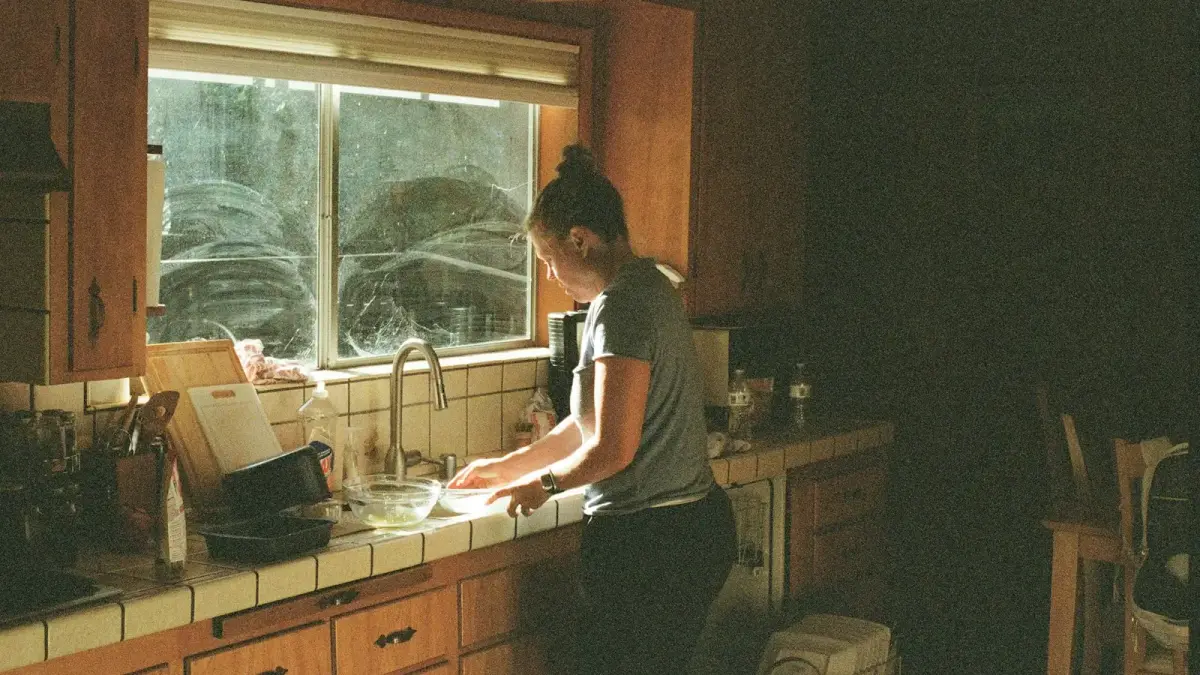
I was cleaning the kitchen floor at eleven o’clock on a Tuesday night - not because the floor was dirty, but because the day had been too much and I didn’t know what else to do with my hands.
I wrung the mop out and the bleach hit me. Not the lemon-scented kind. The real kind. The kind that stings the back of your throat and makes your eyes water just slightly. And something in my chest released. Not relaxation, exactly. Something older than that. Something closer to the feeling of being six years old and waking up on a Saturday morning to the sound of water sloshing in a bucket one floor below.
My mother was already up. She was always already up.
I stood there in my own kitchen at fifty-four, leaning on a mop handle, and realized I’ve been chasing this smell my entire adult life without ever understanding why. It’s not about the clean. It was never about the clean. The bleach is a message. It means someone is downstairs, someone is fighting, someone is holding the walls up. And the person I’m trying to hear in that sharp chemical sting is a woman who’s been dead for eleven years.
The Saturday morning ritual
In our house, Saturday began before dawn.
I don’t know what time my mother got up. I only know that by the time I padded downstairs in bare feet, the kitchen floor was already wet and the whole house smelled like chlorine. She’d be on her hands and knees sometimes, or standing with the mop, her housecoat tied at the waist, hair pulled back with a clip that had lost most of its teeth.
She never asked for help. She never complained about it. She just did it the way other people breathe - automatically, without discussion, as though it were simply the price of being alive in this house.
My father was still sleeping. My brother was still sleeping. The whole street was still sleeping. But my mother was scrubbing the kitchen floor with bleach because that was Saturday. That was what Saturday meant.
I used to think she was just cleaning. I was in my forties before I understood she was performing the only act of control available to her. We didn’t have money. We didn’t take vacations. My father’s paycheck covered the mortgage and the electric and the groceries, and after that there was nothing. My mother couldn’t control the bills. She couldn’t control my father’s moods. She couldn’t control whether the car would pass inspection or whether the roof would hold through another winter.
But she could scrub that floor until it shone.
And she did. Every single Saturday. Without fail. Without being asked. Without being thanked.
Bleach as the language of holding it together
There’s a particular kind of domestic labor that has nothing to do with cleanliness and everything to do with survival.
In working-class homes - and I say this as someone who grew up in one - cleaning was not a lifestyle choice. It wasn’t a Pinterest board or a wellness routine. It was the one domain where the women in my family could impose order on a world that gave them almost none.
My mother couldn’t stop my father from drinking too much on Friday nights. She couldn’t make the landlord fix the plumbing faster. She couldn’t afford to put my brother in the sports program all his friends were in. But she could get down on her knees on a Saturday morning and bleach that linoleum until it glowed.
The bleach was the statement. It said: this home is managed. We may not have much, but we are not falling apart. Someone is awake. Someone is watching. Someone cares enough to fight the grime.
It was, I think now, the most dignified thing she ever did. Not because cleaning is inherently dignified - it’s often the opposite, it’s often invisible, thankless work that society assigns to women and then pretends doesn’t exist. But because she chose it. She chose the ritual. She chose the hour. She chose the ferocity of it. And in a life where very few things were hers, that early morning floor was entirely her own.
The Proust effect - why smell carries what language can’t
Here’s the part that took me decades to understand.
I’m not sentimental about my childhood. I don’t get emotional looking at old photographs. I can talk about my mother’s life - the difficulty of it, the smallness of it - with relative composure. But one whiff of bleach in a hotel corridor and I am undone. Six years old. Saturday morning. Bare feet on cold linoleum. The world held together by chlorine and a woman who wouldn’t let it collapse.
There’s a reason for this, and it isn’t weakness.
A 2014 study published in the journal Progress in Neurobiology found that olfactory memories - memories triggered by smell - are processed through the amygdala and hippocampus in a way that visual and auditory memories are not. Smell bypasses the cognitive filters. It goes straight to the emotional core. This is sometimes called the Proust effect, after the famous passage in which the taste of a madeleine triggers an involuntary cascade of childhood memory.
But what the research also shows is that olfactory memories formed in early childhood are not just more vivid. They are more emotionally loaded. A 2021 study in Psychological Science found that smell-evoked memories were consistently rated as more emotional and more specific than memories triggered by words, images, or sounds. The participants didn’t just remember events. They re-experienced the feelings that accompanied those events.
So when I smell bleach and something loosens in my chest, I’m not being dramatic. I’m experiencing a neurological event that predates language. My brain stored the smell of Saturday mornings as safety. It encoded bleach as the sensory signature of a mother who was awake, who was present, who was fighting.
And no amount of cognitive understanding changes what the body knows.
Cleaning when the world gets loud
I clean when I’m anxious. I suspect you do too, if you’re reading this.
Not tidying - cleaning. Scrubbing. Getting down on your knees and attacking the grout with a brush that’s too small for the job. Wringing out a cloth until your hands ache. Pouring bleach with the kind of precision that would make a chemist nervous.
It’s not about the dirt. It was never about the dirt.
Gabor Mate writes about how children in unpredictable environments develop coping mechanisms that look, from the outside, like personality traits. The anxious cleaner isn’t anxious because she cleans. She cleans because somewhere, very early, she learned that the physical environment was the one variable she could manage. If the counters were wiped and the floor was mopped and the sink was empty, then something - one small something - was under control.
My mother taught me this without ever saying a word. She taught me that when the world is too much, you get up before everyone else and you fight entropy with the only weapon you’ve got. You don’t cry about it. You don’t talk about it. You just do it.
And then you sit down with a cup of tea and you look at your clean floor and for five minutes everything is manageable.
I have been doing this for thirty years and I only recently understood that I’m not cleaning my kitchen. I’m performing my mother’s vigil. I’m picking up where she left off.
The bottle under the sink
There is a bottle of bleach under my sink right now.
It’s the same brand she used. I didn’t realize this until my daughter pointed it out - “Mom, they make better stuff now, you know” - and I heard myself say “I know” in a voice that made it clear I wasn’t going to switch.
Because it isn’t a cleaning product. It’s a relic. It’s the closest thing I have to a photograph of my mother at five in the morning, on her knees, in a kitchen that was too small, in a life that was too hard, doing the one thing she could do to make the world feel manageable.
Rachel Herz, a neuroscientist at Brown University who studies the psychology of smell, has written extensively about how scent becomes a carrier of emotional meaning that outlasts every other sensory channel. We forget faces. We misremember conversations. But the smell associated with a formative emotional experience remains intact for decades - not as a fact, but as a feeling.
The bleach under my sink is a feeling.
It’s the feeling of a house that’s held together. Of someone being awake before the world wakes up. Of a woman with no power, no money, no voice in the larger world, refusing to let her kitchen floor be one more thing that defeated her.
What the daughter inherits
My daughter doesn’t clean with bleach. She uses some plant-based spray that smells like eucalyptus and comes in a bottle designed to look good on a countertop. She has that luxury. My mother’s Saturday mornings bought it for her, in a way - one generation’s desperate ritual becoming the next generation’s freedom to choose something gentler.
But sometimes, when my daughter comes home stressed from work, I catch her wiping down the kitchen counters before she even takes off her coat. She doesn’t know she’s doing it. She doesn’t know where it comes from.
I do.
It comes from a woman she barely remembers, on a kitchen floor she never saw, at an hour she’s never been awake for. It comes from bleach and cold water and a housecoat tied at the waist. It comes from the particular kind of love that never announces itself - that just gets up earlier than everyone else and scrubs until the world makes sense.
If you are the woman at fifty-four with the bleach under your sink - if the smell of chlorine makes something in your chest go quiet in a way you’ve never been able to explain to anyone - I want you to know what that is.
That’s not a cleaning habit. That’s not a quirk. That’s your mother’s hand on your forehead from forty-eight years ago, reaching you through the only channel that time can’t close.
You’re not broken for needing it. You’re her daughter. And the floor is clean.