She is 58 and has just realized the reason she always touches the walls when she walks through her house - a hand trailing along the hallway, fingertips brushing the doorframe, palm flat against the kitchen wall while she waits for the kettle - is not absent-mindedness but a body that learned at seven that the only way to know a house was still standing was to keep touching it, because a girl whose home changed addresses without warning never stopped checking whether the walls were still there
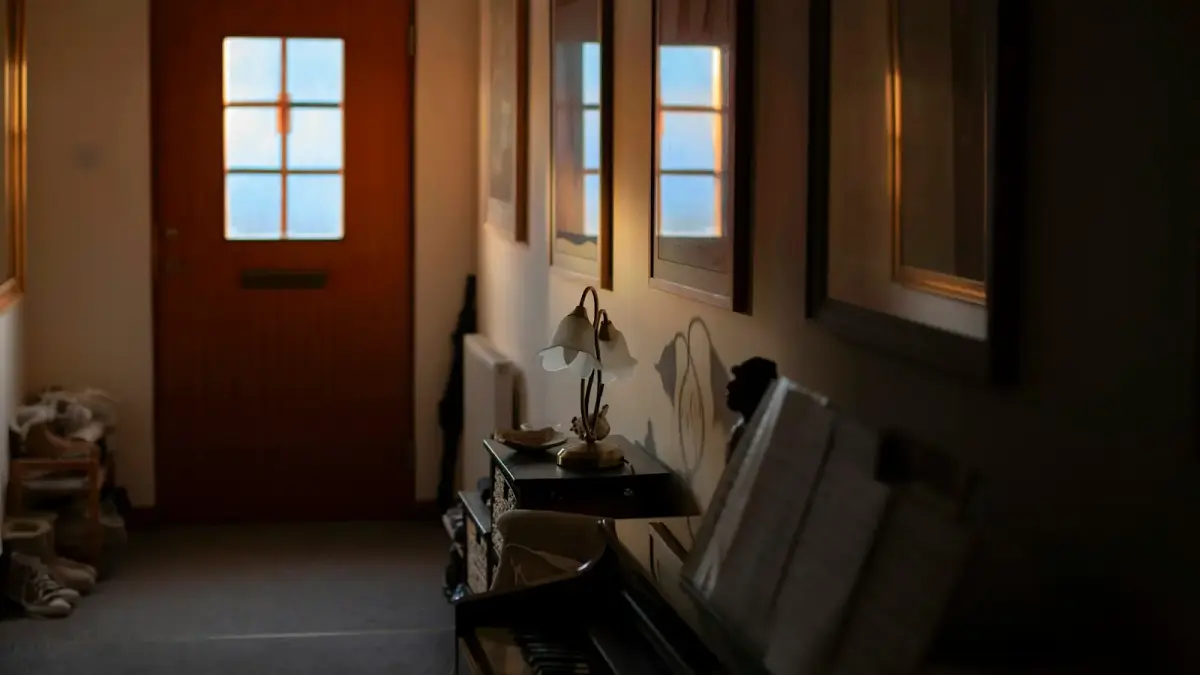
She was halfway to the kitchen when her husband said it.
“You do that thing again.”
She stopped. Her left hand was flat against the hallway wall, fingers slightly spread, palm pressed into the paint as if she were reading the house’s pulse. She hadn’t noticed. She never notices.
“What thing?”
“The wall thing. You always touch the walls when you walk through the house.”
She looked at her hand like it belonged to someone else. And then she laughed, because he was right, and because she had no explanation for it. She does it every time. A hand trailing along the hallway. Fingertips brushing the doorframe as she passes through. Palm flat against the kitchen wall while she waits for the kettle to boil.
She is 58 years old and she has been touching walls her entire adult life.
She thought it was absent-mindedness. A funny habit. One of those things a body does that doesn’t mean anything.
But it means something. It means everything.
The house that kept changing addresses
She moved seven times before she turned eleven.
Not military moves - the orderly kind with a timeline and a new house waiting at the other end. These were the other kind. The kind where you come home from school and the furniture is in the back of a truck. The kind where your mother’s voice gets tight and cheerful at the same time and says, “We’re going on an adventure.”
The apartments blurred together. A brown carpet in one. A window that didn’t lock in another. A bedroom she shared with her sister that smelled like other people’s cooking.
She learned something in those years that she couldn’t have put into words at the time. She learned that walls are not permanent. She learned that a room you sleep in on Monday might belong to someone else by Friday. She learned that “home” was a word adults used for wherever you happened to be standing.
And somewhere in that blur of changing addresses, her body developed a protocol. A small, private check. A way of confirming that the walls were still solid, still present, still here.
She started touching them.
The body’s oldest language
Touch is the first sense we develop and the last one we lose. Before a baby can see clearly or make sense of sound, it can feel. The skin is the body’s largest organ, and it is constantly gathering information the conscious mind never processes.
A 2019 study published in Psychological Science found that haptic contact - the experience of touching solid surfaces - activates the same neural pathways involved in emotional regulation. The researchers discovered that people who touched stable, grounding objects during moments of stress showed measurably lower cortisol responses than those who didn’t.
This isn’t surprising when you think about what touch actually does. It tells the nervous system where you are. It confirms the boundary between your body and the world. It says: you are here, the ground is solid, the wall is real.
Gabor Mate has written extensively about how the body stores what the mind cannot process. When a child’s environment is unstable - when the ground keeps shifting - the body develops its own methods of establishing safety. These methods don’t require thought. They don’t require permission. They happen below the level of consciousness, wired into muscle and tendon and skin.
Touching a wall is not a quirk. It is proprioception in action - the body’s way of orienting itself in space when space has historically been unreliable.
She does it everywhere
Once she started paying attention, she realized the scope of it.
She does it in hotels. Her hand finds the wall the moment she enters a new room, trailing along the surface as she walks to the window, touching the desk, pressing her fingers against the bathroom tile. She thought she was just exploring. She was establishing that the room was real.
She does it in friends’ houses. A palm flat against the kitchen counter while she talks. Fingers resting on the doorframe while she waits for someone to come back from another room. Her body quietly confirming the architecture.
She does it in offices. In hospitals. In restaurants where she touches the back of her chair before sitting down, not to steady herself physically but to steady herself in a way she can’t name.
A 2021 study in Frontiers in Psychology examined repetitive self-soothing behaviors in adults with histories of childhood residential instability. The researchers found that these individuals were significantly more likely to engage in what they called “environmental anchoring” - habitual physical contact with stable objects in their surroundings. The behavior was largely unconscious, and participants were often surprised when it was pointed out to them.
She was not surprised. Or rather - she was surprised in the way you are surprised when someone describes your private language and you realize it was never private at all.
What the body remembers when the mind moves on
Here is what I find remarkable about this kind of body memory. The mind moved on decades ago. She built a life. She bought a house - her house, the one with her name on the deed, the one she has lived in for twenty-two years. She is not that girl anymore. She knows this.
But her body doesn’t know it.
Her body is still seven years old, still standing in a hallway that might not be hers tomorrow, still checking. The hand against the wall is the girl’s hand. The fingertips on the doorframe are the fingertips of a child whose world kept rearranging itself without her consent.
Daniel Goleman’s work on emotional intelligence touches on this phenomenon - the way the amygdala stores threat responses independently of the conscious memory system. You can forget every address you ever lived at and your body will still carry the felt sense of impermanence. You can build the most stable life imaginable and your nervous system will still run its old checks.
This is not dysfunction. This is not pathology. This is the body being extraordinarily faithful to the lessons it learned when the stakes were highest.
The girl who lived in seven apartments before she was eleven made a deal with her own nervous system. She said: I will keep checking. I will keep touching. I will keep confirming that the walls are here. And her body honored that deal for fifty-one years.
The architecture of a gesture
What does it look like from the outside? It looks like nothing. It looks like a woman walking down a hallway with her hand on the wall. It looks like someone who leans on countertops, who rests her palm on tables, who always seems to be in contact with whatever surface is nearby.
It looks like absent-mindedness. Like a habit. Like one of those things people do.
But from the inside, it is a full sensory conversation between a body and a building. It is a check-in. A confirmation. A quiet exchange that goes something like this: Are you still here? Yes. Am I still here? Yes. Is this still solid? Yes.
Every single time, the answer is yes. And every single time, the body asks again.
Because the body learned its lessons in a classroom where the answer was sometimes no. Where the walls sometimes weren’t there in the morning. Where “here” was a temporary designation that could be revoked without notice.
You cannot reason a body out of a lesson it learned through experience. You can only understand why it keeps asking the question.
The ones who keep checking
If you are someone whose hand finds walls, whose fingers trail along surfaces, whose body is always quietly in contact with the architecture of whatever room you’re standing in - I want you to know something.
You are not absent-minded. You are not nervous. You are not doing something strange.
You are doing something your body decided to do a long time ago, in a room that probably doesn’t exist anymore, during a chapter of your life that your conscious mind may have filed away as finished. Your body did not file it away. Your body kept the protocol running because the protocol kept you oriented when nothing else did.
That hand on the wall is not a weakness. It is a record. It is your body’s way of saying: I remember when the world was not solid, and I will never stop making sure it is.
There is something deeply human about carrying a gesture whose origin you’ve forgotten. About performing a ritual that your muscles understand better than your mind. About being fifty-eight years old and realizing that you have been having a conversation with the walls of every room you’ve ever entered, and that the conversation started when you were seven, and that your body has been faithful to it for longer than most marriages last.
You are not broken. You are not strange. You are someone whose body learned to check, and who never stopped checking, because the girl who needed to check never got a clear signal that she could stop.
The walls are still here. Your hand already knows.