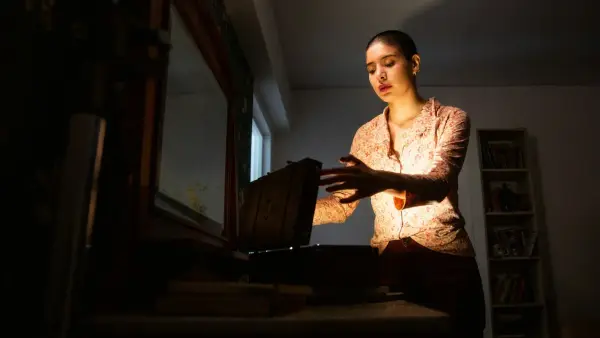
There is a grief that begins long before anyone has died, the grief that arrives the first time your mother asks you to repeat yourself or your father writes down the name of a restaurant he used to remember without trying, and by the time anyone is ready to use the word loss you have already been mourning in silence for years inside a funeral nobody else can see
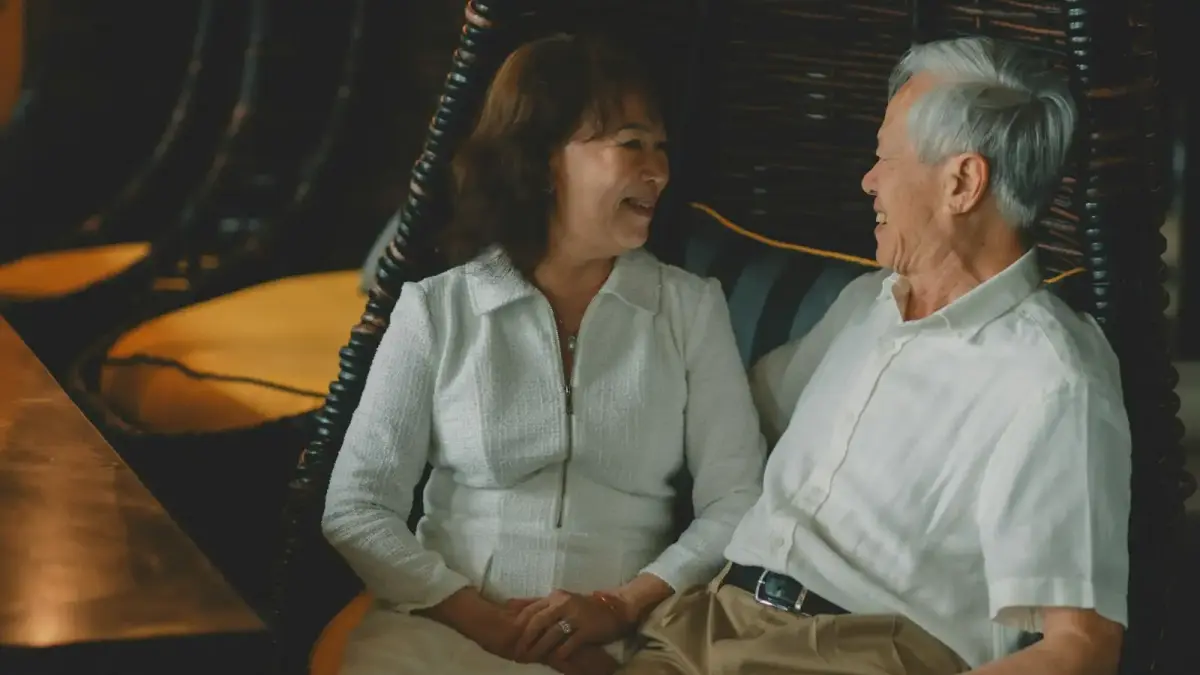
I was standing in my kitchen on a Tuesday afternoon, the kind of nothing-Tuesday that does not ask anything of you, when my mother called and asked me the name of the restaurant.
I told her. She asked again a minute later. I told her again, a little slower this time, and I heard a small quiet laugh on her end, the kind of laugh people use when they are trying to cover something they cannot yet name. She asked a third time, and I held the receiver away from my ear for a second and looked at my hand, and my hand was shaking.
She was still talking. She did not know that something had just ended in the room I was standing in. The kettle was whistling. The light was slanting through the window the way it always slants through the window at three in the afternoon in April, and outside two children were arguing about whose turn it was on a bike, and I was standing very still in the middle of my own kitchen understanding, for the first time, that I had just begun losing her.
Nobody had died. Nobody was even sick in any way I could have explained at a dinner party. But a door had closed somewhere inside the house of my life, and I was the only one who heard it.
The funerals nobody tells you about
There is a kind of grief that begins years before anyone is permitted to call it grief.
It does not arrive with a phone call at two in the morning. It does not come with a diagnosis you can hand to other people like a small brown envelope and say, here, this is why I am the way I am right now. It comes in Tuesdays. It comes in the name of a restaurant repeated three times. It comes in the birthday your mother has remembered for forty-two years, and this year she did not.
It comes in the moment you realize you are speaking slightly slower to your father, and he has not asked you to, and you did not decide to, and your mouth has simply begun doing it on its own because some part of you has already accepted what the rest of you is not ready to say.
These are the unmarked milestones. Nobody brings a casserole. Nobody sends a card. You do not get to leave work early. You do not get to cry in front of anyone because you cannot explain, even to yourself, what exactly you are crying about. Your mother is alive. Your father is alive. They are, by every measure the world recognizes, still here.
And yet you are, very quietly, already in mourning.
What ambiguous loss actually is
The psychologist Pauline Boss spent decades describing a grief that has no funeral. She called it ambiguous loss, and it is one of the most under-recognized sorrows in modern life.
Ambiguous loss is what happens when someone is physically present but psychologically receding, or psychologically present but physically gone. It is the parent who is sitting across the table from you eating soup, and who is also, somehow, not quite the person who taught you to ride a bike on Bell Street in 1987. Both of them are real. Both of them are at the table. You are grieving one while feeding the other, and there is no language for this, and there is no ritual for it, and there is no day on the calendar when you are allowed to wear black.
A 2019 study published in Death Studies found that adult children caring for parents with early cognitive decline report some of the highest levels of unacknowledged grief of any caregiving population, in part because the losses accumulate without any external event that signals to the world that something has happened.
Therese Rando, who pioneered the concept of anticipatory grief, described this kind of mourning as the grief that runs ahead of the loss. You are not grieving what has happened. You are grieving what is happening, in small increments, under the surface of ordinary life. And you are often grieving alone, because the person you would most want to talk to about it is the person you are losing.
The photographs you did not used to take
You start taking photographs you would never have taken of other people.
Your mother at the sink. Your father reading the paper, his glasses slid down his nose the way they have slid down his nose for thirty years. The back of her head as she walks ahead of you on the beach. You are not taking these photos for Instagram. You are not taking them for a slideshow. You are taking them because some animal part of you has begun quietly archiving, and you will not understand for a long time why you cannot delete them.
You save a voicemail where she asks what time you are coming over. You save another where he tells you the neighbor’s dog got into the garbage. They are not important messages. They are not messages about anything, really. You save them because the voice is the voice, and one day the voice will not be the voice, and you are starting to feel the weight of that even though you cannot yet say it out loud.
You ask small unnecessary questions at dinner. You ask your father to tell you again about the summer he worked at the cannery. You have heard the story. You know how it ends. You ask because you want to watch him tell it, the way his hands still move when he gets to the part about the foreman, the way his eyes still go somewhere far away and come back warmer. You are not gathering information. You are gathering him.
The loneliness of a grief with no permission
What makes this grief so heavy is that the culture does not let you have it.
If your mother had died, people would hold you differently for a while. They would bring food. They would say her name gently. They would understand when you canceled plans or cried at a song or had a hard week for no reason in October. You would be allowed to be a person who had lost something.
But she has not died. She is, by all official accounts, fine. She is a little more forgetful. She asks the same question twice at lunch, sometimes three times. She forgot your birthday this year, and she was devastated when she realized, and you told her it was fine, it was completely fine, and you went into the bathroom and stood with your hands braced against the sink because it was not fine, and because you could not say to anyone, I think I am losing my mother, because she is still here, and because what would you even be telling them.
So you carry it alone. You go to dinner parties and you talk about work and you ask people how their kids are doing and inside you, a funeral is quietly running. A small, continuous funeral that nobody in the room can see. You go home. You text her goodnight. You wait for her to text back, and when she does, you feel a small relief that you cannot name, and you put the phone face down and you try to sleep.
This loneliness is not an accident of your personality. It is a feature of the grief itself. A 2021 paper in The Gerontologist described this exact pattern - the way adult children of aging parents often report feeling socially invisible in their mourning, because the loss is diffuse, gradual, and happening to someone who is still, in every outward way, present.
You are not being dramatic. You are not being morbid. You are tracking a real loss in real time, with no ritual, no permission, and no witness. That is the hardest kind of grief to carry, because you have to carry it and pretend you are not carrying anything at all.
The slower voice, the softer hand
You will notice yourself changing before you notice them changing.
You will catch yourself explaining something you would not have explained two years ago. You will hear your own voice and realize it has gotten gentler, more careful, the way you once spoke to your children when they were small and the world was still a little too loud for them. You will feel an ache in your chest at how naturally this happens, at how your body already knows how to love someone who is becoming smaller in a way you cannot fix.
You will find yourself holding their hand longer when you say goodbye. You will find yourself standing in the driveway watching the porch light for an extra moment before you get in the car. You will find yourself calling for no reason. You used to need a reason to call your mother. You do not, anymore. The reason is that she is still there to call. That is reason enough now.
None of this is pathology. This is what love does when it senses the shape of a loss that has not yet fully arrived. Bessel van der Kolk has written about how the body often registers grief long before the mind has language for it. Your shaking hand in the kitchen on a nothing-Tuesday was not a mistake. It was your body telling you the truth before your mind was willing to hear it.
What naming it does, and what it does not do
Naming this grief will not make it smaller.
I want to be honest with you about that, because there is a kind of self-help language that promises if you just call a thing by its right name, the thing becomes lighter. This one will not. Your mother is still forgetting. Your father is still writing things down that he never used to write down. The small continuous funeral will keep running inside you, and some days it will be louder than others, and some days you will sit in your car in a parking lot after a phone call and cry for eight minutes, and then you will wipe your face and go buy the groceries.
But naming it does one thing, and it is the thing that matters most. It makes you less alone inside it.
When you know that what you are feeling is anticipatory grief, that it has a name in the literature, that Pauline Boss and Therese Rando and whole generations of people before you have stood in their own kitchens on their own nothing-Tuesdays and felt their hands shake at the name of a restaurant, you stop believing you are being ridiculous. You stop believing you are overreacting. You stop apologizing to yourself for feeling something you have every right to feel.
You start to understand that the ache you have been carrying in silence is not a malfunction. It is the exact right response to what is actually happening. The grief is not a sign that something is wrong with you. It is a sign of how deeply you have loved this person, and how much of yourself has been built inside the sound of their voice.
That is not a small thing. That is, in fact, the whole thing.
The love that built this grief is also the love that will, eventually, carry you through it. It will carry you through the harder rooms that are coming. It will carry you through the goodbyes that have not happened yet. It is carrying you now, even on the Tuesdays when you cannot feel it, even when your hand is shaking and the kettle is whistling and you are the only one in the world who heard the door close.
You are not mourning too early. You are simply mourning in the only way a heart as steady as yours knows how - honestly, quietly, and long before anyone else thinks to ask if you are okay.