There is a particular kind of person who adjusts their walking pace to match whoever they are walking with, speeds up, slows down, matches step for step, because as a child they learned that moving at their own rhythm was always the wrong speed
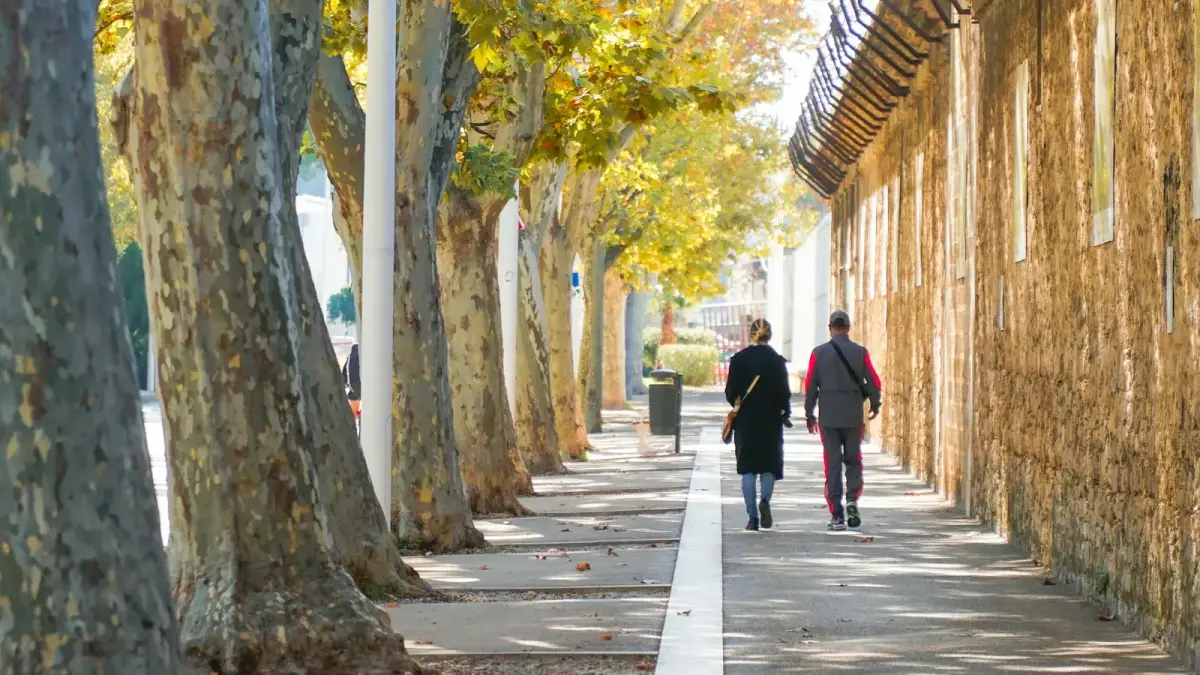
I noticed it on a Tuesday afternoon
I was walking with my mother last fall, down the same block I’ve walked a thousand times. She’s seventy-three now. Her knees aren’t what they were. And somewhere between the second and third house on Maple Street, I realized I had slowed to half my normal stride without thinking about it.
That alone isn’t strange. Most people slow down for someone older, someone smaller, someone recovering from surgery. That’s just kindness.
But then I thought about the morning. Walking with my neighbor David to grab coffee. David is six-foot-four and moves like he’s perpetually late for something. I had matched him too - lengthening my stride, picking up my cadence, arriving at the cafe slightly out of breath without once thinking about why.
And the evening before that. Walking with my eight-year-old niece, who stops every thirty seconds to inspect a leaf or a crack in the sidewalk. I had matched her too. Every pause. Every restart.
Three different people. Three completely different speeds. And I had no idea what my own walking pace actually was.
The body remembers what the mind has forgotten
There’s a word researchers use for this - “interpersonal synchrony.” A 2012 study published in the Journal of Experimental Psychology found that people walking together will naturally begin to synchronize their steps within seconds, and that this synchronization increases with emotional closeness. The researchers framed it as connection. As bonding.
And for many people, that’s exactly what it is. A gentle, unconscious drift toward the rhythm of someone you care about.
But there’s a version of this that isn’t gentle at all. There’s a version where the synchronization isn’t a drift - it’s an override. Where your body doesn’t negotiate between your pace and theirs. It simply erases yours and adopts theirs entirely.
If you’re the person who does this with everyone - not just loved ones, not just elders, but the stranger you happen to be walking beside on a sidewalk, the coworker heading to the parking lot, the acquaintance you barely know - then something different is happening inside you.
Your body isn’t attuning. It’s obeying.
Hurry up, slow down, keep up, wait
Think about how many times a child hears commands about their pace. Hurry up. Slow down. Keep up. Stop running. Wait for me. Not so fast. Come on, let’s go.
Most parents say these things casually. They’re managing logistics - getting to the car, crossing the street, making the appointment on time. There’s no cruelty in it. There’s no intent to harm.
But some children hear it differently. Some children hear it constantly. And what they absorb is not “adjust your speed for this moment” but “your speed is wrong.”
A 2019 study in Frontiers in Psychology explored how early childhood experiences of autonomy suppression - moments where a child’s natural impulses are repeatedly corrected or overridden - shape adult patterns of self-monitoring. The researchers found that adults who scored high in self-monitoring were significantly more likely to have experienced environments where self-directed behavior was discouraged, even in small, everyday ways.
Walking pace. Volume of voice. Enthusiasm level. The speed at which they ate dinner.
When everything about your natural rhythm gets corrected, you stop having a natural rhythm. You develop something else instead - a radar. A constant, unconscious scan of whoever is next to you, calibrating yourself to their tempo before you’ve taken two steps together.
It looks like empathy, but it feels like disappearing
Here’s the part that makes this hard to name. Because from the outside, the person who matches everyone’s pace looks wonderful. They look considerate. Attentive. Easy to be around.
People say things like, “I love walking with you - you never rush me.” Or, “You’re so easy-going.” Or, “You always just go with the flow.”
And the person who hears that smiles, because what else would they do. Because they’ve been praised for this their entire life - for being accommodating, for being flexible, for never making anyone else feel hurried or slowed down.
But inside, something quieter is happening.
Inside, there’s a person who doesn’t know what their natural stride feels like. Who has been matching other people’s rhythms for so long that they’ve genuinely lost track of their own. Who walks differently with every single person they encounter - and who walks differently again when they’re alone, though they might not even notice, because being alone is so rare that their solo pace feels foreign. Like a voice they recognize but can’t quite place.
This is not consideration. This is the absence of a self that was never given room to emerge.
The speed was never about walking
What I’ve come to understand - slowly, reluctantly, the way you understand anything that requires you to look directly at your childhood - is that the walking pace was never really about walking.
It was about existing at a speed that didn’t inconvenience anyone.
The child who learned to match learned something far larger than stride length. They learned that their internal tempo - their desires, their excitement, their restlessness, their need to pause - was always subject to someone else’s approval.
Want to run? Not now. Want to stop and look? We don’t have time. Want to dawdle? You’re making everyone late. Want to go ahead? Don’t leave your sister.
A 2021 study in the Journal of Personality and Social Psychology examined what the researchers called “chronic self-concept clarity” - the degree to which a person has a stable, clear sense of who they are. They found that adults with low self-concept clarity were disproportionately likely to engage in what they called “behavioral mirroring” - unconsciously adopting the mannerisms, pace, and emotional tone of whoever they were with.
Not because they wanted to connect. Because they had never been allowed to establish their own baseline.
You can’t mirror someone if you have a strong center of gravity. Mirroring requires a kind of emptiness - a willingness to be filled by whatever the other person is radiating. And for some of us, that emptiness wasn’t a choice. It was installed.
The forty-eight-year-old who has never found their own tempo
I think about this sometimes when I’m walking alone. Which I do more often now, deliberately, as a kind of experiment.
I’ll leave the house with no destination and no companion, and I’ll try to walk at whatever speed feels natural. And for the first few minutes, I genuinely don’t know what that is. My body keeps scanning - looking for someone to calibrate to. When there’s no one, it feels oddly adrift. Untethered. Like a satellite that’s lost its signal.
Then, slowly, something settles. A pace that’s neither fast nor slow. A rhythm that belongs to no one but me. And the feeling that comes with it is so unfamiliar it almost makes me emotional.
This is what it feels like to move through the world at your own speed.
Not performing ease for the slow walker. Not performing urgency for the fast one. Not scanning, adjusting, erasing, and replacing. Just walking.
It sounds like such a small thing. But for the person who has spent forty or fifty years unconsciously abandoning their rhythm the moment someone falls into step beside them, it is not small at all. It is the first time their body has been allowed to answer the question: how fast do you actually want to go?
What it means to find a pace that is yours
I’m not suggesting this is something you fix in a weekend. You don’t read one article about walking synchronization and suddenly start striding confidently past your elderly neighbor.
That’s not the point.
The point is recognition. The point is noticing, the next time you fall into step with someone, whether you chose that pace or whether your body chose it for you. Whether you’re walking with them or walking as them - disappearing into their rhythm because yours was corrected out of you so long ago that you forgot it existed.
The person who matches everyone’s pace is not broken. They survived a childhood where the safest thing to do was erase their own tempo and adopt someone else’s. That was intelligent. That was adaptive. That kept them connected to people who might have left them behind - literally and otherwise.
But you’re not that child anymore. And the people walking beside you now - most of them would not love you less if you walked at your own speed.
They might even love you more. Because they’d finally be walking with you, instead of walking with a reflection of themselves they never asked for.
Your pace is in there somewhere. Underneath decades of calibration and correction and accommodation. It might take time to find. It might feel strange and selfish and wrong when you do.
Walk anyway. At whatever speed that is. The world can keep up.