There is a kind of walking that belongs to women who grew up understanding they were taking up space that was borrowed and never owned - the woman who steps aside on a wide, empty sidewalk for a stranger still thirty feet away, who presses herself against the elevator wall before anyone has asked her to move, who has perfected a way of moving through the world that takes up almost no room at all, not because she is polite but because a girl who grew up in rooms that belonged to other people learned that her presence in any space was conditional, and the body that makes itself small at fifty-two is still the child practicing a disappearance she was never allowed to complete
I was walking to the post office last Tuesday morning when I did it again.
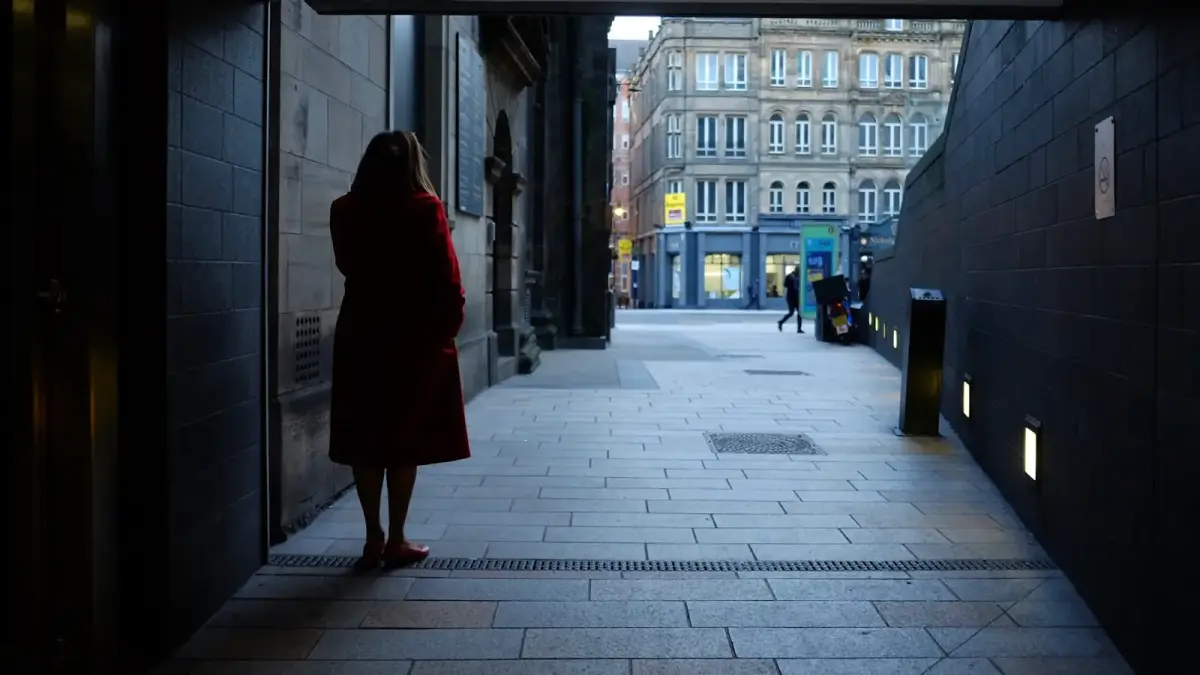
The sidewalk was wide enough for four people to walk abreast. A man was coming toward me from the opposite direction, still at least thirty feet away, and I had already begun drifting to the right. Not just drifting - pressing myself toward the edge of the concrete, shortening my stride, tucking my bag closer to my body. Making myself narrow.
He passed without noticing. Of course he didn’t notice. There was nothing to notice. A woman moved, a man walked by, and the sidewalk continued being wide and empty.
But I stopped. I stood there on the edge of the pavement, half on the grass, and I felt something old and familiar rise up in my chest. Not anger. Not sadness, exactly. Recognition. The sudden, startling awareness that my body had just performed a choreography I never consciously learned - a lifetime of yielding, of making room, of erasing the outline of myself in spaces where I have every right to exist.
I am fifty-two years old. I have a career, a mortgage, a name on a lease. And I still walk like a girl who isn’t sure she’s allowed to be here.
The choreography of conditional presence
You know it when you see it, even if you have never had words for it.
It is the woman who sits on the very edge of the chair in a waiting room, as if she might need to leave at any moment. The one who takes the smallest portion at the table, not because she isn’t hungry but because something in her body resists the act of reaching for more.
She presses herself against the back wall of the elevator before anyone else has stepped in. She angles her body in the grocery aisle to take up as little room as possible. She holds her elbows close and her shoulders in and her presence at a low hum, as though the volume of her existence is something that needs to be carefully managed.
People call this politeness. They call it consideration. And sometimes it is those things.
But there is a version of spatial yielding that has nothing to do with manners and everything to do with memory. A version that lives below conscious thought, below choice, below the adult woman’s awareness of what her body is doing. It is automatic. It is ancient. And it started in a room that didn’t belong to her.
The rooms that belonged to other people
I grew up in a house that was always almost ours.
My mother cleaned houses for women who had rooms they didn’t even use - guest bedrooms with white comforters that no guest ever slept on, living rooms preserved behind closed doors like tiny museums of a life that was too precious for daily contact. We lived in a two-bedroom apartment where the walls were thin enough to hear the neighbor’s television, and I shared a room with my sister until I was fourteen.
I don’t say this with bitterness. I say it because it matters.
When you grow up in spaces that are tight, spaces that belong to a landlord, spaces where the rules are someone else’s - you learn something in your body that your mind may never fully articulate. You learn that your presence is conditional. That you are tolerated, not entitled. That the space you occupy is borrowed, and borrowed things must be returned in the same condition you found them.
This is different from being told to be small. Nobody told me to shrink. But the architecture of our life told me. The thin walls told me. The way my mother moved through the houses she cleaned - careful, quiet, touching nothing that wasn’t strictly necessary - told me something about what it means to exist in a space that holds you but does not belong to you.
And I watched, and I learned, and my body learned faster than my mind.
How class writes itself onto the body
The French sociologist Pierre Bourdieu had a word for this: habitus. He described it as the way social conditions become physical dispositions - how the circumstances of your upbringing don’t just shape what you think but how you move, how you stand, how much room you feel permitted to take up in the world.
Bourdieu understood that class is not only an economic reality. It is a bodily reality. It lives in your posture, your gait, the width of your gestures, the way you hold your hands when you are not doing anything with them. A person who grew up with space - with property, with rooms to spare, with the fundamental security of knowing the ground beneath them was theirs - moves differently than a person who grew up understanding that space was something granted by others and revocable without warning.
A 2009 study published in Psychological Science found that individuals from lower socioeconomic backgrounds displayed more constrained body language during social interactions - fewer expansive gestures, less spatial occupation, more self-touching behaviors. The researchers framed this as a marker of social vigilance. But I think it is something simpler and sadder than that. It is the body remembering what it was taught about permission.
You don’t decide to make yourself small. Your bones decide for you.
Research on proxemics - the study of how humans use and perceive space - has consistently shown that spatial behavior is shaped by early social environments. A 2016 study in the Journal of Personality and Social Psychology demonstrated that people who grew up in lower-income households maintained larger interpersonal distances and were more likely to yield space in shared environments, even decades after their economic circumstances had changed.
The money changes. The body doesn’t.
The woman at fifty-two who is still the girl at seven
Here is what nobody tells you about class and the body: you can outgrow every external marker of where you came from and still carry it in your shoulders.
I own my home now. I have a guest room - a real one, with a bed no one sleeps in and a door that stays closed. I have more space than I have ever had in my life. And I still press myself against the elevator wall when someone steps in behind me. I still sit on the front three inches of a chair in a doctor’s office. I still angle my body in narrow hallways as though my very width is an inconvenience.
Gabor Mate writes beautifully about how the body stores what the conscious mind has moved past. He describes the way childhood adaptations - the things we did to survive emotionally in environments that required us to be less visible, less loud, less present - become neurological patterns that outlast the circumstances that created them. The adaptation becomes the identity. The survival strategy becomes the self.
I did not learn to make myself small because someone was cruel. I learned it because the world I grew up in had limited room, and the people around me were doing the best they could with what they had, and the smartest thing a child in that environment could do was take up as little space as possible. It was not a wound. It was intelligence. It was a girl reading the room with her whole body and adjusting accordingly.
The problem is that the room changed, and the reading didn’t.
The geometry of invisible women
There are so many of us.
We are the women who tuck ourselves into corners at parties, not because we are shy but because standing in the center of a room activates something very old - a feeling that the center is for people who have earned it, who have paid for it, who hold the deed. We are the women who apologize when someone else bumps into us. Who say “sorry” while stepping out of the way of a person who was not inconvenienced by our presence.
We fold our legs on public transportation. We eat lunch at our desks instead of taking up a table in the break room. We hold our arms at our sides when we walk, while other women swing theirs freely, occupying the full span of their own bodies without a second thought.
And the strange part is that most of us don’t know we are doing it. It is so woven into the way we move that it feels like personality. “I’m just not a big-presence person,” we say. “I like being in the background.” And sometimes that is true. But sometimes what we call preference is just a very old accommodation wearing the costume of choice.
I think about my mother. How she moved through those large houses she cleaned as though she were trying to pass through walls without disturbing the paint. How she could occupy a kitchen for hours and leave no trace of herself - no crumb, no smell, no sign that a woman with a full inner life had stood there working. She had perfected the art of productive invisibility. And I watched her, and something in me took notes.
The moment the sidewalk is wide enough
I don’t have a tidy resolution for this. I don’t think the body unlearns what it spent decades practicing.
But I do think there is something that happens in the moment of recognition. Standing on that sidewalk last Tuesday, half on the grass for no reason at all, I felt something shift. Not in my body - my body was still pressed to the edge, still yielding, still performing the old choreography. But in my awareness.
I saw myself. I saw the girl and the woman at the same time. I saw the borrowed rooms and the owned home and the sidewalk wide enough for both of us and the fact that I had moved anyway.
And there was a tenderness in that seeing. Not a fixing, not a correcting, not a promise to “take up more space” as the self-help language would have it. Just a quiet acknowledgment: Oh. There you are. Still stepping aside. Still making room for someone who didn’t need it.
If you recognize yourself in any of this - the angled shoulders, the edge-of-the-chair sitting, the reflexive yielding on sidewalks that belong to everyone - I want you to know something. Your body is not broken. Your body is a record. It is a faithful, devoted record of everything you learned about what it meant to exist in the spaces you were given.
And the fact that you are still here, still moving through the world, still occupying rooms even as your body tries to make you smaller - that is not a failure of healing. That is the quiet, persistent courage of a woman whose first language was disappearance, choosing every day to remain visible anyway.
The sidewalk was always wide enough. Your body just hasn’t heard the news yet. And that’s all right. It will learn. It is already learning, in the moment you stand still long enough to notice what you have been doing all along.