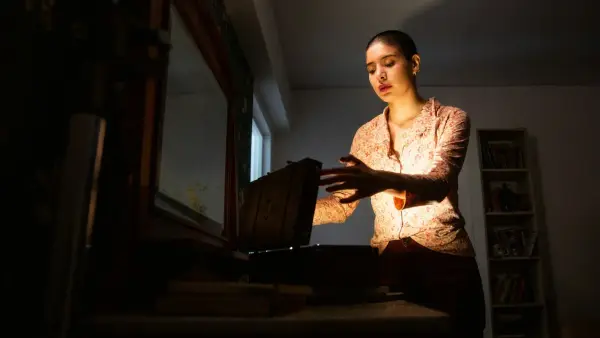
There is a woman in every family, every office, every circle of friends who remembers everyone's birthday, every preference, every allergy, every child's name - who sends the card, brings the right coffee, asks about the scan results nobody else remembered were happening - and she has quietly noticed, sometime around fifty-seven, that on her own birthday the phone is mostly silent, not because people don't care but because nobody ever had to learn the practice of remembering her, because she was always the one who remembered first

I know a woman who keeps a notebook in her kitchen drawer.
It is not a journal. It is not a planner. It is a record of other people’s lives - every birthday, every anniversary, every food allergy, every name of every child in every family she has touched across forty years. Her neighbor’s daughter is lactose intolerant. Her coworker’s husband had a stent placed last March. The woman at church whose grandson just started kindergarten prefers lilies, not roses, and cannot eat gluten.
She knows all of this the way most people know their own phone number. Without trying. Without being asked.
And this year, on her fifty-seventh birthday, she sat at the kitchen table with that notebook closed in front of her and noticed something she had probably always known but had never allowed herself to name. The phone did not ring. Not because people are cruel. Not because she is forgotten in the way that word usually implies. But because she had spent so long being the person who remembered first that nobody ever had to develop the reflex of remembering her.
She had made herself unforgettable to everyone - and invisible at the same time.
The ledger nobody asked her to keep
There is a specific kind of labor that has no job title, no salary, no performance review. Sociologist Arlie Hochschild called it emotional labor when she first described it in 1983 - the work of managing feelings, both your own and other people’s, as part of maintaining relationships. But what this woman does goes beyond even that.
She is what researchers call the kin-keeper.
The term comes from family sociology, and it describes the person - almost always a woman - who holds the social fabric of an entire network together. She is the one who organizes the group birthday card. She is the one who texts your spouse to ask what you might want for Christmas because she knows you will never say. She is the one who remembers that your mother died in April and sends a quiet message on the anniversary because she understands that grief does not follow a calendar anyone else is watching.
A 2020 study published in the Journal of Family Issues found that women perform significantly more kin-keeping labor than men across every demographic - tracking birthdays, maintaining contact with extended family, organizing holiday gatherings, sending thank-you notes. The researchers noted something that will sound familiar if you are one of these women: the labor is so invisible that most family members do not realize it is happening until the kin-keeper stops doing it.
And she almost never stops doing it. That is the thing.
She does not stop because stopping would mean someone’s birthday goes unacknowledged. Someone’s surgery goes unmentioned. Someone’s child feels unseen. And she cannot bear that - not because she is a martyr, but because she knows what it feels like to be noticed, and she cannot bring herself to let anyone else go without it.
How remembering became her language
You have to understand something about the woman who remembers everything. She did not choose this role the way you choose a career or a hobby. She fell into it the way water falls into the lowest point in a landscape - naturally, inevitably, because the space was empty and she was shaped to fill it.
Maybe it started in childhood. Maybe she was the oldest daughter in a house where someone had to track the emotional weather - when Dad was in a mood, when Mom needed quiet, when her younger brother’s feelings were about to spill over and somebody needed to catch them before they hit the floor.
She learned early that paying attention was a form of love. That noticing was currency. That the fastest way to make someone feel safe was to remember what mattered to them and bring it back at exactly the right moment - the right coffee order, the right song, the right question about the thing they mentioned three weeks ago that nobody else filed away.
A 2019 study in Psychological Science found that people who demonstrate high relational attentiveness - the ability to recall personal details about others and act on that knowledge - are perceived as significantly more caring and trustworthy. But the study also found something else: the attentive person’s own needs were consistently rated as less urgent by the people around them.
Read that again.
The better you are at remembering other people, the less other people feel the need to remember you. Not because they are selfish. Because you have removed the friction. You have made yourself so reliable that your absence from the receiving end of care does not register as a gap. It registers as normal.
The silence she finally let herself hear
For decades, she did not notice the asymmetry. Or maybe she noticed and called it something else - called it “I’m just not a birthday person” or “I don’t need a fuss” or “it’s fine, really.” Women of her generation were taught to frame their own invisibility as a preference. To say they did not want attention rather than admit they had stopped expecting it.
But something shifts around fifty-five, fifty-seven, sixty. The kids are grown or nearly grown. The pace of life slows just enough to hear what was always underneath the noise.
And what she hears is silence.
Not the cruel silence of being deliberately excluded. Not the dramatic silence of a fight or a falling-out. A softer silence. The silence of a phone that does not vibrate on the morning of her birthday because nobody set a reminder. The silence of a mailbox without a card because nobody thought to send one. The silence of a dinner that nobody planned because she is the one who plans the dinners, and she cannot plan her own without it feeling like a performance.
She looks at the notebook in the drawer and thinks: I know that my neighbor takes oat milk in her coffee. I know that my coworker’s daughter had a recital last Tuesday. I know that the woman from book club is getting a colonoscopy on Thursday and is nervous about it, so I will text her Wednesday night.
And she wonders - she lets herself wonder for the first time - does anyone know what she takes in her coffee?
The cost of being easy to overlook
Here is the devastating part, and it is not what you might expect.
The devastating part is not that people forgot her. It is that she made forgetting her possible.
She was so good at her role that she eliminated the need for anyone else to practice the same skill in her direction. She always called first. She always checked in first. She always remembered first. And because she did, nobody else ever had to develop that muscle. They did not atrophy a skill they once had - they never built it in the first place.
Adam Grant, the organizational psychologist, has written about how givers in social networks often experience what he calls “generosity burnout” - the exhaustion that comes not from giving too much but from giving in a system that does not reciprocate. The burnout is not about volume. It is about asymmetry.
And the asymmetry is not anyone’s fault. That is what makes it so hard to grieve.
You cannot be angry at someone for not doing something they never knew needed doing. You cannot resent a person for not remembering your birthday when you made remembering everyone else’s birthday look so effortless that the very concept of effort disappeared from the equation.
She taught everyone around her that she was handled. That she was fine. That she did not need what she gave.
And they believed her.
What the notebook really contains
If you could read her notebook - the one in the kitchen drawer with the fraying cover and the ink that changes color where she switched pens over the years - you would not just find dates and dietary restrictions.
You would find a map of love.
Every entry is a small act of saying: I see you. I was paying attention. You matter enough to be written down.
She recorded her sister-in-law’s favorite flower because remembering it was a way of saying you are real to me. She noted her friend’s child’s name and school because it was a way of saying your life has texture, and I am paying attention to the texture.
A 2021 study in the Journal of Personality and Social Psychology found that the single strongest predictor of relationship satisfaction across friendships, romantic partnerships, and family bonds was not grand gestures or verbal affirmation. It was what the researchers called “attentive responsiveness” - the consistent, quiet demonstration that you have noticed the details of someone’s inner life and held them carefully.
She did this for everyone. She did this like breathing. She did this so well that people forgot it was a thing that someone had to do.
The reframe she deserves
If you are this woman - and some part of you knows whether you are - I want to say something that nobody has said to you clearly enough.
The fact that your phone is quiet on your birthday does not mean you are unloved. It means you loved so effectively, so consistently, so seamlessly that you made the infrastructure of care invisible. You became the plumbing. And nobody thinks about the plumbing until it breaks.
That is not a failure of your character. It is a consequence of your competence.
But you are allowed to want what you gave. You are allowed to want someone to remember that you drink Earl Grey, not English Breakfast. You are allowed to want a card that arrives without you having hinted. You are allowed to stop performing the effortlessness of not needing anything and admit - quietly, even just to yourself - that you do.
You are not high-maintenance for wanting to be maintained.
You are not needy for wanting to be known.
You are a person who spent decades learning the language of noticing, and you are finally letting yourself feel the weight of speaking it alone.
Putting the notebook down
She will not stop remembering. That is not how this works. She will still send the card, still bring the right coffee, still text the morning of the scan. Because that is who she is, and who she is was never the problem.
But maybe - and this is the quiet, radical thing - she lets herself be a little less easy to overlook.
Maybe she mentions her own birthday. Maybe she says what she wants for dinner. Maybe she stops answering “I don’t care, whatever you want” and starts answering honestly. Maybe she lets there be a gap where someone else has to remember, even if they get it wrong, even if they forget, even if the silence stretches a little longer than she would like.
Because the only way anyone learns to remember you is if you stop remembering for them.
And that is not selfish. That is not high-maintenance.
That is a woman who kept a notebook for forty years finally leaving a blank page for someone else to fill.