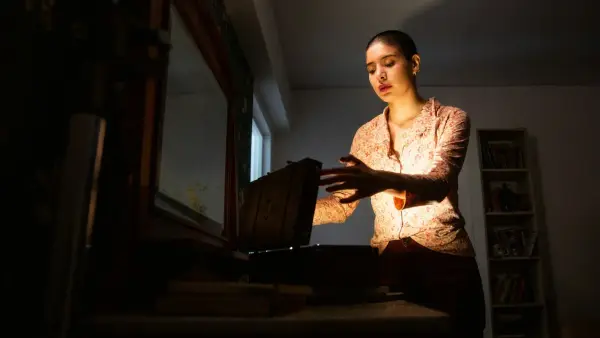
There is a woman in every office who notices when someone has been crying in the bathroom, who leaves a cup of tea on their desk without a word, who remembers which coworker's parent is in the hospital and asks about them by name, and she has been doing this for years without anyone calling it work because nobody has ever written a job description for the person who quietly makes everyone else capable of staying

I worked with a woman named Linda for six years before I understood what she actually did.
Her title was something in operations. I couldn’t tell you the exact wording even now. But what she did - what she really did, the work that never appeared on a single performance review - was hold the entire floor together with nothing but her attention.
She knew when people were struggling before they told anyone. She just knew. She’d show up at your desk with a cup of tea and a quiet “how are you doing, really?” and somehow the question never felt intrusive. It felt like being caught by someone you didn’t know was watching.
The Job That Has No Title
Every workplace has one. You already know who yours is.
She’s the one who remembers that your mother started chemo last Tuesday. She asks about it on Wednesday - not in the group chat, not at the team meeting - but quietly, at your desk, when nobody else is around. She says your mother’s name. She remembers the name because she was actually listening the first time you mentioned it, three months ago, when you were pretending to be fine.
She notices when someone has been crying. She doesn’t announce it. She doesn’t pull them aside in a way that draws attention. She just leaves something small on their desk - a tea, a note, a piece of chocolate - and later that day she finds a reason to walk past and ask about something unrelated, giving them a doorway to talk if they want one, and a graceful exit if they don’t.
She tracks the emotional weather of the entire building the way a sailor tracks the sky. She knows who is about to quit before they’ve updated their resume. She can feel a conflict between two team members before it surfaces in a meeting. She knows when a manager is burned out and starting to take it out on people, and she quietly absorbs the fallout so it doesn’t ripple further.
None of this appears anywhere in her job description. There is no KPI for knowing that someone in accounting just went through a divorce and is eating lunch alone in their car.
She Has Been Doing Two Jobs for Her Entire Career
Here’s the part that doesn’t get said enough: she does all of this and her actual job. The one with the title. The one that gets reviewed, measured, and evaluated against quarterly targets.
She answers the emails and hits the deadlines and prepares the reports. And then, in the margins of all of that, in the small pockets of time between tasks, she tends to the emotional pulse of every person around her. She does it so naturally that it looks like personality rather than labor. People call her warm. They call her thoughtful. They call her a really good person.
What they don’t call her is overworked.
A 2018 study published in the Journal of Applied Psychology found that women in organizational settings performed significantly more “organizational citizenship behavior” - the academic term for voluntary acts that support the social and psychological environment - than their male colleagues. The study also found that when women performed these behaviors, they were less likely to be recognized or rewarded for them, because evaluators perceived them as natural extensions of female character rather than discretionary effort.
Read that again. When she remembers your mother’s name and asks about her treatment, the system registers that as who she is, not what she does. And because it’s coded as identity rather than labor, it never shows up in the conversation about raises or promotions.
She knows this. She has always known this. And she keeps doing it anyway, because the alternative - letting someone sit at their desk in silent pain with no one noticing - is something her nervous system won’t allow.
The Weight She Carries Home
It would be easier if the noticing had an off switch.
But the woman who tracks the emotional weather at work doesn’t stop tracking when she gets home. She walks through her own front door still carrying the weight of everything she absorbed that day - the coworker who is struggling with fertility treatments, the new hire who reminds her of her younger self, the manager who snapped at someone in a meeting and will never apologize.
She processes all of it. She turns it over in her mind while she makes dinner or folds laundry or stares at the ceiling at eleven o’clock at night. Not because she wants to. Because her system was built for this kind of attention, and it doesn’t know how to look away.
Brene Brown’s research on connection and belonging describes this kind of person as a “container” - someone who holds space for others’ vulnerability, often at significant personal cost. Brown’s work suggests that organizations with even one such person report higher levels of team trust and psychological safety. But the container herself often reports the opposite: a quiet exhaustion that doesn’t have a name, because how do you explain being tired from caring?
She is tired. Not the kind of tired that sleep fixes. The kind of tired that comes from doing something essential, every single day, that the world has decided doesn’t count.
What the Building Feels Like Without Her
Then one day she leaves.
Maybe she takes another job. Maybe she retires. Maybe she finally burns out in a way that’s visible enough for someone to notice. Whatever the reason, she is gone, and something shifts.
The meetings feel different. Not worse, exactly, but colder. Less human. People start eating lunch at their desks with headphones on. Small conflicts that used to dissolve before they reached critical mass now escalate into formal complaints. The new hires look lost in a way they didn’t before. Someone’s father dies and nobody finds out until the funeral has already happened.
Everyone feels it. The atmosphere has changed. Something essential is missing, like a building that suddenly lost its heating in November - the walls are still standing, but nobody wants to be inside.
And here’s the cruelest part: nobody can name what left. They say things like “the vibe is different” or “it’s just not the same,” but they can’t point to what changed, because the thing that changed was never acknowledged as a thing in the first place. You can’t mourn what you never named.
A 2021 study in Frontiers in Psychology found that the departure of high-emotional-labor employees created measurable declines in team cohesion and interpersonal trust - even when the departing individual held no formal leadership role. The researchers described this as the loss of “relational infrastructure.” The person was never officially responsible for connection, but connection had been quietly organized around them the entire time.
The Quiet Reckoning
If you are this woman - and part of you already knows whether you are - I want to say something that might feel unfamiliar.
What you do is work.
It is real, consequential, exhausting work. It requires skill and attention and an emotional bandwidth that most people don’t possess. The fact that it has never been named, measured, or compensated does not mean it isn’t happening. It means the system was never built to see you.
You are not just a warm person. You are not just thoughtful. You are performing a function that holds organizations together, and you have been doing it for so long that even you have started to believe it’s just your personality. That it doesn’t count because it comes naturally. That it isn’t labor because it doesn’t feel like a choice.
But here’s what I’ve learned from studying this pattern for years: the fact that you can’t stop noticing doesn’t make the noticing free. Every time you absorb someone else’s pain and hold it gently enough that they feel safe, that costs you something. Every time you remember a name, track a struggle, offer a doorway - that is emotional energy leaving your body. The fact that you replenish it and do it again tomorrow doesn’t mean the cost was zero. It means you’ve been running a deficit so long you forgot what full felt like.
The Room Remembers
I left that job eventually. So did Linda, about a year before me.
I remember the week after she was gone. It wasn’t dramatic. Nobody cried. There was no announcement about what we’d lost. But I noticed - the way she would have noticed - that people started closing their office doors more. That the kitchen was quieter. That a new hire sat alone at lunch for three days straight and nobody walked over.
I walked over on the fourth day. I sat down and asked her how she was settling in. And I felt, in that small gesture, the echo of something Linda had been doing for decades. The simple, radical act of paying attention to another person and letting them know they’d been seen.
It didn’t feel like nothing. It felt like the most important thing I’d done all week.
If you are the one who notices - the one who tracks, who remembers, who quietly holds the room together with nothing but your attention - I want you to know something.
The room knows. Even if it can’t say it. Even if it never shows up in your review or your title or your paycheck. The room knows it is being held. And on the day you leave, the room will remember, even if nobody can find the words for what they’ve lost.
You were never just warm. You were the infrastructure. And the building was only livable because you were inside it.